Freedom251 › Learning Management Systems
TalentCards
by TalentCards
What TalentCards is
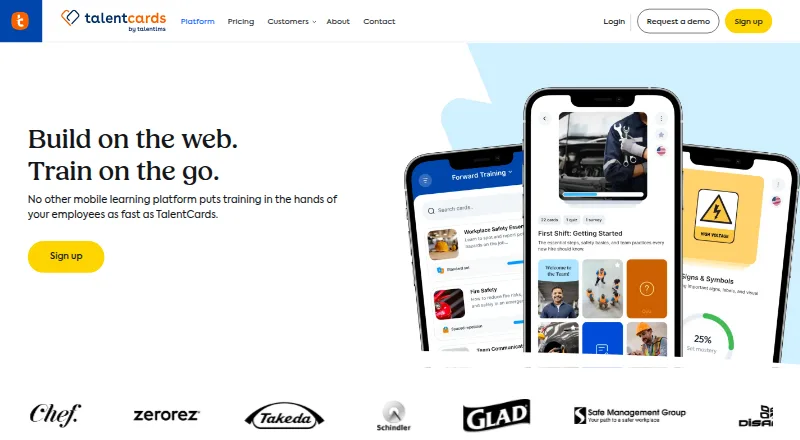
TalentCards is a mobile training platform for short, flashcard-based microlearning courses, particularly for employees away from desks. QR codes on equipment, products, or workstations can take learners to relevant card sets, and content can be downloaded for offline access. Courses can include flashcard lessons, quizzes, learning paths, spaced repetition, and certificates. Listed AI tools cover course creation, translation, AI-graded short-answer questions, and PDF-to-card-set conversion, which is in beta. Learners use iOS or Android phones and tablets, while administrators create and manage content in a web browser. A public API connects TalentCards with HR and workforce management systems. The Free plan supports up to five users with no credit card needed. Standard costs $0.80 a month per user and Premium costs $1.20 a month per user; both are sold in 50-user increments and cover up to 2,000 users. Larger deployments require a custom plan. Paid plans include a 90-minute onboarding session, email and chat support, and knowledge-base access; Premium customers with 200 or more users also get a dedicated account manager.
Who it suits
TalentCards suits deskless and frontline teams that need brief mobile training or quick access to workplace information. It also fits organizations connecting training with HR or workforce-management systems through an API.
What it does well
- Learners can download courses for offline access.
- QR codes link card sets to workplace locations or equipment.
- Includes quizzes, learning paths, spaced repetition, and certificates.
- Free plan covers up to five users.
- Paid plans include onboarding, email, and chat support.
What to know first
- Free plan is limited to five users.
- Standard and Premium are sold in 50-user increments.
- Plans cover up to 2,000 users; larger deployments need a custom plan.
- PDF-to-card-set conversion is in beta.
Limits
The Free plan supports up to five users. Standard and Premium are sold in 50-user increments and cover up to 2,000 users; deployments above that require a custom plan.
Plans
| Plan | Billed and limits | Price |
|---|---|---|
| Standard | $0.80 per user, per month; sold in 50-user increments from 50 users · Unlimited courses · AI features · email/SMS invites · push notifications · chat support · setup consultation | $0.80 a month |
| Premium | $1.20 per user, per month; sold in 50-user increments from 50 users · Unlimited AI course creation · automated push notifications · AI grading · account manager on plans with 800+ users | $1.20 a month |
| Free | $0 per user, per month; up to 5 users · Unlimited courses · AI course creation · video/PDF storage · surveys · analytics · teams · Microsoft learner SSO | Free |
| Enterprise | Custom quote for more than 2,000 users · White-labeled mobile apps · unlimited courses · public API · custom solutions | On request |
As talentlms.com lists them, read 15 Oct 2026. The maker's own page has the final word.
Getting started
- Open the TalentCards website.
- Choose the Free plan for up to five users or a paid plan starting at 50 users.
- Have learners use the iOS or Android app on a phone or tablet.
- Create and manage course content in a web browser.
- Use the public API to connect HR or workforce management systems, if needed.
Overview
TalentCards turns training into short, flashcard-based lessons delivered to employees’ phones or tablets. It is best suited to frontline teams that need concise instruction or quick-reference material at work. QR access and offline downloads are useful strengths, but paid seats start in blocks of 50.
Key features
Lessons and reinforcement
Flashcards, quizzes, learning paths, spaced repetition, and certificates support short lessons and follow-up practice. That combination suits focused topics and reinforcement; teams seeking a format centered on extended instruction may prefer a different approach.
Training at the point of work
Each card set can have a QR code placed on equipment, products, or workstations, giving employees a direct route to relevant material. Learners can download content for offline use, a practical fit for locations with limited connectivity.
AI, integrations, and security
AI tools cover course creation, translation, and grading short-answer questions. PDF-to-card-set conversion is in beta, so it is not yet a settled workflow. A public API supports connections to HR and workforce management systems. TalentCards cites ISO 27001:2022, ISO 9001:2015, ISO 14001:2015, ISO 45001:2018, and GDPR compliance; it says AWS servers use AES-256 encryption and data in transit uses SSL/TLS 1.2.
Pricing
The Free plan costs nothing and covers up to 5 users, with no credit card needed. It is suitable for a small trial or team, but its five-user ceiling limits broader deployment. There is no free trial.
Standard costs $0.80 per user per month, and Premium costs $1.20 per user per month. Both are sold in 50-user increments, start at 50 users, and cover up to 2,000 users. That makes the entry point a 50-seat purchase even for a team that needs fewer active users; active users are those able to log in to the app. Enterprise has custom pricing for deployments above 2,000 users.
Paid plans include a 90-minute onboarding session, email and chat support, and knowledge-base access. Premium customers with at least 200 users also get a dedicated account manager. Those support terms may matter to larger rollouts, while the published plan details do not establish other differences between Standard and Premium.
Platforms
Learners use the iOS and Android apps on smartphones and tablets. Administrators manage content in a web browser, and the public API supports integrations. The mobile-first setup fits employees who are away from desks, though content administration remains browser-based.
Who it's for
TalentCards is a strong fit for deskless and frontline teams that need short mobile training, point-of-work reference material, or offline access. It is less compelling for very small teams that cannot justify a 50-seat paid minimum, or organizations above 2,000 users that need custom terms.
Pros and cons
- QR-linked training: Card sets can be tied to physical equipment or work areas for direct access to relevant guidance.
- Offline use: Learners can download content in advance, helping teams work where connectivity is unreliable.
- Useful learning structure: Quizzes, learning paths, spaced repetition, and certificates extend the short-lesson format.
- Paid entry is in 50-seat blocks: Smaller organizations may pay for more capacity than they need.
- Free plan is capped at five users: It is useful for a small group but not a broad rollout.
- PDF conversion remains in beta: Teams should not depend on that capability as a mature process.
Alternatives
Microlearning Platforms is a useful category to compare when the short-lesson format is the priority; Learning Management Systems offers a broader category comparison.
Consider Headway for daily book-summary reading: its free plan provides one pre-selected summary per day, rather than workplace training for a team. MetaMinder may suit creators who want AI-generated lessons and avatars, with a free plan capped at five learners, one creator, and 30 lessons. Quitch offers a free basic tier for up to 10 learners, unlimited educators, one class, and unlimited quizzes, making it worth considering for small class-based quiz use.
7taps is a web-only option with a free plan offering unlimited course creation, two shared courses, and up to 500 active learners, alongside link and QR delivery. Haekka may fit teams using Slack, with free training courses for up to 1,000 users and completion reports. Nialtus has a free plan for 10 active learners, five courses, and one admin, a more limited starting point for teams focused on course hosting.
Axonify is another paid frontline-training option, with quote-based pricing dependent on team size, locations, and features. Mindmarker may suit organizations looking for learning journeys, pre-built content libraries, and reinforcement; its training agency platform starts at $750 a year, billed yearly.
Verdict
Choose TalentCards if frontline employees need brief lessons and job-specific guidance accessible by phone, QR code, or offline download. Its main advantage is putting focused training close to the work; its main drawback is the 50-user minimum for paid plans. Small teams should stay within the five-user Free plan or compare alternatives, while larger deployments should weigh custom pricing above 2,000 users.
Verdict
TalentCards focuses on short mobile lessons for employees who are not desk-based. The Free plan is small, while paid plans are sold in 50-user increments and larger deployments require custom terms.
Questions
Is TalentCards free?
Yes. The Free plan costs nothing and supports up to five users without a credit card.
How much do the paid plans cost?
Standard costs $0.80 per user per month, and Premium costs $1.20 per user per month. Both are sold in 50-user increments, starting at 50 users.
Which devices can learners use?
Learners can use the app on iOS and Android smartphones and tablets. Administrators manage content in a web browser.
Can courses be used offline?
Yes. Learners can download training content in advance for use without an internet connection.
Does TalentCards connect to other systems?
Its public API connects with HR and workforce management systems.
What support comes with paid plans?
Paid plans include a 90-minute onboarding session, email and chat support, and access to a knowledge base. Premium customers with 200 or more users also get a dedicated account manager.
Facts from TalentCards's own pages
- AI features
- Listed AI features include course creation, PDF-to-card-set conversion in beta, course translation, and AI-graded short-answer questions. · talentlms.com, 29 Sept 2026
- API authentication
- API requests authenticate with an administrator API key managed on an admin user’s Advanced tab. · talentcards.com, 15 Oct 2026
- Assessments
- The product supports quizzes, certificates, surveys, polls, and AI-graded short-answer questions. · talentlms.com, 15 Oct 2026
- Course tools
- The platform supports flashcard lessons, quizzes, learning paths, spaced repetition, and certificates. · talentlms.com, 29 Sept 2026
- Data protection
- TalentCards says AWS servers are encrypted with AES-256 and data exchanged between its servers and users is encrypted using SSL/TLS 1.2. · talentlms.com, 29 Sept 2026
- Deployment model
- TalentCards is provided as a hosted SaaS service; the privacy policy says Epignosis owns the service code and databases. · talentlms.com, 15 Oct 2026
- Documentation depth
- The public API PDF is 95 pages and documents authentication, errors, rate limiting, pagination, filtering, request URLs, and endpoint examples. · talentcards.com, 15 Oct 2026
- Founded
- 2014 · talentlms.com, 23 Sept 2026
- Free plan
- Yes · talentlms.com, 20 Sept 2026
- Gamification
- Badges and challenges can use completion, points, and login-frequency goals to motivate learners. · talentlms.com, 15 Oct 2026
- Integrations
- TalentCards connects with TalentLMS to synchronize eligible users into selected TalentCards groups. · help.talentlms.com, 15 Oct 2026
- Learning paths
- Card sets can be ordered into sequences so learners complete content in a defined order. · talentlms.com, 15 Oct 2026
- Limit: app reliability
- An App Store reviewer reported completion percentages and tracked time changing unexpectedly between sessions. · apps.apple.com, 15 Oct 2026
- Limit: authoring flexibility
- Capterra reviewers report constraints such as limited quiz answer types, character limits, and an editor that can feel restrictive. · capterra.com, 15 Oct 2026
- Limit: customization
- G2 and Capterra reviewers mention limited image, font, layout, or app-branding customization. · g2.com, 15 Oct 2026
- Limit: reporting
- G2 reviewers report that route codes or representative codes may be missing from reports and ask for stronger analytics. · g2.com, 15 Oct 2026
- Maker headquarters
- LinkedIn lists San Francisco, California as Epignosis learning technologies’ headquarters. · linkedin.com, 15 Oct 2026
- Maker legal entity
- The service privacy policy identifies Epignosis LLC in San Francisco and Epignosis UK Limited in London as the companies providing TalentCards. · talentlms.com, 15 Oct 2026
- Maker ownership
- TalentCards is a product of Epignosis, whose LinkedIn profile describes it as a privately held software company founded in 2012. · linkedin.com, 15 Oct 2026
- Maker size
- LinkedIn lists Epignosis in the 201–500 employee company-size band and shows 296 employees on the profile. · linkedin.com, 15 Oct 2026
- Mixed media
- Cards can contain text, images, video, audio, links, and attached PDF files. · g2.com, 15 Oct 2026
- Mobile-first delivery
- Administrators build courses in a browser while learners use native iOS or Android apps. · g2.com, 15 Oct 2026
- Multilingual content
- Administrators can synchronize versions of a card set in multiple languages, while the app supports more than 20 languages. · talentlms.com, 15 Oct 2026
- Notable update
- The App Store lists version 3.14.7 on September 17, 2026 with a redesigned completion certificate and user-interface improvements. · apps.apple.com, 15 Oct 2026
Where TalentCards stands on Freedom251
- Learning Management Systems#7 of 111
- Microlearning Platforms#5 of 26
- Mobile Learning Software#6 of 17