Freedom251 › Microlearning Platforms
Haekka
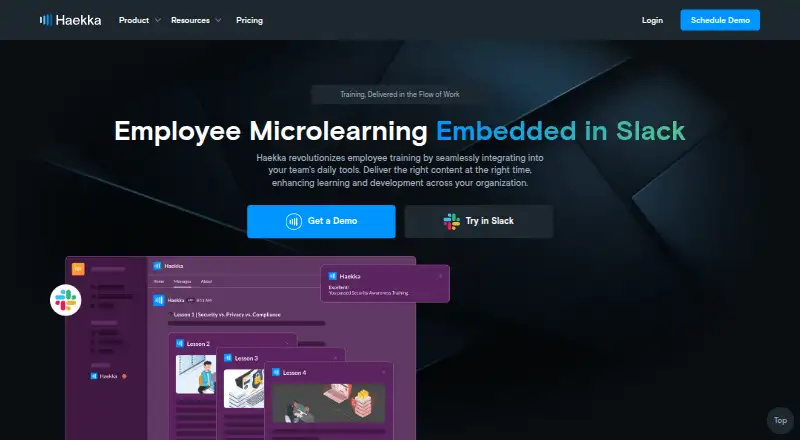
What Haekka is
Haekka delivers employee microlearning and training through Slack, where employees can complete courses, including video content. Its catalog contains hundreds of courses, micro-trainings, and lessons that organizations can use or edit. Administrators can organize training with tags and categories, set dynamic due dates, and arrange automatic renewals.
Training reports show results, and a public API can push or retrieve training results in real time. Workflows can react to SaaS events by messaging users, assigning training, or logging activity. Listed integrations include Slack, Google Workspace, Okta, Vanta, Gusto, Docebo, and Seismic. Its phishing simulator can trigger Slack training when an employee clicks a simulated phishing link; administrators can also use a Chrome extension to track email campaign responses and employee threat reports.
Use cases include security awareness, sales enablement, product knowledge, compliance, onboarding, and change management. The free plan supports up to 1,000 users with Slack training courses and completion reports. Paid plans are priced per employee and billed annually, starting at $1/employee/month. Haekka is available on the web and as an extension.
Who it suits
Haekka suits organizations delivering employee training in Slack, including for compliance, onboarding, security awareness, or product knowledge. It may also fit teams that want event-triggered workflows and real-time training results.
What it does well
- Employees can complete video training directly in Slack.
- Catalog includes hundreds of courses and lessons.
- Training results are available through a public API.
- Workflows can assign training in response to SaaS events.
- Free plan supports up to 1,000 users.
What to know first
- Paid plans are billed annually.
- Paid pricing is per employee.
- The free plan is limited to 1,000 users.
Limits
The free plan supports up to 1,000 users and includes free Slack training courses and course completion reports. Paid plans start at $1 per employee per month, billed annually.
Plans
| Plan | Billed and limits | Price |
|---|---|---|
| Try Haekka for Free | Up to 1000 users; free training courses in Slack; course completion reports | Free |
| Base | $1/employee/month - paid annually · Per employee pricing; annual billing | $1 |
| One | $2/employee/month - paid annually · Per employee pricing; annual billing | $2 |
As haekka.com lists them, read 7 Oct 2026. The maker's own page has the final word.
Getting started
- Visit https://www.haekka.com/.
- Choose the free plan or review the paid plans, which are priced per employee and billed annually.
- Use Haekka in Slack for chat-based training; web and extension platforms are also listed.
- Start with courses from the catalog, which organizations can use or edit.
- Organize training with tags, categories, due dates, and automatic renewals.
Overview
Haekka is a Slack-delivered employee learning platform for organizations that want training embedded in everyday chat. It is best suited to teams running security, compliance, onboarding, sales or product programs in Slack. The main reason to choose it is the link between assigned learning, workplace events and live reporting; organizations that need a broader delivery environment should consider other platforms.
Employees complete mixed-format lessons, including video, without leaving Slack. Administrators get a sizable starting catalog and tools for recurring assignments, while the free tier provides a practical way to evaluate the Slack workflow before committing to annual per-employee plans.
Key features
Slack learning and content
The catalog contains hundreds of courses, micro-trainings and lessons that an organization can use or edit. That is useful when common topics need a quick rollout but local policies or terminology still require changes. Chat delivery suits employees who already work in Slack; it is less suitable when learners need a dedicated web or mobile classroom.
Scheduling and workflows
Admins can set dynamic due dates, automatic renewals, tags and categories. These controls support recurring compliance cycles, onboarding cohorts and segmented programs rather than one-off content drops. Workflows can react to SaaS events by messaging users, assigning training or logging activity, turning an external trigger into an actionable learning task.
Security, reporting and integrations
The phishing simulator can send immediate Slack training after an employee clicks a simulated phishing link, connecting the exercise to remediation. Training reports and a public API support real-time pushing and pulling of results for operational or compliance reporting. Listed integrations include Slack, Google Workspace, Okta, Vanta, Gusto, Docebo and Seismic.
Extension, privacy and support
The Chrome extension lets administrators track email-campaign responses and employee threat reports. Haekka’s privacy policy says it collects only data needed to provide the service and does not sell customer data; deletion requests are processed within 30 days. Support is available 24x7, with email replies within 24 hours.
Pricing
Try Haekka for Free
The free plan costs nothing and supports up to 1,000 users, free training courses in Slack and course-completion reports. It is the sensible starting point for evaluating Slack delivery or running a smaller program, but it does not describe the broader paid-plan scope.
Base
Base is $1 a year, billed at $1/employee/month and paid annually, with per-employee pricing. It is aimed at organizations ready to move beyond the free cap and accept an annual commitment; the published plan information does not define additional quotas or features.
One
One is $2 a year, billed at $2/employee/month and paid annually, also priced per employee. It is the higher paid tier for teams that need the plan above Base, though the published description does not specify which extra capabilities or limits it adds.
A free trial is offered.
Platforms
Haekka is delivered through a web experience and an extension, including its Chrome extension for campaign-response and threat-report tracking. Its primary learner channel is Slack chat.
Who it's for
Haekka fits Slack-centric organizations managing security awareness, sales enablement, product knowledge, compliance, onboarding or change management. It is particularly compelling when SaaS events should trigger assignments or when phishing exercises need immediate follow-up. It is a weaker choice for teams seeking mobile-first learning or training delivery independent of Slack.
Pros and cons
Pros
- Slack-native completion: Employees can take mixed-format courses, including video, in the chat environment they already use.
- Event-driven automation: SaaS events can message users, assign training or log activity without a separate manual process.
- Actionable security training: Simulated phishing clicks can trigger immediate remediation in Slack.
- Large free allowance: Up to 1,000 users and completion reports make the free tier viable for substantial pilots.
- Operational reporting: Advanced analytics, reports and a public real-time API support connected oversight.
Cons
- Slack dependence: Organizations that do not want chat-based delivery will find the core approach restrictive.
- Annual paid commitment: Base and One are paid annually per employee, which reduces flexibility for short-term or fluctuating programs.
- Unclear paid differentiation: The published plan descriptions do not explain the feature or quota differences between Base and One.
- Extension scope is narrow: The Chrome extension is described for email-campaign responses and threat reports, not as a general learning client.
Alternatives
Choose Headway instead for individual book-summary reading across Android, iOS, macOS and web, including one pre-selected daily summary on its free plan. MetaMinder is a better fit when a small creator-led program needs AI generations and avatar allowances. Quitch suits classroom-style quiz programs, with a free tier for up to 10 learners and one class.
TalentCards is an option for card-based learning across mobile, web and API, while 7taps fits link- or QR-delivered micro-courses with up to 500 active learners on its free plan. Nialtus is aimed at course administration through web and API, and Axonify offers paid plans with quote-based pricing. Mindmarker is designed for training agencies needing learning journeys, content libraries and reinforcement.
See the broader Microlearning Platforms list when Slack is not the deciding requirement.
Verdict
Choose Haekka if your employees already live in Slack and you need recurring training tied to SaaS events, phishing responses and reportable completion data. Its free 1,000-user tier lowers the barrier to a meaningful pilot, while editable content and automation support ongoing programs. Look elsewhere if learners need dedicated mobile or standalone course delivery, or if you require clearly documented differences between paid tiers before accepting annual billing.
Verdict
Haekka brings training, reporting, and event-driven workflows into a Slack-centered setup. The free plan includes courses and completion reports for up to 1,000 users; paid plans use annual per-employee billing.
Questions
Does Haekka have a free plan?
Yes. The free plan supports up to 1,000 users and includes free Slack training courses and course completion reports.
How much do Haekka’s paid plans cost?
Paid plans are priced per employee and billed annually. The listed starting price is $1 per employee per month; another plan is listed at $2 per employee per month, paid annually.
Is there a free trial?
Yes, Haekka offers a free trial.
Which platforms does Haekka support?
Haekka is available on the web and as an extension. Its training is delivered through chat, including in Slack.
Which services are listed as integrations?
The integrations page lists Slack, Google Workspace, Okta, Vanta, Gusto, Docebo, and Seismic.
What kinds of training can organizations use Haekka for?
Haekka describes use cases including security awareness, sales enablement, product knowledge, compliance, onboarding, and change management.
Facts from Haekka's own pages
- Audience
- Haekka describes its use cases as including security awareness, sales enablement, product knowledge, compliance, onboarding, and change management. · haekka.com, 7 Oct 2026
- Browser extension
- Haekka says admins can use its Chrome extension to track email campaign responses and employee threat reports. · haekka.com, 7 Oct 2026
- Content
- The training catalog includes hundreds of courses, micro-trainings, and lessons that organizations can use or edit. · haekka.com, 7 Oct 2026
- Customization
- Admins can set dynamic due dates, automatic renewals, tags, and categories for training. · haekka.com, 7 Oct 2026
- Data deletion
- The privacy policy says deletion requests are processed within 30 days. · haekka.com, 7 Oct 2026
- Integrations
- The integrations page lists Slack, Google Workspace, Okta, Vanta, Gusto, Docebo, and Seismic. · haekka.com, 7 Oct 2026
- Phishing
- The phishing simulator can trigger immediate Slack training when an employee clicks a simulated phishing link. · haekka.com, 7 Oct 2026
- Privacy
- Haekka's privacy policy says it collects only data needed to provide its services and does not sell customer data. · haekka.com, 7 Oct 2026
- Product
- Haekka delivers employee microlearning and training in Slack. · haekka.com, 7 Oct 2026
- Reporting
- Haekka offers training reports and a public API for pushing and pulling training results in real time. · haekka.com, 7 Oct 2026
- Support
- The contact page says its team is available 24x7, with replies by email within 24 hours. · haekka.com, 7 Oct 2026
- Training
- Employees can complete training, including video content, directly in Slack. · haekka.com, 7 Oct 2026
- Workflows
- Workflows can respond to SaaS events by sending users messages, assigning training, or logging activity. · haekka.com, 7 Oct 2026
Where Haekka stands on Freedom251
- Microlearning Platforms#4 of 26