Freedom251 › Physics Simulation Software
SynxFlow
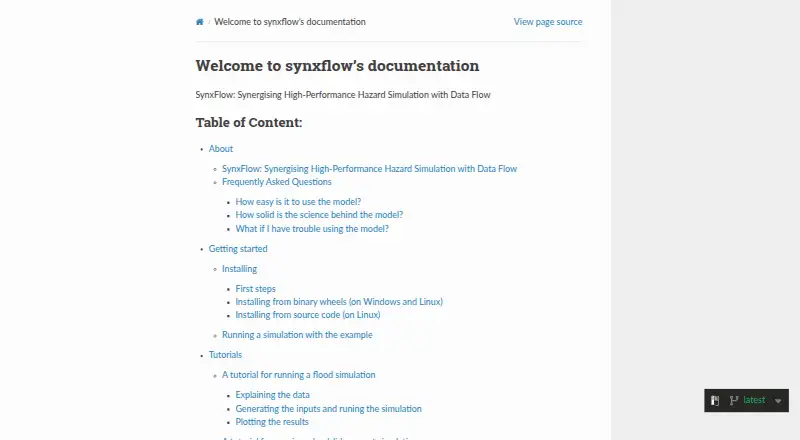
What SynxFlow is
SynxFlow is a free, open-source model for dynamically simulating flood inundation, landslide runout, and debris flows with CUDA-enabled GPUs. Its Python interface covers input preparation, simulation, and output visualization, with NumPy, Pandas, and GDAL integrations for data work. The quickstart describes compressed, ArcGIS ASCII, and GeoTIFF DEM inputs, plus optional rainfall and land-cover inputs. Flood tutorials configure rainfall, land cover, boundaries, gauges, and runtime, and include raster visualization functions. Flood simulations support multiple GPUs; the landslide and debris-flow tutorials currently describe single-GPU solvers. Running simulations requires an NVIDIA CUDA-capable GPU and CUDA Toolkit. Binary wheels target Windows 10 or later and Linux with Python 3.9–3.11 and CUDA 11.3 or newer. Linux source builds require CMake and a C++ compiler. The project uses GPL-3.0 licensing.
Who it suits
SynxFlow suits research and business users performing natural-hazard risk assessment with Python and CUDA-capable NVIDIA hardware. Google Colab compatibility is documented for a flood simulation.
What it does well
- Models floods, landslides, and debris flows
- Python interface for setup and visualization
- Integrates NumPy, Pandas, and GDAL
- Flood solver supports multiple GPUs
- Free and GPL-3.0 licensed
What to know first
- Requires an NVIDIA CUDA-capable GPU
- CUDA Toolkit is required
- Landslide and debris solvers currently support one GPU
- Linux source installation needs CMake and C++
Verdict
SynxFlow provides a Python-driven, GPU-based workflow for several natural hazards, with documented data integrations and visualization. Hardware, CUDA, and solver-specific GPU limits are important setup considerations.
Facts from SynxFlow's own pages
- Cloud use
- The FAQ says SynxFlow is compatible with Google Colab for running simulations in the cloud. · synxflow.readthedocs.io, 12 Oct 2026
- Data tools
- The documentation names NumPy, Pandas, and GDAL as tools SynxFlow integrates with for data processing and visualization. · synxflow.readthedocs.io, 12 Oct 2026
- Flood solver
- The flood tutorial demonstrates configuring rainfall, land cover, boundary conditions, gauges, and simulation runtime. · synxflow.readthedocs.io, 5 Oct 2026
- Free plan
- Yes · synxflow.readthedocs.io, 24 Sept 2026
- GPU requirement
- Running simulations requires an NVIDIA GPU that supports CUDA and the CUDA Toolkit. · synxflow.readthedocs.io, 5 Oct 2026
- GPU support
- SynxFlow requires an NVIDIA GPU that supports CUDA and the CUDA Toolkit to run simulations. · synxflow.readthedocs.io, 12 Oct 2026
- Hazard modeling
- SynxFlow is an open-source model for dynamically simulating flood inundation, landslide runout, and debris flows with CUDA-enabled GPUs. · synxflow.readthedocs.io, 5 Oct 2026
- Input formats
- The quickstart lists DEM input in compressed, ArcGIS ASCII, or GeoTIFF formats, with rainfall mask, rainfall time series, and landcover inputs described as optional. · synxflow.readthedocs.io, 12 Oct 2026
- Install platforms
- The binary wheel instructions cover Windows 10 or later and Linux, with Python 3.9, 3.10, or 3.11 and CUDA 11.3 or newer. · synxflow.readthedocs.io, 5 Oct 2026
- Integrations
- The documentation names NumPy, Pandas, and GDAL as tools that SynxFlow integrates with for data processing and visualization. · synxflow.readthedocs.io, 5 Oct 2026
- Intended users
- The project describes its applications as natural hazard risk assessment for research and business, and the repository also mentions research and industrial applications. · synxflow.readthedocs.io, 12 Oct 2026
- License
- The project's GitHub repository identifies its license as GPL-3.0. · github.com, 12 Oct 2026
- Linux requirements
- Binary wheel installation is documented for Linux with Python 3.9, 3.10, or 3.11 and CUDA 11.3 or newer; source installation is documented as tested only on Linux. · synxflow.readthedocs.io, 12 Oct 2026
- Linux source install
- Building from source is documented for Linux and requires CMake, the NVIDIA CUDA Toolkit, and a C++ compiler. · synxflow.readthedocs.io, 5 Oct 2026
- Multiple GPUs
- The flood tutorial says the flood solver supports multiple GPUs. · synxflow.readthedocs.io, 5 Oct 2026
- Output visualization
- The flood tutorial demonstrates plotting simulation outputs and describes built-in raster visualization functions. · synxflow.readthedocs.io, 12 Oct 2026
- Purpose
- SynxFlow is an open-source model for dynamically simulating flood inundation, landslide runout, and debris flows using CUDA-enabled GPUs. · synxflow.readthedocs.io, 12 Oct 2026
- Python interface
- The model provides a Python interface for preparing inputs, running simulations, and visualizing outputs. · synxflow.readthedocs.io, 12 Oct 2026
- Scientific methods
- The FAQ says the model uses Godunov-type shock-capturing methods to solve shallow-water-based equations and links to papers documenting its numerical methods. · synxflow.readthedocs.io, 12 Oct 2026
- Simulation scope
- The official repository says SynxFlow can use multiple CUDA-enabled GPUs for flood, landslide runout, and debris flow simulations. · github.com, 12 Oct 2026
- Single GPU limits
- The landslide runout and debris flow tutorials state that those solvers currently support only a single GPU. · synxflow.readthedocs.io, 5 Oct 2026
- Support
- The FAQ directs users with issues or questions to leave a comment on the project's GitHub Discussions page. · synxflow.readthedocs.io, 12 Oct 2026
- Windows requirements
- Binary wheel installation is documented for Windows 10 or newer, Python 3.9, 3.10, or 3.11, and CUDA 11.3 or newer. · synxflow.readthedocs.io, 12 Oct 2026
Where SynxFlow stands on Freedom251
- Physics Simulation Software#32 of 89