Freedom251 › Physics Simulation Software
Quimb
What Quimb is
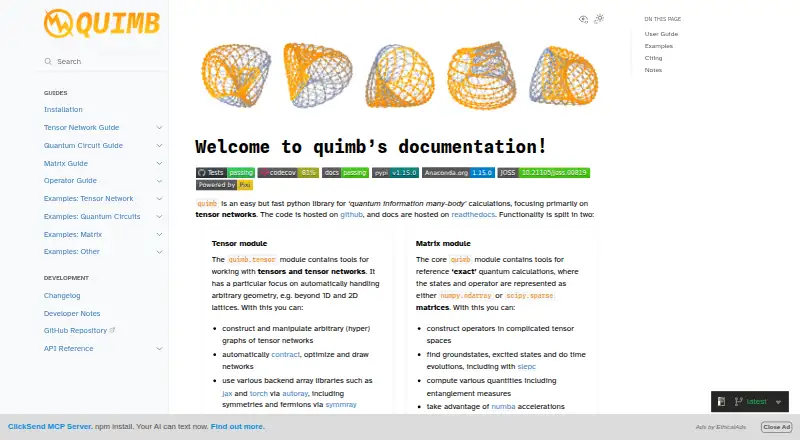
Quimb is a free Python library for quantum information and many-body calculations, with particular emphasis on tensor networks. Its tensor module lets users build and manipulate tensor-network graphs, contract and optimize them, and draw their structure. It includes methods for MPS, PEPS, and MERA networks, plus quantum-circuit algorithms such as DMRG and TEBD. The core module supports quantum calculations with NumPy arrays or SciPy sparse matrices, including finding ground and excited states and carrying out time evolution. Quimb can also compute entanglement measures and stochastically estimate trace functions. Through autoray, tensor calculations can use backend array libraries including JAX and PyTorch. Documentation includes guides to quantum circuits and importing OpenQASM circuits. Quimb is distributed through PyPI and conda-forge, and its installation guide recommends Pixi. The documented core requirements include Python 3.11 or newer, NumPy, SciPy, Numba, cytoolz, tqdm, and psutil. Optional SLEPc and PETSc packages, together with MPI dependencies, support accelerated and optionally distributed partial eigensolving, SVD, and exponentiation. The project is published in the Journal of Open Source Software, and its documentation asks researchers to cite it when useful in research.
Who it suits
Quimb suits researchers and developers doing quantum information or many-body calculations, especially those working with tensor networks. It also fits users who want Python tools for quantum circuits, exact calculations, or entanglement analysis and can work with its documented Python environment.
What it does well
- Builds, contracts, optimizes, and draws tensor-network graphs.
- Includes MPS, PEPS, MERA, DMRG, and TEBD methods.
- Supports exact calculations with NumPy arrays or SciPy sparse matrices.
- Can use JAX and PyTorch backends through autoray.
- Available through PyPI and conda-forge.
What to know first
- Documented core requirements include Python 3.11 or newer.
- Optional acceleration packages bring SLEPc, PETSc, and MPI dependencies.
Plans
| Plan | Billed and limits | Price |
|---|---|---|
| quimb | Python library; no paid plans or usage limits stated | Free |
As quimb.readthedocs.io lists them, read 11 Oct 2026. The maker's own page has the final word.
Getting started
- Install Python 3.11 or newer.
- Choose PyPI or conda-forge as the distribution route.
- Follow the installation guide, which recommends Pixi.
- Install the documented core requirements: NumPy, SciPy, Numba, cytoolz, tqdm, and psutil.
- Add optional SLEPc and PETSc packages with MPI dependencies if using the described acceleration options.
Verdict
Choose Quimb if you need a free Python library centered on tensor-network work or quantum information calculations. Its documented setup requires Python 3.11 or newer, and the optional acceleration route involves additional packages and MPI dependencies.
Questions
Is Quimb free?
Yes. The plan is listed as free, with no paid plans or usage limits stated.
What is Quimb used for?
It is a Python library for quantum information and many-body calculations, with a primary focus on tensor networks.
Where can I get Quimb?
It is available from PyPI and conda-forge. The installation guide recommends Pixi.
What are the core requirements?
The documented core requirements include Python 3.11 or newer, NumPy, SciPy, Numba, cytoolz, tqdm, and psutil.
Does Quimb support quantum circuits?
Its documentation includes a quantum-circuit guide and a guide for importing OpenQASM circuits.
Is it open source?
The listed facts say Quimb is published in the Journal of Open Source Software; they do not state a license.
Facts from Quimb's own pages
- Algorithms
- The tensor module includes MPS, PEPS, MERA, and quantum-circuit algorithms such as DMRG and TEBD. · quimb.readthedocs.io, 11 Oct 2026
- Analysis
- Quimb can compute quantities including entanglement measures and stochastically estimate Tr f(X) quantities. · quimb.readthedocs.io, 11 Oct 2026
- Array backends
- The tensor module can use backend array libraries including JAX and PyTorch through autoray. · quimb.readthedocs.io, 11 Oct 2026
- Assessment tools
- No · quimb.readthedocs.io, 23 Sept 2026
- Authoring tools
- No · quimb.readthedocs.io, 23 Sept 2026
- Circuit support
- The documentation includes a quantum-circuit guide and a guide for importing OpenQASM circuits. · quimb.readthedocs.io, 11 Oct 2026
- Delivery mode
- desktop · quimb.readthedocs.io, 23 Sept 2026
- Distribution
- Quimb is available from PyPI and conda-forge, and the installation guide recommends Pixi for setup. · quimb.readthedocs.io, 11 Oct 2026
- Exact calculations
- The core module supports quantum calculations using NumPy arrays or SciPy sparse matrices, including finding ground and excited states and performing time evolution. · quimb.readthedocs.io, 11 Oct 2026
- Free plan
- Yes · quimb.readthedocs.io, 23 Sept 2026
- Lesson library
- No · quimb.readthedocs.io, 23 Sept 2026
- Optional acceleration
- The guide describes optional SLEPc and PETSc packages, with MPI dependencies, for accelerated and optionally distributed partial eigensolving, SVD, and exponentiation. · quimb.readthedocs.io, 11 Oct 2026
- Purpose
- Quimb is a Python library for quantum information and many-body calculations, with a primary focus on tensor networks. · quimb.readthedocs.io, 11 Oct 2026
- Requirements
- The documented core requirements include Python 3.11 or newer, NumPy, SciPy, Numba, cytoolz, tqdm, and psutil. · quimb.readthedocs.io, 11 Oct 2026
- Research audience
- The documentation says quimb is published in the Journal of Open Source Software and asks researchers to cite it when useful in research. · quimb.readthedocs.io, 11 Oct 2026
- Tensor networks
- Its tensor module can construct and manipulate arbitrary tensor-network graphs, then contract, optimize, and draw networks. · quimb.readthedocs.io, 11 Oct 2026
- 3D visuals
- No · quimb.readthedocs.io, 23 Sept 2026
Where Quimb stands on Freedom251
- Physics Simulation Software#28 of 89