Freedom251 › Cloud Detection and Response Software

Sweet Security
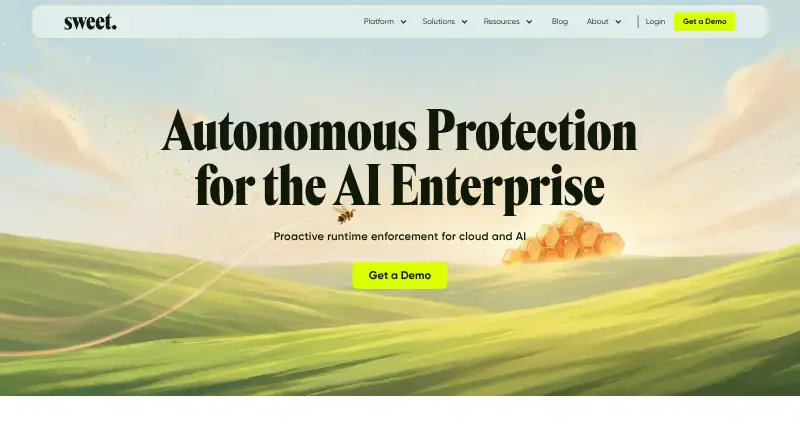
What Sweet Security is
Sweet Security is a cloud security platform for applications, workloads, infrastructure, and AI agents. Its Runtime CNAPP brings together cloud, application, and workload detection and protection, drawing on eBPF sensors and cloud logs. Sweet describes AI security that spans the model layer through agent execution, with visibility, runtime intelligence, and policy controls. An AI Gateway analyzes agent traffic; policies can authorize individual operations or block risky activity while a session continues. Cloud posture tools identify misconfigurations, prioritize risk, offer remediation guidance, and set deployment guardrails. Incident storylines arrange activity into sequences to help teams assess false positives and decide who should act. Playbooks guide manual or automatic termination of malicious processes, and listed responses include killing compromised containers and preventing pod scheduling. Coverage includes AWS, Google Cloud, Azure, private cloud, Kubernetes, Linux-based virtual machines, and Linux and Windows hosts. Sweet lists container, serverless, and Kubernetes protection, along with automated compliance checks. It is agent-based, with pricing on request and demos offered to prospective customers.
Who it suits
Sweet names CISOs, CloudSec and DevSecOps, SOC and incident response, and AppSec teams as audiences. It may suit teams seeking cloud workload protection and controls for AI agents across supported environments.
What it does well
- Combines cloud, application, and workload detection and protection.
- AI Gateway analyzes agent traffic and supports policy controls.
- Automated checks cover industry and custom frameworks.
- Lists AWS, Google Cloud, Azure, and private cloud support.
What to know first
- Pricing is available on request.
- Deployment is agent-based.
Getting started
- Visit the Sweet Security website.
- Request a demo to discuss the platform.
- Review the deployment coverage for your cloud environments, Kubernetes, and host systems.
- Discuss pricing with Sweet Security.
Sweet Security is a runtime CNAPP and AI-security platform for cloud applications, workloads, infrastructure, and autonomous agents. It is best suited to organizations with CloudSec, SOC, AppSec, DevSecOps, or security leadership teams that can operate an agent-based platform across mixed environments. Its unusually broad runtime and AI controls are attractive, but buyers must engage sales rather than select a public plan.
Overview
Sweet unifies Cloud Detection and Response, Application Detection and Response, and Cloud Workload Protection. eBPF sensors and cloud logs are intended to correlate runtime activity across cloud and application layers, giving a staffed security operation more context than a basic alerting product. Container, serverless, and Kubernetes protection are included, alongside Linux-based virtual-machine coverage.
Deployment is agent-based, with Linux and Windows hosts supported. Sweet lists AWS, Google Cloud, Azure, and private cloud environments, making it a credible option for organizations that cannot standardize on one provider. The trade-off is rollout and operational work associated with placing sensors across those environments.
Key features
Runtime detection and response
The eBPF-based sensor is designed to provide cloud visibility without performance penalties, while cloud logs add surrounding context. AI-generated incident storylines arrange activity into a readable sequence, helping analysts separate false positives from incidents and identify who should act. AI-powered playbooks can guide manual or automatic termination of malicious processes; Sweet also describes killing compromised containers and preventing pod scheduling, with response intended to avoid production disruption.
AI security and guardrails
Sweet extends protection from the model layer to agent execution. An AI Gateway analyzes agent traffic, and policy-based guardrails can block malicious operations. Per-operation authorization and real-time blocking of risky actions let a session continue when only a particular action is unsafe. This is a stronger fit for teams deploying autonomous agents than for organizations needing infrastructure monitoring alone, although the value depends on defining and maintaining effective policies.
Posture, testing, and compliance
Runtime CSPM detects misconfigurations in real time, prioritizes risk, provides remediation guidance, and adds deployment guardrails. Governance and Compliance runs automated checks against industry and custom frameworks. Sweet also describes continuous attack cycles that test environments against zero-day threats and use each cycle to improve the next, then turn fixes into runtime guardrails intended to stop recurring threats across workloads and agents.
Integrations include GitHub, GitLab, Slack, Microsoft Teams, ServiceNow, Jira, Splunk, Microsoft Sentinel, and Torq. That range can connect findings to existing development, ticketing, communication, and response workflows.
Pricing
Sweet is paid software with custom pricing. Prospective customers are directed to request a demo, and no public plan price, seat allowance, quota, trial term, or renewal condition is provided. This sales-led approach can support a tailored deployment for large security programs, but it prevents straightforward budget comparison and makes Sweet a poor fit for teams seeking self-serve purchasing or a transparent entry tier.
Platforms
Sweet runs as an agent-based deployment on Linux and Windows hosts, with stated coverage for containers, serverless workloads, Kubernetes, and Linux-based virtual machines. Supported cloud environments are AWS, Google Cloud, Azure, and private cloud. A web interface is listed, and the platform also supports self-hosted deployment. Buyers should expect to plan sensor deployment across their estate rather than install a single standalone desktop application.
Who it's for
Sweet is aimed at CISOs, CloudSec and DevSecOps groups, SOC and incident-response teams, and AppSec practitioners. It makes the most sense where one program needs runtime detection, cloud posture management, automated response, compliance checks, and controls for AI agents. Smaller teams with a single cloud and limited security operations may find its breadth and agent rollout heavier than necessary.
Pros and cons
Pros
- Broad runtime coverage: cloud, application, and workload detection share one platform across containers, serverless, Kubernetes, and virtual machines.
- Useful response options: incident storylines and playbooks support investigation and process or container termination, including pod-scheduling prevention.
- AI-specific controls: gateway inspection, per-operation authorization, and real-time blocking address risks unique to autonomous agents.
- Multi-cloud and workflow reach: AWS, Google Cloud, Azure, private cloud, and numerous engineering and SOC integrations support heterogeneous estates.
Cons
- Custom pricing only: there is no public plan, free tier, or stated trial to enable quick evaluation.
- Agent-based rollout: organizations must deploy and operate sensors across hosts and workloads.
- Potentially excessive scope: teams wanting only basic cloud detection may not need its combined CNAPP, CSPM, compliance, and AI feature set.
Alternatives
Choose Cloud Detection and Response Software when the primary requirement is comparing dedicated cloud-detection products. The Cloud Workload Protection Platforms list is more appropriate when workload protection is the central buying decision.
Oligo Security is a better starting point for buyers wanting a free, cancel-anytime runtime-security subscription, though additional AWS infrastructure costs may apply. Amazon GuardDuty suits AWS-focused teams preferring pay-as-you-go billing and a 30-day free trial. Sysdig Secure is worth considering when host-count licensing and support for macOS and Windows matter. FortiCNAPP fits buyers comparing one- or three-year Standard entitlements per vCPU. Palo Alto Networks Cortex Cloud API Security is an alternative for an API-focused security requirement. SUSE Multi-Linux Manager is oriented toward Linux lifecycle management and monitoring subscriptions. ARMO Platform is a free-tier option centered on Kubernetes and Kubescape. Red Hat OpenShift Pipelines is the alternative when OpenShift pipeline tooling and subscription choices are the priority.
Verdict
Sweet is a strong candidate for security organizations that want one runtime layer spanning multi-cloud workloads, cloud posture, response automation, compliance, and AI-agent authorization. Its main reason to choose it is the combination of deep runtime controls and agent-specific guardrails. Look elsewhere if transparent pricing, a free evaluation tier, or a narrowly focused cloud-security tool is more important than that breadth.
Verdict
Sweet combines runtime cloud protection with controls for AI agents and cloud posture management. Teams evaluating it will need to request pricing and a demo.
Questions
How is Sweet Security priced?
Pricing is available on request. The site directs prospective customers to book a demo.
Which cloud platforms does it support?
Sweet lists AWS, Google Cloud, Azure, and private cloud. Its deployment coverage also includes Kubernetes and Linux-based virtual machines.
Which host operating systems are supported?
The listed supported host operating systems are Linux and Windows.
Does Sweet Security protect containers, serverless, and Kubernetes?
Yes. Container protection, serverless protection, and Kubernetes protection are listed.
What does the platform include for AI security?
Sweet describes AI security from the model layer through agent execution, with visibility, runtime intelligence, and policy-based guardrails. Its AI Gateway analyzes agent traffic, and policies can block malicious operations.
Who is Sweet Security for?
Sweet identifies CISOs, CloudSec and DevSecOps, SOC and incident response, and AppSec teams as audiences.
Facts from Sweet Security's own pages
- AI access controls
- The platform describes per-operation authorization and real-time blocking of risky actions while allowing a session to continue. · sweet.security, 4 Oct 2026
- AI controls
- The AI security page describes analyzing AI agent traffic through an AI Gateway and blocking malicious operations with policies and guardrails. · sweet.security, 3 Oct 2026
- AI security
- Sweet says its AI security platform inventories models and agents, monitors AI posture, supports agent red teaming, and detects or blocks agent attacks through an AI Gateway. · sweet.security, 4 Oct 2026
- Attack testing
- The homepage says continuous attack cycles test environments against zero-day threats and use each pass to improve the next. · sweet.security, 3 Oct 2026
- Audience
- The site identifies CISOs, CloudSec and DevSecOps, SOC and IR, and AppSec teams as audiences for Sweet. · sweet.security, 3 Oct 2026
- Cloud posture
- Runtime CSPM includes real-time misconfiguration detection, risk prioritization, remediation guidance, and deployment guardrails. · sweet.security, 4 Oct 2026
- Cloud providers
- The integrations page lists AWS, Azure, and Google Cloud. · sweet.security, 4 Oct 2026
- Company leadership
- The About page lists Dror Kashti as Co-Founder and CEO and Eyal Fisher as Co-Founder and CPO. · sweet.security, 4 Oct 2026
- Compliance
- Sweet lists continuous compliance checks for HIPAA, CIS Kubernetes Benchmark, GDPR, NIST, SOC 2, AWS MITRE ATT&CK, and AWS PCI. · sweet.security, 4 Oct 2026
- Deployment coverage
- Sweet's CloudSec and DevSecOps page lists support for AWS, Google Cloud, Azure, private cloud, Kubernetes, and Linux-based virtual machines. · sweet.security, 3 Oct 2026
- Incident response
- Sweet says its AI-generated incident storylines organize activity into a readable sequence and help teams identify false positives and who needs to act. · sweet.security, 4 Oct 2026
- Intended teams
- Sweet names CISOs, CloudSec and DevSecOps, SOC and IR, and AppSec teams as audiences for its solutions. · sweet.security, 4 Oct 2026
- Other integrations
- Listed integrations include GitHub, GitLab, Slack, Microsoft Teams, Splunk, Microsoft Sentinel, ServiceNow, Jira, Torq, and CyberArk. · sweet.security, 4 Oct 2026
- Product
- Sweet describes itself as a Runtime CNAPP and AI security platform for cloud and AI environments. · sweet.security, 4 Oct 2026
- Response playbooks
- Its AI-powered playbooks guide manual or automatic termination of malicious processes, which Sweet says can be done without disrupting production. · sweet.security, 4 Oct 2026
- Runtime guardrails
- Sweet says it can turn fixes into real-time guardrails that stop threats from returning across cloud workloads and autonomous AI agents. · sweet.security, 3 Oct 2026
- Runtime protection
- Its Runtime CNAPP combines Cloud Detection and Response, Application Detection and Response, and Cloud Workload Protection. · sweet.security, 3 Oct 2026
- Sales and support
- The site directs prospective customers to book a demo and does not display public plan pricing on the pages opened. · sweet.security, 3 Oct 2026
- Sales and support route
- The product pages direct prospective customers to request a demo; the site does not state public plan prices on the pages reviewed. · sweet.security, 4 Oct 2026
- Sensor
- Sweet says its eBPF-based sensor provides cloud protection and visibility without performance penalties. · sweet.security, 3 Oct 2026
- Threat detection
- The platform combines Cloud Detection and Response, Application Detection and Response, and Cloud Workload Protection using eBPF sensors and cloud logs. · sweet.security, 4 Oct 2026
Where Sweet Security stands on Freedom251
- Cloud Detection and Response Software#14 of 25
- Cloud Workload Protection Platforms#17 of 23