Freedom251 › AI Agent Evaluation Tools
Strands Evals
What Strands Evals is
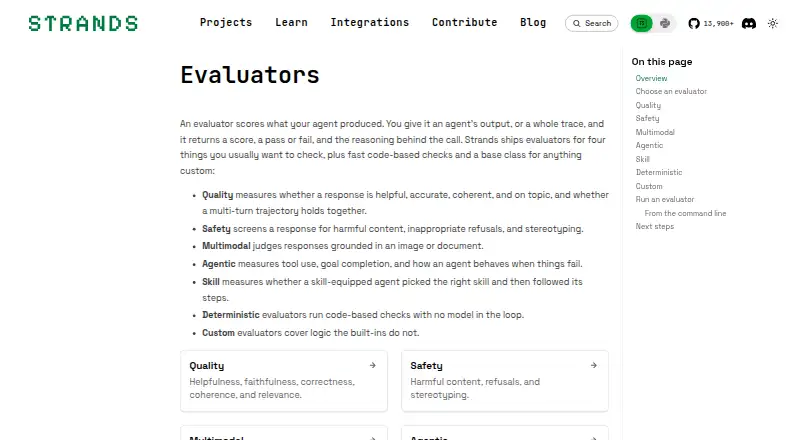
Strands Evals is an open-source Python SDK and command-line interface for assessing AI agent behavior during development and after deployment. It scores outputs and trajectories, helps diagnose failures, checks unsafe behavior, and can simulate users and tools. Evaluators can target a single output, tool call, trace, or complete session, and multiple evaluators can be combined in an experiment. Built-in groups cover quality, safety, multimodal responses, agent behavior, and skill selection and instruction following. Deterministic checks run without an LLM judge, and developers can create domain-specific evaluators by extending the base Evaluator class. Install the package with pip as strands-agents-evals; its CLI can generate experiments, validate JSON, run evaluations, render reports, and diagnose sessions. Trace providers can retrieve data from AWS CloudWatch Logs, Langfuse, and OpenSearch. The SDK can evaluate production or staging traces without rerunning the agents. The quickstart uses Amazon Bedrock with Claude as its default judge and requires authorized credentials to invoke Claude for the example. The red-teaming API is marked experimental. The project is licensed under Apache License 2.0.
Who it suits
Strands Evals suits developers who want to validate agent behavior, measure changes, and evaluate agents through development cycles. It requires Python, and the quickstart example requires credentials authorized to invoke Claude.
What it does well
- Evaluates outputs, tool calls, traces, and full sessions.
- Deterministic checks do not require an LLM judge.
- CLI supports evaluation runs and report rendering.
- Can evaluate existing production or staging traces.
What to know first
- The quickstart example requires authorized Claude credentials.
- Red-teaming API is marked experimental.
- Trace-provider access may require separate credentials or services.
Limits
The SDK and CLI are free and open source, but model-provider and trace-provider access may require separate credentials or services. The documented quickstart uses Amazon Bedrock with Claude as the default judge and requires credentials authorized to invoke Claude. The red-teaming API is experimental and may change in a minor release.
Plans
| Plan | Billed and limits | Price |
|---|---|---|
| Strands Evals SDK | Open-source Python SDK and CLI · install with pip · model-provider and trace-provider access may require separate credentials or services | Free |
As strandsagents.com lists them, read 4 Oct 2026. The maker's own page has the final word.
Getting started
- Install strands-agents-evals with pip.
- Use the Python API or the strands-evals command-line interface.
- Configure access to the model and trace providers you plan to use; some require separate credentials or services.
- Create or generate an experiment, then validate its JSON.
- Run evaluations and render reports, or diagnose sessions.
Strands Evals is a free, open-source Python SDK and CLI for evaluating AI-agent behavior from development through production. It suits developers who need both repeatable checks and analysis of existing traces. Its strongest case is flexible, multi-level evaluation; the main qualification is its default reliance on Amazon Bedrock credentials.
Overview
The toolkit scores outputs and trajectories, diagnoses failures, probes unsafe behavior, and simulates users and tools. Evaluations can run against staging or production traces without rerunning the agents that generated them, making it practical for regression analysis and post-deployment investigation.
Install the package with pip as strands-agents-evals. The Python API supports embedded workflows, while the strands-evals command-line interface handles experiment generation, validation, execution, report rendering, and session diagnosis. Strands Agents is released under the Apache License 2.0.
Key features
Granular evaluation targets
Evaluators can inspect one output, a tool call, a trace, or an entire session. Multiple evaluators can be combined in one experiment, so a team can isolate a narrow failure and still maintain broader session-level coverage.
Built-in and deterministic checks
Built-in groups address quality, safety, multimodal responses, agentic behavior, and skill selection or instruction following. Deterministic evaluators avoid an LLM judge for code-based assertions such as Equals, Contains, StartsWith, ToolCalled, StateEquals, and SkillInvoked. These checks are a good fit for regression gates where identical inputs should produce an unambiguous result.
Custom logic and CI workflows
Developers can extend the base Evaluator class to encode domain-specific rules. The CLI can generate experiments, validate experiment JSON, run evaluations, render reports, and diagnose sessions; documented validation and evaluation steps fit naturally into continuous-integration pipelines.
Trace providers and mapping
Trace integrations fetch data from AWS CloudWatch Logs, Langfuse, and OpenSearch, with optional extras for Langfuse and OpenSearch. Session mappers support Strands in-memory spans, LangChain OpenTelemetry spans, and OpenInference instrumentation such as Arize Phoenix. This breadth helps teams evaluate agents built with different observability stacks instead of forcing a single tracing system.
Judge and safety caveats
The quickstart uses Amazon Bedrock with Claude as its default judge. Running that example requires credentials authorized to invoke Claude, and provider or trace access may require separate services and credentials. The red-teaming API is experimental and may change in a minor release, so it should not be treated as a stable contract for critical automation.
Pricing
| Plan | Price | Includes |
|---|---|---|
| Strands Evals SDK | free | Open-source Python SDK and CLI; pip installation; model-provider and trace-provider access may require separate credentials or services |
There are no paid seats, usage quotas, trial periods, or renewal terms in this plan. The zero software price does not remove the operational cost of the model and trace services needed by particular evaluators, especially the Bedrock-based default judge.
Platforms
Strands Evals supports API, Linux, macOS, self-hosted deployments, and Windows. The SDK language is Python, so teams standardizing on another language will need a separate integration approach. Its self-hosted and CLI model suits local development and CI environments rather than requiring a hosted dashboard.
Who it's for
This is a strong fit for Python developers building agents who want evaluation during development cycles, measurable improvement checks, and the ability to inspect deployed behavior. Teams already sending traces to CloudWatch, Langfuse, OpenSearch, LangChain, or OpenInference can reuse those records. It is less suitable for buyers seeking a fully managed, provider-agnostic evaluation service or a stable red-team API.
Pros and cons
Pros
- Flexible scope: output, tool-call, trace, and session-level targets support both focused assertions and end-to-end reviews.
- Repeatable regression checks: deterministic evaluators provide code-based results without an LLM judge.
- Open customization: Python extension points let teams encode domain-specific evaluation rules.
- Deployment-aware: production and staging traces can be evaluated without rerunning the original agents.
- CI-ready CLI: experiment generation, JSON validation, execution, reporting, and diagnosis cover the mechanics of automated evaluation.
Cons
- Credential dependency: the default Claude judge requires Amazon Bedrock authorization, and trace providers can require additional services.
- Python-centered: the published SDK support is Python, limiting direct use for teams whose primary tooling is elsewhere.
- Experimental red teaming: the API may change in a minor release, creating maintenance risk for production workflows.
Alternatives
Future AGI AI Evaluation SDK is the better choice when a freemium platform with web access, Docker, Python, and Node SDK self-hosting options is preferable.
Promptfoo fits teams wanting a free Community plan with 10,000 red-team probes per month, broad model-provider integrations, and local or self-hosted execution.
W&B Weave suits users who want a hosted free tier combining AI-application evaluations, tracing, scorers, and defined ingestion and storage allowances.
DeepEval is a free Apache 2.0 framework for local and CI/CD LLM evaluation.
Noveum is an option for teams seeking managed freemium observability with metered credits, spans, storage, members, and retention.
Opik is worth considering for open-source observability and evaluation that can run locally or through its cloud plans.
AgentClash provides a freemium workspace focused on bounded evaluation runs and replay retention.
Arklex offers the free, Apache-2.0 ArkSim agent-testing framework for self-hosted use.
For a broader comparison, see AI Agent Evaluation Tools.
Verdict
Choose Strands Evals if you build Python agents and need one open-source toolkit for deterministic checks, model-based evaluation, CI regression runs, and analysis of real traces. Look elsewhere if you need a managed interface, non-Python SDKs, or a stable red-teaming contract without arranging provider credentials.
Verdict
Strands Evals provides SDK and CLI workflows for agent evaluation, including deterministic checks and trace-based runs. Account for its credential and service requirements, and treat the experimental red-teaming API accordingly.
Questions
Is Strands Evals free and open source?
Yes. The Strands Evals SDK plan is free, and the maker identifies Strands Agents as an open-source project under the Apache License 2.0.
How do I install it?
Install the package with pip as strands-agents-evals. It provides a Python API and the strands-evals command-line interface.
What can it evaluate?
Evaluators can assess an output, tool call, trace, or full session. Built-in groups cover quality, safety, multimodal responses, agent behavior, and skill selection and instruction following.
Does it require an LLM judge?
Not for deterministic checks such as Equals, Contains, StartsWith, ToolCalled, StateEquals, and SkillInvoked. The quickstart uses Amazon Bedrock with Claude as its default judge and requires credentials authorized to invoke Claude.
Which trace systems and formats are supported?
Trace providers fetch data from AWS CloudWatch Logs, Langfuse, and OpenSearch. Session mappers support Strands in-memory spans, LangChain OpenTelemetry spans, and OpenInference instrumentation such as Arize Phoenix.
Can it run evaluations in CI?
The CLI can generate experiments, validate experiment JSON, run evaluations, render reports, and diagnose sessions. Its documentation shows validation and evaluation steps in a CI workflow.
Facts from Strands Evals's own pages
- Built-in evaluators
- Built-in evaluator groups cover quality, safety, multimodal responses, agentic behavior, and skill selection and instruction following. · strandsagents.com, 4 Oct 2026
- Custom evaluators
- Developers can implement domain-specific evaluation logic by extending the base Evaluator class. · strandsagents.com, 4 Oct 2026
- Default judge
- The quickstart states that evaluators use Amazon Bedrock with Claude as the default judge model, and that running its example requires credentials authorized to invoke Claude. · strandsagents.com, 4 Oct 2026
- Deterministic checks
- Deterministic evaluators run code-based checks without an LLM judge and include Equals, Contains, StartsWith, ToolCalled, StateEquals, and SkillInvoked. · strandsagents.com, 4 Oct 2026
- Evaluation levels
- Evaluators can assess a single output, tool call, trace, or full session, and multiple evaluators can be combined in one experiment. · strandsagents.com, 4 Oct 2026
- Experimental feature
- The red-teaming API is marked experimental and may change in a minor release. · strandsagents.com, 4 Oct 2026
- Intended users
- The SDK is presented for developers who want to validate agent behavior, measure improvements, and evaluate agents during development cycles. · strandsagents.com, 4 Oct 2026
- License
- The maker’s announcement identifies Strands Agents as an open-source project licensed under Apache License 2.0. · strandsagents.com, 4 Oct 2026
- Local and remote use
- The SDK can run evaluations against production or staging traces without rerunning the agents that produced them. · strandsagents.com, 4 Oct 2026
- Purpose
- Strands Evals measures agent behavior before shipping and after deployment by scoring outputs and trajectories, diagnosing failures, probing unsafe behavior, and simulating users and tools. · strandsagents.com, 4 Oct 2026
- SDK and CLI
- The package installs with pip as strands-agents-evals and provides both a Python API and the strands-evals command-line interface. · strandsagents.com, 4 Oct 2026
- Test generation and CI
- The CLI can generate experiments, validate experiment JSON, run evaluations, render reports, and diagnose sessions; its documentation shows validation and evaluation steps in a CI workflow. · strandsagents.com, 4 Oct 2026
- Trace integrations
- Trace providers fetch data from AWS CloudWatch Logs, Langfuse, and OpenSearch, with optional package extras for Langfuse and OpenSearch. · strandsagents.com, 4 Oct 2026
- Trace mapping
- Session mappers include support for Strands in-memory spans, LangChain OpenTelemetry spans, and OpenInference instrumentation such as Arize Phoenix. · strandsagents.com, 4 Oct 2026
Where Strands Evals stands on Freedom251
- AI Agent Evaluation Tools#20 of 28