Freedom251 › Content Marketing Platforms

Storyblok
by Storyblok
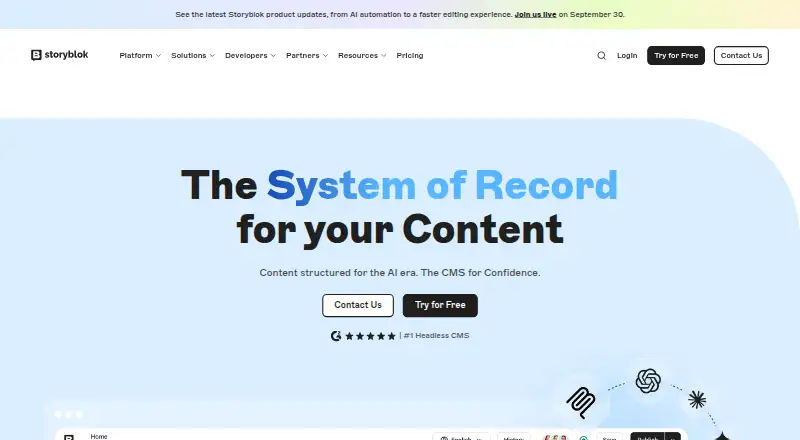
What Storyblok is
Storyblok is a web-based content management platform for creating and managing content across locales. Its Visual Editor is available on every listed plan, alongside content preview, asset transformations, webhooks, and custom role permissions. API options include Content Delivery, Management, and GraphQL Content Delivery APIs. The listed frameworks are Next.js, Astro, Nuxt, React, Vue, Symfony, and Angular. The free Starter plan includes one space, one user seat, 100 GB of monthly traffic, 100,000 API requests, and two locales. Growth costs $99 per month and includes five seats, 400 GB of monthly traffic, one million API requests, and two locales. Growth Plus costs $349 per month with 15 seats, 1 TB of monthly traffic, four million API requests, and 10 locales. Premium and Elite use custom pricing and offer enterprise options; Elite lists an uptime SLA of up to 99.99%. Security-related features include 2FA, SSO, SCIM, access controls, and an Elite security audit. Integrations include Figma, Netlify, Vercel, Shopify, Slack, and GitHub. Self-service customers pay no setup fees.
Who it suits
Storyblok suits teams building localized content experiences with a visual editor and API choices. Its higher-tier options address teams needing custom roles, workflows, and enterprise controls.
What it does well
- Visual Editor is available across all listed plans.
- Supports content localization and preview.
- Provides delivery, management, and GraphQL APIs.
- Starter plan includes two locales.
- Self-service customers pay no setup fees.
What to know first
- Starter is limited to one space and one seat.
- Starter includes 100 GB of monthly traffic.
- Premium and Elite pricing is custom.
Limits
Starter includes one space, one user seat, 100 GB of traffic per month, 100,000 API requests per month and two locales. Growth includes five seats, 400 GB of monthly traffic, one million API requests and two locales; Growth Plus includes 15 seats, 1 TB, four million requests and 10 locales.
Plans
| Plan | Billed and limits | Price |
|---|---|---|
| Starter | Free plan; requires no credit card. · 1 space · 1 user seat · 100 GB traffic/month · 100,000 API requests/month · 2 locales | Free |
| Growth | billed monthly · 1 space · 5 user seats · 400 GB traffic/month · 1 million API requests/month · 2 locales | $99 a month |
| Growth Plus | billed monthly · 1 space · 15 user seats · 1 TB traffic/month · 4 million API requests/month · 10 locales | $349 a month |
| Premium | Custom · Custom plan · Custom spaces and seats · Enterprise security options | On request |
| Elite | Custom · Custom plan · Custom spaces and seats · Up to 99.99% uptime SLA | On request |
| FlowMotion Core | Contact Sales | On request |
| FlowMotion Advanced | Contact Sales | On request |
| FlowMotion Pro | Contact Sales | On request |
As storyblok.com lists them, read 28 Sept 2026. The maker's own page has the final word.
Getting started
- Visit https://www.storyblok.com/.
- Start with the free Starter plan or choose a paid plan; a 45-day trial is listed.
- Use Storyblok on the web.
- Select a listed framework, such as Next.js, Astro, Nuxt, React, Vue, Symfony or Angular.
- Connect a listed integration if needed, such as Figma, Netlify, Vercel, Shopify, Slack or GitHub.
Storyblok is a web-based headless CMS that combines a visual editing workspace with API delivery, localization, and integrations. It is best suited to development teams supporting several front-end frameworks and to organizations that need structured editorial permissions. The free tier is a sensible way to evaluate it, while growing traffic, API volume, seats, or locales quickly points toward paid or custom plans.
Overview
Storyblok, founded in 2017 and headquartered in Linz, Austria, separates content management from presentation. Editors can work in a Visual Editor and use content preview, while developers deliver that content through Storyblok's APIs. The web-only platform is a natural fit for sites and digital products built around web frameworks, rather than a general-purpose desktop publishing tool.
Its freemium model lowers the entry barrier: Starter costs nothing and requires no credit card. A 45-day trial and paid plans beginning at $99 per month provide a path from experimentation to larger operations. Self-service customers do not pay setup fees.
Key features
The Visual Editor appears on every plan, so choosing the free tier does not mean giving up visual content work. Content preview, localization, asset transformations, and webhooks cover the practical needs of publishing teams. Webhook allowances range from 3 on Starter to 15 on Premium and Elite, which matters for projects that trigger many downstream systems.
Storyblok offers a Content Delivery API, Management API, and GraphQL Content Delivery API. Supporting both API styles gives developers flexibility over how content is delivered and administered, although Starter's 100,000 monthly request allowance can constrain busier deployments.
Framework support includes Next.js, Astro, Nuxt, React, Vue, Symfony, and Angular. Integrations include Figma, Netlify, Vercel, Shopify, Slack, and GitHub, making the service a practical candidate for teams that already rely on those tools.
Custom role permissions are available, while enterprise plans add custom roles, workflows, language-specific workflows, and access controls. Security options include 2FA, SSO, and SCIM; Elite also includes a security audit. Support ranges from Core to Advanced and Priority, with dedicated customer success on Premium and Elite. These are meaningful advantages for structured teams, but unnecessary overhead for a personal project.
Pricing
Starter
Starter is free and includes 1 space, 1 user seat, 100 GB of traffic per month, 100,000 API requests per month, and 2 locales. It is explicitly aimed at testing and personal projects. The single seat, modest request ceiling, and two-locale cap make it unsuitable for a collaborative production operation, but useful for a solo developer proving a concept.
Growth
Growth costs $99 a month, billed monthly. It provides 1 space, 5 user seats, 400 GB of monthly traffic, 1 million API requests, and 2 locales, with optional add-ons. This is the practical upgrade for a small team that needs more capacity and editors without adding languages.
Growth Plus
Growth Plus costs $349 a month, billed monthly. It raises capacity to 15 seats, 1 TB of traffic, 4 million API requests, and 10 locales in one package. Teams serving multiple markets or expecting substantially more delivery traffic get far more headroom than Growth, though the price is a significant jump.
Premium, Elite, and FlowMotion
Premium and Elite use custom pricing. Premium offers custom spaces and seats, unlimited options for multiple editorial teams, multilingual content, or testing environments, plus enterprise security options and dedicated customer success. Elite includes the other plans' capabilities, additional enterprise features, up to a 99.99% uptime SLA, and a security audit. FlowMotion Core, Advanced, and Pro are contact-sales offerings for workflow automation, scaling across teams and systems, and complex operations respectively.
Traffic allowances rise as high as 1 TB on Growth Plus. Buyers should match the selected tier to expected traffic, API requests, seats, locales, and webhook volume rather than treating the free plan as a permanent production allocation.
Platforms
Storyblok runs on the web. Its supported development frameworks are Next.js, Astro, Nuxt, React, Vue, Symfony, and Angular, giving teams several established routes for building the consuming application.
Who it's for
Choose Storyblok when editors need visual control and preview while developers want headless delivery through REST-style or GraphQL options. Growth suits a small collaborative team; Growth Plus is more appropriate for multilingual sites with heavier traffic. Premium and Elite target organizations with multiple editorial groups, advanced permissions, security requirements, or service-level expectations. Solo users with tiny sites should stay on Starter or consider a simpler free CMS.
Pros and cons
- Pro: Visual editing is included across all plans, so teams can retain a visual workflow while using headless APIs.
- Pro: Framework coverage and integrations with tools such as Shopify, Vercel, Netlify, Figma, Slack, and GitHub can reduce stack friction.
- Pro: Localization, custom permissions, enterprise workflows, SSO, SCIM, and a security audit on Elite support increasingly formal organizations.
- Con: Starter allows only one seat and two locales, limiting it to personal or evaluation work.
- Con: Moving from Growth to Growth Plus is costly if a project needs substantially more traffic, requests, or locales.
- Con: Premium, Elite, and FlowMotion require sales contact, so their final costs are not predictable from the public tiers.
Alternatives
Sanity is worth choosing for individuals experimenting or shipping smaller projects who want a free plan with 20 seats, two permission roles, two public datasets, and 10,000 documents.
Prismic fits a developer building a personal website or proof of concept, with a free repository-based plan and 4 million API calls per month.
dotCMS is an option when unlimited users and roles, development and production environments, or self-hosted deployment matter.
Payload CMS suits teams that prefer an MIT-licensed, self-hosted Node.js CMS using MongoDB, Postgres, or SQLite.
Directus is a consideration for teams wanting a free core plan with 3 seats, 25 collections, and 5 flows, or a paid team tier with SSO seats.
ButterCMS is aimed at freelancers and developers launching small projects or MVPs, with web, Android, and iOS access.
Contentful offers a free plan with 10 users, 2 roles, 2 locales, 100,000 API calls per month, and 50 GB of monthly CDN bandwidth.
DatoCMS is another freemium API and web option, with a free plan covering 3 projects, one collaborator per project, 300 records, and 10 GB of monthly bandwidth.
For a broader comparison, browse the Headless CMS directory.
Verdict
Storyblok is a strong choice for web teams that want visual editing without abandoning headless APIs, especially when localization, framework choice, and structured permissions are central. Start with Starter for a small evaluation, then select Growth or Growth Plus according to capacity. Look elsewhere if you need predictable enterprise pricing, more generous free collaboration limits, or a platform beyond the web.
Verdict
Storyblok pairs visual content editing with localization, APIs, and integrations. Compare the listed traffic, request, seat, and locale allowances with your needs before selecting a plan.
Questions
Does Storyblok have a free plan?
Yes. Starter is free, requires no credit card and includes one space, one seat, 100 GB monthly traffic, 100,000 monthly API requests and two locales.
How much do the paid plans cost?
Growth costs $99 a month and Growth Plus costs $349 a month. Premium and Elite have custom pricing.
What platform does Storyblok run on?
Storyblok is web-based. Its listed frameworks include Next.js, Astro, Nuxt, React, Vue, Symfony and Angular.
Which APIs does Storyblok offer?
The platform includes Content Delivery API, Management API and GraphQL Content Delivery API options.
What integrations are listed?
Listed integrations include Figma, Netlify, Vercel, Shopify, Slack and GitHub, among others.
Where is Storyblok based, and when was it founded?
Storyblok was founded in 2017 and is headquartered in Linz, Austria.
Facts from Storyblok's own pages
- API Capabilities
- The platform includes Content Delivery API, Management API, and GraphQL Content Delivery API options. · storyblok.com, 28 Sept 2026
- API types
- both · storyblok.com, 20 Sept 2026
- Asset transformations
- Yes · storyblok.com, 20 Sept 2026
- Content Localization
- Plans support locales, internationalization, AI translations, and translatable content features. · storyblok.com, 28 Sept 2026
- Founded
- 2017 · storyblok.com, 28 Sept 2026
- Free plan
- Yes · storyblok.com, 20 Sept 2026
- Starter Limits
- Starter includes 1 space, up to 2 seats, 100GB traffic, 100k API requests, and 2 locales. · storyblok.com, 28 Sept 2026
- Free Trial
- Every space includes a 45-day free trial on the Growth Plus plan. · storyblok.com, 28 Sept 2026
- Headquarters
- Linz, Austria · storyblok.com, 28 Sept 2026
- Available Integrations
- Listed integrations include Figma, Netlify, Vercel, Shopify, Slack, GitHub, and others. · storyblok.com, 28 Sept 2026
- Content localization
- Yes · storyblok.com, 20 Sept 2026
- Content preview
- Yes · storyblok.com, 20 Sept 2026
- Role permissions
- custom · storyblok.com, 20 Sept 2026
- Security Controls
- Security-related features include 2FA, SSO, SCIM, access controls, and a security audit on Elite. · storyblok.com, 28 Sept 2026
- Setup Fees
- Self-service customers do not pay setup fees. · storyblok.com, 28 Sept 2026
- Paid from
- 99 · storyblok.com, 20 Sept 2026
- Supported Frameworks
- The page lists Next.js, Astro, Nuxt, React, Vue, Symfony, and Angular. · storyblok.com, 28 Sept 2026
- Support Services
- Support levels range from Core to Advanced and Priority, with dedicated customer success on Premium and Elite. · storyblok.com, 28 Sept 2026
- Team Permissions
- Enterprise plans include custom roles, workflows, language-specific workflows, and access controls. · storyblok.com, 28 Sept 2026
- Traffic Limits
- Included monthly traffic ranges from 100GB on Starter to 1TB on Growth Plus. · storyblok.com, 28 Sept 2026
- Visual Editor
- Storyblok provides a Visual Editor available across all listed plans. · storyblok.com, 28 Sept 2026
- Webhook Limits
- Webhook limits range from 3 on Starter to 15 on Premium and Elite. · storyblok.com, 28 Sept 2026
Where Storyblok stands on Freedom251
- Content Marketing Platforms#8 of 20
- Headless CMS#15 of 34
- Digital Experience - Midmarket Software#13 of 28
- CMS Tools#21 of 31
- Cms No Code#19 of 28
- Website Development tools#21 of 30