Freedom251 › Inventory Optimization Software
Stockpyl
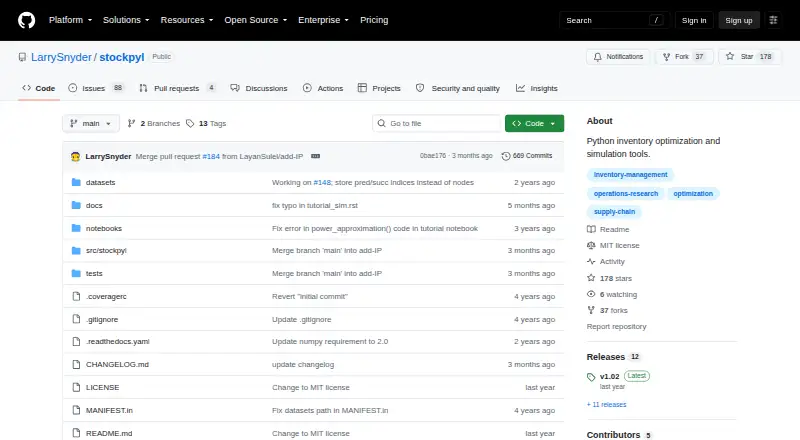
What Stockpyl is
Stockpyl is an open-source Python package for inventory optimization and simulation. It implements single-node models including economic order quantity, newsvendor, and Wagner-Whitin, alongside methods for multi-echelon stochastic-service and guaranteed-service inventory systems. The package can simulate multi-echelon systems, and its documented optimization methods include dynamic programming for Wagner-Whitin and finite-horizon stochastic inventory problems. It also documents algorithms for serial networks and acyclical guaranteed-service systems. Stockpyl is available through PyPI and installs with `pip install stockpyl`; Python v3.7 or later is required. Its documentation includes tutorials and API modules for optimization, simulation, and supply-chain data structures. The project lists API and Linux as platforms, and is released under the MIT License. The package credits Lawrence V. Snyder as its author. The listed plan is free. For questions and problem reports, the project directs users to GitHub Issues, with email as an alternative. PyPI classifies it under education, office/business, and scientific/engineering topics.
Who it suits
Stockpyl suits Python users working on inventory optimization, supply-chain simulation, or related education and scientific or business work. It requires Python v3.7 or later.
What it does well
- Implements EOQ, newsvendor, and Wagner-Whitin models.
- Includes multi-echelon optimization and simulation methods.
- Documents dynamic programming for inventory problems.
- Available through PyPI under the MIT License.
- Free, with a listed price of $0.
What to know first
- Requires Python v3.7 or later.
- The listed platforms are API and Linux.
Plans
| Plan | Billed and limits | Price |
|---|---|---|
| Stockpyl | Open-source Python package · MIT License | Free |
As github.com lists them, read 4 Oct 2026. The maker's own page has the final word.
Getting started
- Use a Python 3.7-or-later environment.
- Install Stockpyl from PyPI with `pip install stockpyl`.
- Follow the project documentation's tutorials and API modules.
- Send feedback or report problems through GitHub Issues, or use email.
Stockpyl is best suited to analysts, researchers, and developers who are comfortable working in Python. Its appeal is the combination of established inventory models and multi-echelon optimization; it is less suited to teams looking for a ready-to-use business application.
Overview
Stockpyl brings single-node inventory models, network algorithms, and simulation into a package that can be installed from PyPI with pip install stockpyl. It requires Python v3.7 or later and is released under the MIT License, making it a practical option for open-source Python projects and technical coursework.
Tutorials and API modules cover optimization, simulation, and supply-chain data structures. The project directs feedback and problem reports to GitHub Issues, with email as an alternative. That support route fits users comfortable working with a software project, rather than organizations expecting a dedicated service channel.
Key features
Inventory models and optimization
Stockpyl implements economic order quantity, newsvendor, and Wagner-Whitin models, and supports safety stock optimization. It also includes stochastic-service and guaranteed-service methods for multi-echelon inventory. This range is useful for comparing different formulations within one Python workflow, especially when the analysis spans basic replenishment decisions and more complex inventory networks.
Dynamic programming and network methods
Documented optimization methods include dynamic programming for Wagner-Whitin and finite-horizon stochastic inventory problems. Algorithms for serial systems and acyclical guaranteed-service systems give users methods suited to those network structures. The focus is on model-based analysis; teams seeking a broader operational application should consider a different category of tool.
Simulation
Stockpyl can simulate multi-echelon inventory systems as well as optimize them. Having both capabilities in one package helps users examine system behavior alongside optimization results, though the Python package format favors technical workflows over a turnkey interface.
Pricing
Stockpyl is free: the Stockpyl plan costs free and includes an open-source Python package under the MIT License. There are no paid tiers or stated seat and usage caps. It is a strong fit for individuals and teams that can work directly in Python; organizations that need a packaged business application or a commercial support arrangement may prefer a paid product.
Platforms
Stockpyl is an API-oriented package for Linux. Its Python v3.7-or-later requirement makes it unsuitable for environments that cannot meet that version requirement.
Who it's for
Stockpyl is a good fit for supply-chain analysts, researchers, educators, and developers building or studying inventory models in Python. Its coverage of single-node decisions, multi-echelon optimization, and simulation supports a range of technical work. It is not the right choice for buyers seeking a general inventory application with a nontechnical workflow.
Pros and cons
- Pros: Free and MIT-licensed, with no paid tier to weigh against the core package.
- Pros: Combines single-node models, multi-echelon methods, and simulation, useful for varied model-based inventory work.
- Pros: Tutorials and API modules cover optimization, simulation, and supply-chain data structures.
- Cons: Requires Python v3.7 or later, so older Python environments are not suitable.
- Cons: Its API-oriented, technical format is a poor fit for teams wanting a ready-made business application.
- Cons: Support is routed through GitHub Issues or email, rather than a dedicated commercial support channel.
Alternatives
Inventory Optimization Software is a useful place to compare tools in the broader category. Choose ZebraDesigner instead if the need is basic barcode label and tag design and printing: its free Essentials 3 plan supports Zebra Link-OS and Link-OS Basic printers, and it also offers a free trial and paid pricing. Manhattan Active Inventory Replenishment is a paid alternative with API and web platforms. 4R Systems Intelligent Inventory Optimization is a paid web option with custom pricing and a demo request. Bluemingo Production Planning & Scheduling is another paid web option, with pricing through its sales team. Decion Demand Planning is a paid web product with pricing tailored to capabilities, scope, users, integrations, and implementation requirements. E2open Planning offers a paid connected-planning product with custom pricing. GAINS is a paid API and web platform with pricing by request. Logility DemandAI+ is a paid web product with pricing by request.
Verdict
Choose Stockpyl if you need a free, open-source Python toolkit for inventory optimization and multi-echelon simulation, and your work can live in a technical workflow. Its breadth of models is the main reason to choose it; look elsewhere if your priority is a ready-to-use business application rather than a package for building and analyzing models.
Verdict
Stockpyl combines inventory models, multi-echelon methods, and simulation in a free Python package. Its documented tutorials and API modules provide coverage across optimization, simulation, and supply-chain data structures.
Questions
How much does Stockpyl cost?
The listed Stockpyl plan is free. The project is open source under the MIT License.
What does Stockpyl do?
It provides inventory optimization models and methods, plus simulation features for multi-echelon inventory systems.
Which inventory models does it include?
Single-node models include economic order quantity, newsvendor, and Wagner-Whitin. Multi-echelon algorithms cover stochastic-service and guaranteed-service models.
How do I install it?
Stockpyl is distributed through PyPI; the installation command is `pip install stockpyl`. Python 3.7 or later is required.
Who is credited as the author?
The package credits Lawrence V. Snyder as its author.
Where can I get help?
The project directs users to GitHub Issues for feedback and problems, with email as an alternative.
Facts from Stockpyl's own pages
- Audience
- PyPI classifies the project under education, office/business, and scientific/engineering topics. · pypi.org, 4 Oct 2026
- Distribution
- The installation guide says Stockpyl is available on PyPI and installs with `pip install stockpyl`. · stockpyl.readthedocs.io, 4 Oct 2026
- Documentation
- The project links to documentation covering tutorials and API modules for optimization, simulation, and supply-chain data structures. · stockpyl.readthedocs.io, 4 Oct 2026
- License
- The project describes itself as open-source and released under the MIT License. · github.com, 4 Oct 2026
- Maker
- The package credits Lawrence V. Snyder as its author. · pypi.org, 4 Oct 2026
- Multi-echelon optimization
- It includes multi-echelon inventory optimization algorithms for stochastic-service and guaranteed-service models. · github.com, 4 Oct 2026
- Network models
- It documents algorithms for serial systems and acyclical guaranteed-service systems. · stockpyl.readthedocs.io, 4 Oct 2026
- Optimization methods
- Its documented methods include dynamic programming for Wagner-Whitin and finite-horizon stochastic inventory problems. · stockpyl.readthedocs.io, 4 Oct 2026
- Purpose
- Stockpyl is a Python package for inventory optimization and simulation. · stockpyl.readthedocs.io, 4 Oct 2026
- Python requirement
- The installation guide requires Python v3.7 or later. · stockpyl.readthedocs.io, 4 Oct 2026
- Simulation
- It has features for simulating multi-echelon inventory systems. · stockpyl.readthedocs.io, 4 Oct 2026
- Single-node models
- It implements economic order quantity, newsvendor, and Wagner-Whitin inventory models. · github.com, 4 Oct 2026
- Support
- The project directs users to GitHub Issues for feedback and problems, with email as an alternative. · github.com, 4 Oct 2026
Where Stockpyl stands on Freedom251
- Inventory Optimization Software#3 of 25