Freedom251 › Inventory Optimization Software
replenishment
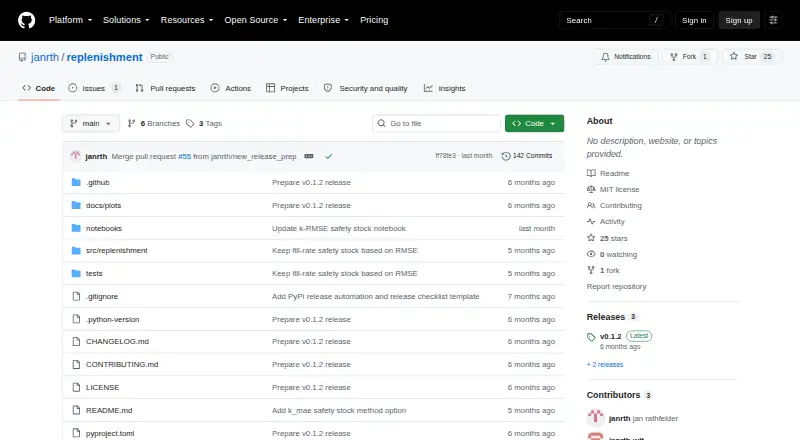
What replenishment is
replenishment is an open-source Python library for simulating stock replenishment, optimizing policies, and visualizing results. It is intended for teams comparing policies against historical or synthetic demand. Listed optimization workflows include safety stock based on mean forecasts, k*RMSE or k*MAE, and percentile targets. For the k*RMSE and k*MAE approaches, safety stock can optionally increase when forecast quantities across lead time rise above a baseline. The library also supports workflows between CSV or DataFrame inputs and simulation configurations, and visual comparisons of policies on replenishment time series. Installation is documented through PyPI with `pip install replenishment`. The project says it is tested on Python 3.10, 3.11, 3.12, and 3.13; listed dependencies include pandas, Polars, PyArrow, matplotlib, ipykernel, and scienceplots. It uses the MIT license and is classified as Alpha. The repository includes notebooks for policy variants, synthetic data generation, and loading stock replenishment data. Minimum order quantities, case-pack constraints, and promotion-aware demand handling are listed as areas for future contribution.
Who it suits
This library suits Python teams simulating replenishment policies against historical or synthetic demand and comparing policy outcomes. It may also interest contributors working on the listed future areas, such as case-pack constraints.
What it does well
- Supports historical or synthetic demand scenarios.
- Includes mean-forecast, k*RMSE/k*MAE, and percentile policies.
- Visualizes policy comparisons on replenishment time series.
- Tested on Python 3.10 through 3.13.
- Uses the MIT license.
What to know first
- Package status is classified as Alpha.
- Minimum order quantities are listed as future work.
- Case-pack constraints are listed as future work.
- Promotion-aware demand handling is listed as future work.
Plans
| Plan | Billed and limits | Price |
|---|---|---|
| Open source library | Python package · MIT license | Free |
As github.com lists them, read 10 Oct 2026. The maker's own page has the final word.
Getting started
- Install the package from PyPI with `pip install replenishment`.
- Use Python 3.10, 3.11, 3.12, or 3.13.
- Start with a repository notebook for policy variants, synthetic data, or stock replenishment data loading.
Replenishment is a Python library for analysts who want to compare stock policies against historical or synthetic demand. Its practical appeal is a focused set of safety-stock workflows; it is a weaker fit when replenishment decisions depend on ordering constraints or promotion-aware demand.
Overview
The project centers on modeling and comparing replenishment policies, with workflows that connect demand data to simulation configurations. It gives Python teams room to explore policy behavior, but its Alpha status and stated future contribution areas matter for anyone considering it in an operational process.
Key features
Replenishment simulates policies against historical or synthetic demand and supports visual comparisons across replenishment time series. Optimization workflows include mean-forecast safety stock, k*RMSE and k*MAE, and percentile-target policies. That selection lets analysts compare several buffer-setting approaches; for k*RMSE and k*MAE, an optional adjustment can increase safety stock when lead-time forecast quantities rise above a baseline.
CSV and DataFrame inputs can be connected to simulation configurations. Included notebooks cover policy variants, synthetic data generation, and stock data loading, giving contributors and analysts concrete examples to adapt. Installation is through PyPI with pip install replenishment.
The project is tested on Python 3.10, 3.11, 3.12, and 3.13. Its dependencies include pandas, Polars, PyArrow, matplotlib, ipykernel, and scienceplots, so teams should account for that Python data and visualization stack. Minimum order quantities, case-pack constraints, and promotion-aware demand handling are identified as areas for future contribution; teams that rely on those rules will need additional work beyond the library’s current focus.
Pricing
The Open source library plan is free. It is an MIT-licensed Python package, with no seat or usage caps stated in the plan. The free plan suits teams able to install and work with a Python library; it does not provide a separate paid tier with broader capabilities. The README welcomes contributions and links to setup, testing, pull request guidance, and the issue tracker.
Platforms
Replenishment is distributed as a Python package through PyPI and is tested on Python 3.10 through 3.13. The project metadata lists pandas, Polars, PyArrow, matplotlib, ipykernel, and scienceplots as dependencies.
Who it's for
It suits analysts and development teams that can work in Python and want to simulate demand scenarios, compare safety-stock policies, or build on the included notebooks. Teams looking for a packaged operational workflow around minimum orders, case packs, or promotions should look elsewhere or plan to extend the project, since those are future contribution areas.
Pros and cons
Pros
- Several policy optimization workflows, including mean-forecast, error-based, and percentile-target approaches, support comparative analysis.
- Historical and synthetic demand simulation, visual policy comparisons, and CSV or DataFrame workflows form a coherent toolkit for Python-based exploration.
- The package is free, MIT-licensed, installable through PyPI, and tested across Python 3.10–3.13.
Cons
- Alpha development status may be a concern for teams that need a mature operational dependency.
- Minimum order quantities, case-pack constraints, and promotion-aware demand handling remain future contribution areas, limiting its fit for workflows governed by those rules.
- Its Python package and dependencies make it best suited to teams already working in that ecosystem.
Alternatives
Inventory Optimization Software is a useful category starting point when you want to compare a broader set of tools.
Choose ZebraDesigner if barcode label and tag design and printing are your priority; its free Essentials 3 plan supports Zebra Link-OS and Link-OS Basic printers.
supplychainpy is another free option, with its 0.0.5 source package available through PyPI.
Stockpyl is a free, MIT-licensed open-source Python package and a reasonable alternative to evaluate alongside Replenishment.
Manhattan Active Inventory Replenishment is a paid option for readers comparing web or API offerings.
4R Systems Intelligent Inventory Optimization uses custom pricing, with a demo request as the pricing route.
Bluemingo Production Planning & Scheduling uses custom pricing through its sales team.
Decion Demand Planning has custom pricing tailored to selected capabilities, scope, users, integrations, and implementation needs.
E2open Planning uses custom pricing, with pricing details available by contacting E2open.
Verdict
Choose Replenishment if your team works in Python and wants a free, MIT-licensed way to simulate demand and compare safety-stock policies. Its focused analytical workflows are the reason to choose it; its Alpha status and unfinished support for ordering constraints and promotions are the reasons to look elsewhere when those rules shape day-to-day replenishment.
Verdict
replenishment provides a focused set of simulation, optimization, and visualization workflows for stock policies in Python. Its Alpha status and listed future-work areas are relevant considerations for teams evaluating its scope.
Questions
How much does replenishment cost?
The open source library plan is free.
Is replenishment open source?
Yes. The package uses the MIT license.
Which Python versions are supported?
The project says it is tested on Python 3.10, 3.11, 3.12, and 3.13.
How do I install it?
Install it from PyPI with `pip install replenishment`.
What can it optimize?
Its workflows include mean-forecast safety stock, k*RMSE or k*MAE, and percentile-target policies.
What constraints are identified for future contribution?
Minimum order quantities, case-pack constraints, and promotion-aware demand handling are areas for future contribution.
Facts from replenishment's own pages
- Contribution
- The README welcomes contributions and links to guidance for setup, tests, and pull requests. · github.com, 10 Oct 2026
- Data handling
- The README describes workflows for moving between CSV/DataFrame inputs and simulation configs. · github.com, 4 Oct 2026
- Data workflows
- The project describes workflows moving between CSV or DataFrame inputs and simulation configs. · github.com, 10 Oct 2026
- Demand scenarios
- It simulates replenishment policies against historical or synthetic demand. · github.com, 10 Oct 2026
- Dependencies
- The package metadata lists pandas, Polars, PyArrow, Matplotlib, and SciencePlots among its dependencies. · github.com, 10 Oct 2026
- Development status
- The project metadata classifies the package as Alpha. · github.com, 4 Oct 2026
- Distribution
- The README documents installation from PyPI with pip install replenishment. · github.com, 10 Oct 2026
- Forecast buffering
- The README says k*RMSE or k*MAE safety stock can optionally increase when lead-time forecast quantities rise above a baseline. · github.com, 4 Oct 2026
- Installation
- The README gives `pip install replenishment` as the PyPI installation command. · github.com, 4 Oct 2026
- Intended use
- The README says it is designed for teams that simulate replenishment policies against historical or synthetic demand. · github.com, 4 Oct 2026
- License
- The project metadata identifies the license as MIT. · github.com, 4 Oct 2026
- License and maturity
- The package metadata identifies the license as MIT and development status as Alpha. · pypi.org, 10 Oct 2026
- Notable limits
- The README lists minimum order quantities, case-pack constraints, and promotion-aware demand handling as areas for future contribution. · github.com, 10 Oct 2026
- Policy optimization
- It supports optimizing mean-forecast safety stock, k*RMSE/k*MAE, and percentile-target policies. · github.com, 10 Oct 2026
- Purpose
- The project describes replenishment as a Python library for stock replenishment simulation, policy optimization, and decision visualization. · github.com, 4 Oct 2026
- Python support
- The project says it is tested on Python 3.10, 3.11, 3.12, and 3.13. · github.com, 10 Oct 2026
- Python versions
- The README says the project is tested on Python 3.10, 3.11, 3.12, and 3.13. · github.com, 4 Oct 2026
- Support and contribution
- The README welcomes contributions and links to contribution guidance and the repository issue tracker. · github.com, 4 Oct 2026
- Visualization
- It can compare replenishment policies visually on time series. · github.com, 10 Oct 2026
- Walkthroughs
- The repository includes notebooks for policy variants, synthetic data generation, and stock replenishment data loading. · github.com, 10 Oct 2026
- What it does
- replenishment is a Python library for stock replenishment simulation, policy optimization, and decision visualization. · github.com, 10 Oct 2026
Where replenishment stands on Freedom251
- Inventory Optimization Software#4 of 25