Freedom251 › Software Supply Chain Security Software
StepSecurity
What StepSecurity is
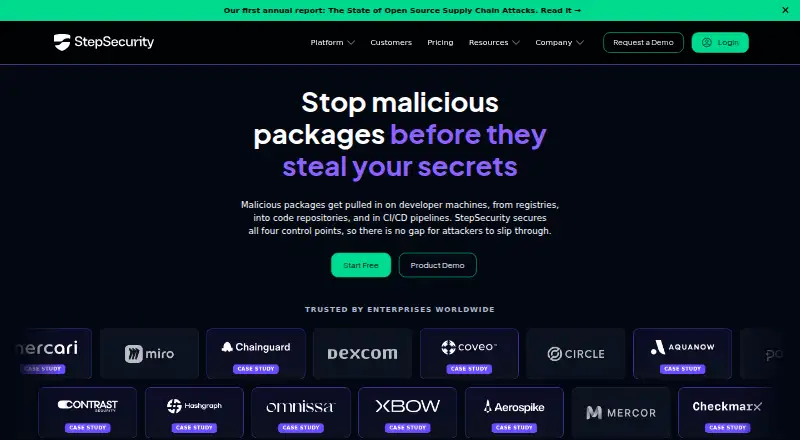
StepSecurity addresses software supply chain risks across developer machines, code repositories, and CI/CD pipelines. Harden-Runner uses eBPF to monitor network calls, file writes, and process executions, then relates those events to workflow steps. Dev Machine Guard inventories AI coding agents, MCP servers, IDE extensions, and local packages on developer devices. Secure Registry offers package cooldowns, blocking for compromised versions, typosquat protection, and blocklists. Code Repo Security screens pull requests and can open remediation pull requests based on policies. Event alerts can be sent by email, Slack, or Microsoft Teams. Dev Machine Guard supports agentless deployment through Intune, SCCM, or Jamf on macOS, Windows, and Linux. The free Community plan covers unlimited public repositories and lists GitHub-hosted runners on GitHub Cloud; private repositories are included in the 14-day trial. Dev Machine Guard is $8 a month per device, and Enterprise is $16 a month per contributing developer. The Trust Center lists SOC 2 Type 2 and ISO 27001:2022 compliance. Community includes community support; Enterprise and Dev Machine Guard list priority support.
Who it suits
StepSecurity suits teams seeking controls across development machines, repositories, and CI/CD pipelines. Dev Machine Guard is also presented for employees who use development tools but do not contribute code.
What it does well
- Monitors workflow activity with eBPF.
- Inventories developer tools and local packages.
- Provides package cooldowns and typosquat protection.
- Sends alerts by email, Slack, or Microsoft Teams.
- Lists SOC 2 Type 2 and ISO 27001:2022 compliance.
What to know first
- Free Community is limited to public repositories.
- Community lists GitHub-hosted runners on GitHub Cloud.
- Private repositories are included in the 14-day trial.
Limits
The free Community plan covers unlimited public repositories and GitHub-hosted runners on GitHub Cloud. Private repositories are included in the 14-day trial.
Plans
| Plan | Billed and limits | Price |
|---|---|---|
| Community | Free · Unlimited public repositories · GitHub-hosted runners on GitHub Cloud · Community support | Free |
| Enterprise | $16 /month per contributing developer · Full platform · Includes Dev Machine Guard and Secure Registry · Priority support with support SLAs | $16 a month |
| Dev Machine Guard | $8 /month per device · Device and registry protection · Includes Secure Registry · For employees who do not contribute code | $8 a month |
As stepsecurity.io lists them, read 3 Oct 2026. The maker's own page has the final word.
Getting started
- Open the StepSecurity website.
- Choose the Community plan, start the 14-day free trial, or select a paid plan.
- For Dev Machine Guard deployment, use Intune, SCCM, or Jamf on macOS, Windows, or Linux.
- Connect relevant repositories, CI/CD pipelines, or artifact registries from the listed integrations.
- Set security event notifications to email, Slack, or Microsoft Teams.
StepSecurity is a software supply-chain security platform covering developer machines, code repositories, packages, and CI/CD workflows. It suits organizations that need controls for both software contributors and employees who use development tools without committing code. Its broad coverage is compelling, but device- and developer-based billing makes the size of your rollout a central consideration.
Overview
StepSecurity brings lifecycle controls into one service: machine inventories, pull-request policy checks, package safeguards, and pipeline monitoring. It also supports dependency analysis, provenance attestations, release policy gates, and source and repository security. Email, Slack, and Microsoft Teams notifications help route events to existing response channels.
For compliance reviews, its Trust Center lists SOC 2 Type 2 and ISO 27001:2022 compliance, along with audit and penetration-testing reports. That documentation is useful when supply-chain controls must support formal assurance requirements.
Key features
CI/CD monitoring
Harden-Runner uses eBPF to observe network calls, file writes, and process executions, correlating activity with individual workflow steps. This step-level context is more actionable than a generic pipeline alert, particularly for teams investigating unexpected build behavior.
Developer machines
Dev Machine Guard inventories AI coding agents, MCP servers, IDE extensions, and local packages. Agentless deployment through Intune, SCCM, or Jamf covers macOS, Windows, and Linux. It is aimed at employees who use development tooling without contributing code, extending coverage beyond the engineering group.
Packages and repositories
Secure Registry provides cooldown periods, compromised-version blocking, typosquat protection, and package blocklists. Code Repo Security screens pull requests and can open remediation pull requests according to policy, reducing the manual work of applying repository-wide fixes.
Integrations and support
Compatibility includes GitLab CI, Azure DevOps, JFrog Artifactory, Sonatype Nexus, and Google Artifact Registry. Community customers receive community support; Dev Machine Guard and Enterprise include priority support, with Enterprise adding support SLAs.
Pricing
| Plan | Price | What it includes |
|---|---|---|
| Community | free | Unlimited public repositories, GitHub-hosted runners on GitHub Cloud, community support |
| Dev Machine Guard | $8 a month, billed $8/month per device | Device and registry protection; Secure Registry included; for employees who do not contribute code |
| Enterprise | $16 a month, billed $16/month per contributing developer | Full platform, Dev Machine Guard and Secure Registry included, priority support with support SLAs |
The Community plan is a practical starting point for public GitHub repositories, but its stated scope excludes private repositories outside the 14-day free trial. Dev Machine Guard is the focused option when machine and registry protection matter more than repository controls. Enterprise is the comprehensive choice for contributing developers, although per-developer pricing can grow with team size. A 14-day trial allows evaluation before paid coverage.
Platforms
StepSecurity supports API, Linux, macOS, self-hosted deployments, web, and Windows. The agentless Dev Machine Guard rollout specifically covers macOS, Windows, and Linux through Intune, SCCM, or Jamf.
Who it's for
Choose it when you want one program spanning developer endpoints, repositories, package intake, and CI/CD, or when non-contributing staff still need device protection. Teams limited to public GitHub repositories can start without a subscription. Organizations with substantial private-repository use or many contributors should model the per-device and per-developer costs before committing.
Pros and cons
Pros
- Broad lifecycle coverage: endpoint inventory, repository policy, package defenses, and workflow telemetry are combined.
- Useful pipeline context: eBPF observations are tied to workflow steps rather than presented only as raw events.
- Practical rollout options: Intune, SCCM, and Jamf support agentless deployment across the three major desktop operating systems.
- Assurance material: SOC 2 Type 2, ISO 27001:2022, audit reports, and penetration-testing reports support procurement reviews.
Cons
- Coverage costs scale: Dev Machine Guard charges per device and Enterprise per contributing developer.
- Free scope is narrow: Community is centered on unlimited public repositories and GitHub-hosted runners on GitHub Cloud.
- Support differs by tier: community users do not receive the priority support and SLAs attached to paid offerings.
Alternatives
For a broader comparison, see Software Supply Chain Security Software.
- ActiveState Platform fits teams seeking a freemium platform with free public projects and paid enterprise options.
- Sonatype Nexus Repository is the better match when repository management and CI/CD integration are the primary requirement, with a free Community Edition.
- Wisec suits projects that need a free tier capped at three projects and 1,000 builds per month, plus certificate generation.
- DevGuard is another freemium supply-chain security option for teams evaluating alternatives.
- GUAC is appropriate when a free, MIT-licensed open-source project is preferred and Docker-based setup is acceptable.
- SafeDep Platform is worth considering for teams wanting free open-source tools such as Vet, PMG, xBom, and Gryph.
- Chainloop fits organizations favoring a self-hosted community edition, accepting no UI or curated policy library.
- Sigstore is the straightforward free choice for developers and software providers focused on signing and provenance.
Verdict
StepSecurity is a strong choice for organizations that want coordinated supply-chain protection from employee machines through production pipelines, especially where compliance evidence and non-contributing users matter. Look elsewhere if you need only repository management, a completely self-hosted open-source stack, or pricing that does not rise with every protected device and contributing developer.
Verdict
StepSecurity combines developer-device inventories, repository controls, and CI/CD monitoring. The free plan is scoped to public repositories, while device and enterprise offerings have per-device or per-developer prices.
Questions
What does StepSecurity cost?
The Community plan is free. Dev Machine Guard costs $8 a month per device, and Enterprise costs $16 a month per contributing developer.
Is there a free trial?
Yes. StepSecurity lists a 14-day trial; private repositories are included in it.
What is included in the free Community plan?
It covers unlimited public repositories, GitHub-hosted runners on GitHub Cloud, and community support.
Which developer machine operating systems are supported?
The pricing page lists agentless Dev Machine Guard deployment on macOS, Windows, and Linux through Intune, SCCM, or Jamf.
Which integrations are listed?
The pricing page lists GitLab CI, Azure DevOps, JFrog Artifactory, Sonatype Nexus, and Google Artifact Registry compatibility.
What compliance does StepSecurity list?
Its Trust Center lists SOC 2 Type 2 and ISO 27001:2022 compliance, and provides audit and penetration testing reports.
Facts from StepSecurity's own pages
- CI/CD monitoring
- Harden-Runner uses eBPF to monitor network calls, file writes, and process executions, correlating events to workflow steps. · docs.stepsecurity.io, 3 Oct 2026
- Company
- The company page identifies Varun Sharma as CEO and co-founder and Ashish Kurmi as CTO and co-founder. · stepsecurity.io, 3 Oct 2026
- Developer machine inventory
- Dev Machine Guard inventories AI coding agents, MCP servers, IDE extensions, and local packages on developer machines. · stepsecurity.io, 3 Oct 2026
- Integrations
- The pricing page lists GitLab CI, Azure DevOps, JFrog Artifactory, Sonatype Nexus, and Google Artifact Registry compatibility. · stepsecurity.io, 3 Oct 2026
- Intended users
- StepSecurity describes its full platform as serving contributing developers and offers Dev Machine Guard for employees who use development tools but do not contribute code. · stepsecurity.io, 3 Oct 2026
- Notable limits
- The free Community plan is for unlimited public repositories and lists GitHub-hosted runners on GitHub Cloud; private repositories are included in the 14-day free trial. · stepsecurity.io, 3 Oct 2026
- Notifications
- Security event notifications can be sent by email, Slack, or Microsoft Teams. · docs.stepsecurity.io, 3 Oct 2026
- Operating systems
- The pricing page lists agentless Dev Machine Guard deployment through Intune, SCCM, or Jamf on macOS, Windows, and Linux. · stepsecurity.io, 3 Oct 2026
- Package protection
- Secure Registry provides cooldown periods, compromised-version blocking, typosquat protection, and package blocklists. · stepsecurity.io, 3 Oct 2026
- Product
- StepSecurity detects, prevents, and responds to software supply chain attacks across developer environments, code repositories, and CI/CD pipelines. · docs.stepsecurity.io, 3 Oct 2026
- Repository controls
- Code Repo Security screens pull requests and can open policy-driven remediation pull requests across repositories. · stepsecurity.io, 3 Oct 2026
- Security compliance
- The Trust Center lists SOC 2 Type 2 and ISO 27001:2022 compliance and provides audit and penetration testing reports. · trust.stepsecurity.io, 3 Oct 2026
- Support
- The Community plan includes community support, while Enterprise and Dev Machine Guard list priority support. · stepsecurity.io, 3 Oct 2026