Freedom251 › Semantic Layer Software

Starburst Enterprise Context Layer
Visit Starburst Enterprise Context Layer Alternatives Pricing
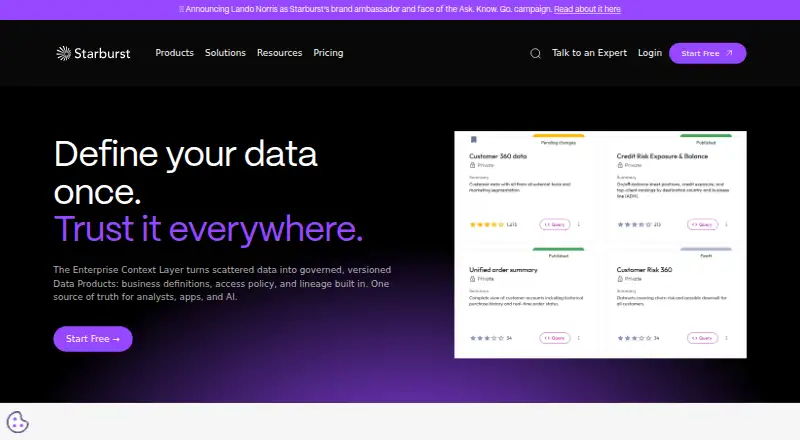
What Starburst Enterprise Context Layer is
Starburst Enterprise Context Layer organizes scattered data into governed, versioned Data Products, with business definitions, access policies and lineage. Each product combines a governed dataset with ownership and related context, and can be discovered in a shared catalog. Policies can include role-based access, column masking and row-level security. Teams can define Data Products in YAML, commit them to git, test changes before merging and roll back when needed; breaking changes are reviewed before release. Automated CI/CD lineage checks verify upstream freshness before a new version is published. A semantic layer translates data into business-ready metrics, dimensions and relationships for BI tools and AI agents. Data Products can be consumed through JDBC or REST, and the platform connects to more than 50 sources, including Apache Iceberg, Delta Lake, Hive, Amazon S3, Snowflake and PostgreSQL. It runs in private cloud, hybrid or on-premises environments and is air-gap ready. Starburst lists a free plan and 30-day trial; paid plans start at $0.50 per credit. The product is aimed at regulated industries such as financial services, healthcare, insurance and government, and advertises 24×7 enterprise support.
Who it suits
The Context Layer is aimed at data teams in regulated industries that need governed, versioned Data Products and lineage. It may suit organizations publishing data to BI tools, APIs, AI agents or apps across private cloud, hybrid or on-premises deployments.
What it does well
- Data Products include definitions, access policies and lineage.
- YAML definitions can be committed to git and tested.
- Automated checks validate upstream freshness before publishing.
- Supports JDBC and REST consumption.
- Runs in air-gap-ready private cloud, hybrid or on-premises environments.
What to know first
- Paid plans start at $0.50 per credit.
- AIDA token usage is billed separately on Enterprise and Mission-Critical.
- Free plan includes up to three clusters.
Limits
The free plan is billed free forever and allows up to 3 clusters, with standard cluster execution for ad hoc queries. Pro adds flexible execution modes, streaming ingest, and advanced cluster management; Enterprise and Mission-Critical list additional capabilities, with AIDA token usage billed separately on those plans.
Plans
| Plan | Billed and limits | Price |
|---|---|---|
| Free | Free forever · Up to 3 clusters · standard cluster execution for ad hoc queries | Free |
| Pro | Starting at $0.50/credit; usage-based · Flexible cluster execution modes · streaming ingest · advanced cluster management | $0.50 a month |
| Enterprise | Starting at $0.75/credit; usage-based · Advanced autoscaling · ABAC and SCIM · AWS PrivateLink · private-preview features · AIDA token usage billed separately | $0.75 a month |
| Mission-Critical | Starting at $1.00/credit; usage-based · Elite support · advanced governance integrations · lakehouse security/compliance tools · highest uptime guarantees · AIDA token usage billed separately | $1 a month |
As starburst.io lists them, read 15 Oct 2026. The maker's own page has the final word.
Getting started
- Visit the Starburst Context Layer website.
- Choose the free plan or review the paid plans.
- Use the 30-day trial if you want to try the platform.
- Select a private cloud, hybrid, or on-premises deployment.
Starburst Enterprise Context Layer is a governed data-product platform for teams that need business definitions, access rules and lineage to travel with shared data. It is best suited to regulated organizations operating across hybrid or restricted environments. Its case is strongest when teams need controlled data products as well as a semantic layer; credit-based costs and separate AIDA usage can make simpler alternatives a better fit.
Overview
Rather than sharing datasets without their operating context, teams can package them as Data Products with definitions, ownership, access policies and lineage. A shared catalog makes those products discoverable, and BI tools, APIs, AI agents and apps can consume them through JDBC or REST.
Connections span more than 50 sources, including Apache Iceberg, Delta Lake, Hive, Amazon S3, Snowflake and PostgreSQL. That breadth is useful for organizations consolidating varied data estates, but the product is more than a metrics layer: its governance and deployment controls are most valuable when data needs formal ownership and oversight.
Key features
Governance and managed change
Role-based access, column masking and row-level security help teams share data without granting every consumer unrestricted access. Products are versioned and tested, with breaking changes reviewed before rollout. YAML definitions committed to git can be tested before merge and rolled back when needed, making the workflow suitable for teams that want data changes to follow software-style review.
CI/CD lineage checks validate upstream freshness before publishing a new version. That can catch stale dependencies in a release workflow, though it does not replace the need to define and maintain the underlying products and policies.
Business semantics and AI
The semantic layer translates raw data into business-ready metrics, dimensions and relationships for analytics tools and AI agents. Governed metrics, dimensions and joins, along with a query API, support reuse across consumers rather than leaving each application to interpret data independently.
AIDA adds plain-language querying, an Agentic Control Plane, full-text search over Iceberg tables and built-in AI tasks. Its value depends on whether analysts need those capabilities; Enterprise and Mission-Critical plans bill AIDA token usage separately, so AI consumption should be included in cost planning.
Deployment and security
Private-cloud, hybrid and on-premises deployment, including air-gap readiness, suit organizations that cannot move all data processing to a shared public service. Security options include column- and row-level RBAC and ABAC, Apache Ranger, HashiCorp Vault, Okta, LDAP, dynamic masking, column-level encryption and unified audit logging. These controls align the product with regulated environments, but are likely excessive for teams seeking a lightweight semantic layer.
Pricing
Starburst uses a freemium model, with a free plan, paid plans from $0.50 per credit and a 30-day trial. The paid figures are credit-based rather than conventional monthly seat prices, so buyers should assess expected usage before comparing headline rates.
| Plan | Price | What it includes |
|---|---|---|
| Free | free, billed Free forever | Up to 3 clusters and standard cluster execution mode for ad hoc queries. |
| Pro | $0.50 per credit | Flexible cluster execution modes, streaming ingest and advanced cluster management. |
| Enterprise | $0.75 per credit | Advanced autoscaling, ABAC and SCIM, AWS PrivateLink and Private Preview access; AIDA token usage billed separately. |
| Mission-Critical | $1 per credit | Elite support and ticketing, advanced governance integrations, lakehouse security and compliance tools, and highest uptime guarantees; AIDA token usage billed separately. |
Free is a limited way to run ad hoc queries, not a substitute for the flexible execution, streaming or governance capabilities in paid tiers. Pro is the entry paid choice for teams needing those operating features. Enterprise adds autoscaling and identity and access controls suited to more demanding deployments, while Mission-Critical targets organizations that prioritize support, compliance tooling and uptime guarantees. The 30-day trial gives teams a defined evaluation window; the free plan is billed Free forever.
Platforms
The platform supports API, web and self-hosted use. Its private-cloud, hybrid and on-premises deployment options, including air-gap readiness, are a notable fit for organizations with strict data-location or network constraints.
Who it's for
Financial services, healthcare, insurance and government teams are the clearest fit, particularly when they need policy-controlled data sharing, reviewed changes and auditability across analytics and applications. Data platform teams seeking a governed product catalog and reusable semantics can also benefit. Smaller teams that only need a shared metrics definition, or buyers who need predictable per-seat pricing, should look elsewhere.
Pros and cons
- Strong governance for shared data: row-level security, masking, ABAC and audit logging support controlled access across consumers.
- Safer product changes: versioning, reviewed breaking changes, git-based definitions and freshness checks put release controls around data products.
- Flexible deployment: hybrid, on-premises and air-gap-ready options address environments where cloud-only services are unsuitable.
- Usage costs need forecasting: paid plans are priced per credit, and AIDA usage is separately billed on Enterprise and Mission-Critical.
- Free tier is narrow: three clusters and standard execution for ad hoc queries do not include the paid plans' flexible modes or advanced management.
Alternatives
Cube is worth considering for a more focused semantic-layer option with a free tier of up to five workbooks, 1,000 daily requests and one-day query-history retention; that free tier includes community support.
dbt Semantic Layer may suit teams already working in dbt that want to start with its free Developer plan, which allows one developer seat, 3,000 successful models per month and one project.
Definite offers a free starting point for small deployments, capped at two users, two connectors, 1 GB of storage and five credits per month, with daily sync.
Sema is another freemium option, with a free Sandbox plan capped at one connector, one user and 100 chat queries per month.
Strata may be preferable for developer-led projects: its free plan allows one developer, 25 users and two data sources per project, with unlimited projects and branches.
MetricFlow is a free, Apache 2.0-licensed option for teams with a working dbt project and dbt adapter.
Malloy is a free alternative for teams seeking a tool available across web, Windows, macOS and Linux.
Tableau is another freemium option for teams looking at self-hosted software.
Browse more options in Semantic Layer Software and Query Engine Software.
Verdict
Choose Starburst Enterprise Context Layer if your organization needs governed, versioned data products across a varied estate and must retain control over deployment and access. Its combination of lineage checks, reusable business semantics and regulated-environment controls is the central reason to choose it. Look elsewhere if a standalone metrics layer will do, or if per-credit charges and separate AIDA usage do not fit your budget model.
Verdict
The Context Layer combines data product governance, version control, lineage checks and a semantic layer. Its deployment options and security controls are relevant to regulated organizations; review per-credit pricing and separately billed AIDA usage where applicable.
Questions
Is there a free plan?
Yes. The Free plan is billed free forever and includes up to 3 clusters with standard cluster execution for ad hoc queries.
Is there a free trial?
Yes. A 30-day trial is listed.
How much do paid plans cost?
Pro is $0.50 per credit, Enterprise is $0.75 per credit, and Mission-Critical is $1.00 per credit.
Where can it be deployed?
Starburst Enterprise supports private cloud, hybrid, and on-premises environments and is air-gap ready.
What can use its Data Products?
BI tools, APIs, AI agents, and apps can consume them through JDBC or REST.
Which industries does it target?
It is built for regulated industries including financial services, healthcare, insurance, and government.
Facts from Starburst Enterprise Context Layer's own pages
- AI assistant
- AIDA lets analysts query in plain language and includes an Agentic Control Plane, full-text search over Iceberg tables, and built-in AI tasks. · starburst.io, 30 Sept 2026
- AI limitation
- AWS Marketplace reviewers say AI query suggestions and natural-language features still need validation and may not fully understand specialized data models. · aws.amazon.com, 15 Oct 2026
- API limitation
- The Galaxy API does not execute queries; query processing uses Trino SQL through the query editor or client drivers. · docs.starburst.io, 15 Oct 2026
- BI and client integrations
- Supported clients include Tableau, Looker, Metabase, Power BI, MicroStrategy, Querybook, QuickSight, ThoughtSpot, Zing Data, JDBC, ODBC, Trino CLI and Python clients. · docs.starburst.io, 15 Oct 2026
- Catalog and governance
- Data Products are discoverable in a shared catalog, and policies include RBAC, column masking, and row-level security. · starburst.io, 30 Sept 2026
- CI/CD lineage
- CI/CD lineage checks validate upstream freshness automatically before publishing a new version. · starburst.io, 30 Sept 2026
- Company facts
- LinkedIn lists Starburst as privately held, founded in 2017, headquartered in Boston and employing 501–1,000 people. · linkedin.com, 15 Oct 2026
- Company legal name
- Crunchbase lists the legal name as Starburst Data, Inc. · crunchbase.com, 15 Oct 2026
- Compliance
- Starburst states that it has SOC 2 Type 2 compliance and ISO/IEC 27001 certification. · docs.starburst.io, 15 Oct 2026
- Connector breadth
- The Enterprise platform advertises more than 50 native connectors, including Iceberg, Delta Lake and Hive. · starburst.io, 15 Oct 2026
- Connector performance
- Starburst connectors provide parallelism, table statistics, dynamic filtering and predicate pushdown to improve query execution. · starburst.io, 15 Oct 2026
- Consumers
- Data Products can be consumed by BI tools, APIs, AI agents, and apps through JDBC or REST. · starburst.io, 30 Sept 2026
- Core purpose
- The Enterprise Context Layer turns scattered data into governed, versioned Data Products with business definitions, access policy, and lineage built in. · starburst.io, 30 Sept 2026
- Data products
- Data products are discoverable catalog assets whose policies travel with them and whose changes are versioned and tested before release. · starburst.io, 15 Oct 2026
- Data products as code
- Definitions and access rules can be written in YAML, committed to git, tested in CI/CD and rolled back. · starburst.io, 15 Oct 2026
- Deployment
- Starburst Enterprise is self-hosted and can run on premises, in private or hybrid clouds, Kubernetes and major cloud marketplaces. · docs.starburst.io, 15 Oct 2026
- Documentation
- Documentation includes tutorials, SQL and Python guidance, connector references, deployment instructions, security topics, release notes, API references and a help center. · docs.starburst.io, 15 Oct 2026
- Enterprise API
- The SEP REST API manages access control, data products, data maintenance, SQL jobs and Warp Speed, with Basic or Bearer authentication and an OpenAPI specification. · docs.starburst.io, 15 Oct 2026
- Federated SQL
- Starburst Enterprise queries lakes, warehouses, operational databases and on-premises systems through one ANSI SQL interface without copying data or building ETL pipelines. · starburst.io, 15 Oct 2026
- Founded
- 2017 · starburst.io, 28 Sept 2026
- Funding news
- Starburst announced a $100 million Series C in 2021, bringing reported total financing to $164 million and valuation to $1.2 billion. · starburst.io, 15 Oct 2026
- Galaxy API
- Galaxy exposes a REST API over TLS/HTTPS with role-linked tokens that expire after 10 minutes; endpoints cover clusters, users, roles, catalogs, policies, data products, domains, SQL jobs and data quality. · docs.starburst.io, 15 Oct 2026
- Headquarters
- Boston, Massachusetts, USA · starburst.io, 28 Sept 2026
- Independent review assessment
- The CX Lead describes strong cross-source analytics and SQL usability but warns of resource intensity, onboarding effort and documentation gaps. · thecxlead.com, 15 Oct 2026
Where Starburst Enterprise Context Layer stands on Freedom251
- Semantic Layer Software#7 of 28
- Query Engine Software#11 of 28
- Big Data Analytics Software#20 of 30