Freedom251 › Semantic Layer Software
Sema
What Sema is
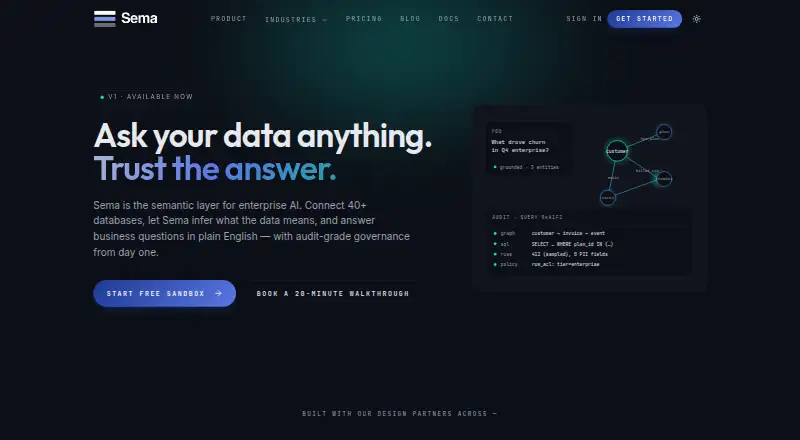
Sema is a semantic layer for enterprise AI that connects databases and answers business questions in plain English with governance. It represents tables, joins, metrics, and business terms in a typed graph, and verified inferred joins can inform later answers. It may ask clarifying questions, show the SQL and graph nodes used, and choose a chart for a response. Users can save and schedule reports for email delivery, as well as set scheduled alerts for metric thresholds or deviations. Available connectors include PostgreSQL, MySQL, MariaDB, SQLite, and SQLAlchemy URIs; ClickHouse and Amazon Redshift are in beta, while SQL Server, Snowflake, BigQuery, Databricks, and dbt metadata are on the roadmap. Sema can run in a customer VPC or its own environment, and offers self-hosted Kubernetes deployment using Helm with customer-provided Postgres and object storage. The free Sandbox allows one connector, one user, and 100 chat queries per month, but has no scheduled delivery or alerts. Pro is $49/user/mo with a three-seat minimum; a 14-day trial is listed. Sema says it was founded in 2025 and is remote-first.
Who it suits
Sema is aimed at enterprise and regulated teams, including those working with warehouses that contain thousands of tables. Its deployment options and governance controls may suit teams with specific data and access requirements.
What it does well
- Answers questions in plain English and shows SQL used.
- Verified inferred joins can be reused.
- Supports scheduled reports and metric alerts.
- Offers customer-VPC and self-hosted deployment options.
- Pro includes unlimited connectors and chat.
What to know first
- Free Sandbox has one connector and one user.
- Sandbox limits chat to 100 queries monthly.
- Several named connectors remain in beta or roadmap.
- Pro requires at least three seats at $49/user/mo.
Limits
The free Sandbox allows one connector, one user, 100 chat queries per month, and five saved reports. It does not include scheduled delivery, alerts, or signals. Pro costs $49 a month per user with a three-seat minimum; its listed 14-day trial is also available.
Plans
| Plan | Billed and limits | Price |
|---|---|---|
| Sandbox | free forever · 1 connector · 1 user · 100 chat queries/month · 5 saved reports · no scheduled delivery · no alerts or signals · “Powered by Sema” embeds | Free |
| Pro | $49/user/mo · minimum 3 seats · 14-day trial · unlimited connectors and chat · unlimited reports, schedules, alerts and signals · RBAC · audit log · email support · no card required | $49 a month |
| Business | $99/user/mo · minimum 10 seats · Everything in Pro · SSO · advanced governance · Compliance Agent V2 · AI evaluation harness V2 · federated joins V2 · priority support · 99.9% SLA | $99 a month |
| Enterprise | Contact annual · Everything in Business · SAML/SCIM · custom DPA · BYOK encryption · on-premises Helm option · SOC 2/HIPAA/GDPR evidence packs · named CSM · 99.95% SLA | On request |
As semalayer.com lists them, read 15 Oct 2026. The maker's own page has the final word.
Getting started
- Visit https://semalayer.com/.
- Choose the free Sandbox or review the Pro and Business plans.
- Connect one of the available database sources.
- Use Sema through the web app or API, or choose self-hosting.
- For Kubernetes self-hosting, use the Helm chart and provide Postgres and object storage.
Overview
Sema is a semantic layer for enterprise AI that connects databases and turns business questions into governed, plain-English answers. It suits data and compliance teams working across large, complicated warehouses, especially when deployment control matters. The trade-off is a tightly limited free Sandbox and paid tiers that start with several required seats.
Key features
Sema models tables, joins, metrics, and business terms in a typed semantic graph. When it verifies an inferred join, that relationship can be reused in later answers, helping teams maintain consistent definitions across warehouses with thousands of tables. The system asks clarifying questions, selects a chart for an answer, and exposes both the SQL executed and the graph nodes traversed. Those inspection points are valuable when analysts need to review an answer rather than accept an opaque result.
Saved reports can be scheduled for email delivery, while metric alerts can run on thresholds or deviations. Governed metrics, dimensions and joins, row-level security, and a query API make Sema more than a chat front end. It can expose its capabilities as MCP tools for Claude, Cursor, or an internal agent, and it supports OAuth2/OIDC identity providers including Okta, Entra, Auth0, and Google Workspace.
Current connector coverage includes PostgreSQL, MySQL, MariaDB, SQLite, and any SQLAlchemy URI. ClickHouse and Amazon Redshift are beta integrations. SQL Server, Snowflake, BigQuery, Databricks, and dbt metadata are on the roadmap, so organizations dependent on those systems should confirm timing before committing.
Pricing
The freemium structure provides a permanent entry point, but meaningful team use begins at the Pro tier.
| Plan | Price and terms | What you get |
|---|---|---|
| Sandbox | free; billed Free forever | One connector, one user, 100 chat queries per month, five saved reports, no scheduled delivery, alerts, or signals, and “Powered by Sema” on embeds |
| Pro | $49 a month; billed $49/user/mo; minimum 3 seats; 14-day trial | Unlimited connectors and chat, unlimited reports, schedules, alerts, and signals, RBAC, audit log, and email support |
| Business | $99 a month; billed $99/user/mo; minimum 10 seats | Everything in Pro, plus SSO, advanced governance (Compliance Agent — V2), AI eval harness and federated joins (V2), priority support, and a 99.9% SLA |
| Enterprise | Custom pricing; billed Contact annual | Everything in Business, SAML/SCIM, custom DPA, BYOK encryption, on-premises Helm deployment, SOC 2, HIPAA, and GDPR evidence packs, a named customer success manager, and a 99.95% SLA |
Sandbox works for a single person validating a connector or interaction pattern, but its one-user, one-connector and 100-query caps make it unsuitable for ongoing team analysis. Pro removes those usage ceilings, though the three-seat minimum sets a practical entry cost above the displayed per-user rate. Business is aimed at larger groups that need SSO, stronger governance, priority support, and an SLA; several higher-tier capabilities are marked V2. Enterprise is the choice for organizations requiring customer-managed encryption, directory provisioning, evidence packs, or on-premises deployment.
Platforms
Sema is offered through a web interface and API, with self-hosted deployment available. It can run in the customer’s VPC or Sema’s environment. The self-hosted Kubernetes option uses a Helm chart and requires customer-provided Postgres and object storage, giving infrastructure teams control while adding operational responsibility.
Who it's for
Sema is designed for enterprise and regulated teams that need governed, explainable answers over broad data estates. Its graph model and reusable joins are particularly relevant to warehouses with thousands of tables. Teams needing row-level controls, identity-provider integration, audit history, or hybrid and self-hosted deployment have a clear reason to consider it. A solo analyst, a small group unwilling to buy three seats, or a team whose primary warehouse is still only on the roadmap will find the fit weaker.
Pros and cons
Pros
- Traceable answers: SQL and traversed graph nodes are shown, with clarifying questions and automatic chart selection.
- Reusable semantic structure: Typed entities and verified inferred joins support consistent definitions across large warehouses.
- Operational reporting: Scheduled email reports and threshold or deviation alerts extend use beyond ad hoc questions.
- Governance and deployment choice: RBAC, masking, row-level security, append-only logs, VPC or self-hosted operation, and hybrid deployment address controlled environments.
Cons
- Small free allowance: Sandbox permits one connector, one user, 100 monthly queries, and five reports, with no schedules or alerts.
- Seat floors: Pro requires three seats and Business ten, which raises the cost for small teams.
- Uneven connector maturity: ClickHouse and Redshift are beta, while several widely used warehouses remain on the roadmap.
- Enterprise features cost extra: SAML/SCIM, BYOK, evidence packs, and on-premises operation are reserved for custom-priced Enterprise.
Alternatives
Synmetrix is a free Apache-2.0 self-hosted option with no stated usage limits, suited to teams prioritizing open-source deployment. Choose Cube when a free tier with five workbooks, 1,000 daily requests, and one day of query history better matches your scale. Starburst Enterprise Context Layer offers a free tier for up to three clusters and standard ad hoc execution. dbt Semantic Layer fits teams already organized around dbt projects and adapters. Definite is an alternative for a small free workspace with two users, two connectors, and daily sync. Strata provides a free developer-oriented plan with 25 users and two data sources per project. Verdonz offers a guided free workspace using sample data. MetricFlow is a free Apache 2.0 component requiring a working dbt project and adapter.
Verdict
Choose Sema if your enterprise needs explainable, governed natural-language analytics across a complex warehouse and values VPC or self-hosted deployment. Look elsewhere if you need a genuinely small-team price, broad connector coverage today, or an open-source tool without paid seat minimums.
Verdict
Sema combines a semantic graph, natural-language querying, reporting, and governance for enterprise data work. Check connector availability and the Sandbox limits before choosing a plan.
Questions
Is Sema free?
Yes. The Sandbox is free forever and includes one connector, one user, 100 chat queries per month, and five saved reports.
What does Pro cost?
Pro is listed at $49 a month per user, with a three-seat minimum. It includes a 14-day trial.
Which databases can Sema connect to?
PostgreSQL, MySQL, MariaDB, SQLite, and SQLAlchemy URIs are listed as available. ClickHouse and Amazon Redshift are in beta.
Can Sema be self-hosted?
Yes. Its Kubernetes deployment uses a Helm chart and customer-provided Postgres and object storage. Sema also says it can run in a customer VPC.
What security and compliance provisions does Sema describe?
Sema lists encryption in transit and at rest, role-based access, restricted-column masking, workspace isolation, and an append-only log. Its trust page says SOC 2 Type II is in progress; GDPR-ready processing terms and HIPAA support with a BAA are available under stated conditions.
What tools can connect to Sema?
Sema describes its capabilities as MCP tools for Claude, Cursor, or an in-house agent. It also supports OAuth2/OIDC identity providers including Okta, Entra, Auth0, and Google Workspace.
Facts from Sema's own pages
- Alerts
- Threshold and deviation rules can monitor metrics on a schedule and route breaches to owners with frozen evidence. · semalayer.com, 15 Oct 2026
- API
- The roadmap lists a developers API using workspace-scoped keys, and the product states that governed definitions resolve through an API. · semalayer.com, 15 Oct 2026
- Audience
- Sema describes itself as built for enterprise and regulated teams, and its About page says it is designed for warehouses with thousands of tables. · semalayer.com, 2 Oct 2026
- Audit logging
- Mutations, questions, plans and answers are recorded in an append-only log that can be filtered and exported to CSV. · semalayer.com, 15 Oct 2026
- Auto-glossary
- The system drafts business definitions for tables and columns, adds synonyms, sensitivity and lifecycle metadata, and lets people confirm them. · semalayer.com, 15 Oct 2026
- Company
- Sema says it was founded in 2025 and is remote-first. · semalayer.com, 2 Oct 2026
- Company founding
- Sema's about page states that it was founded in 2025 and is remote-first. · semalayer.com, 15 Oct 2026
- Company size and headquarters on LinkedIn
- LinkedIn lists Sema as privately held, headquartered in San Francisco, founded in 2017, with 11–50 employees. · linkedin.com, 15 Oct 2026
- Compliance
- Sema’s trust page says SOC 2 Type II is in progress, GDPR-ready data processing terms are available, and HIPAA support with a BAA is available for eligible plans on request. · semalayer.com, 2 Oct 2026
- Compliance status
- The company describes DPDP Act alignment, GDPR readiness and a SOC 2 program; its trust page says SOC 2 Type II is still in progress and HIPAA support is available on request. · semalayer.com, 15 Oct 2026
- Connectors
- The connectors page lists PostgreSQL, MySQL, MariaDB, SQLite, and any SQLAlchemy URI as available; ClickHouse and Amazon Redshift are in beta, while SQL Server, Snowflake, BigQuery, Databricks, and dbt metadata are on the roadmap. · semalayer.com, 2 Oct 2026
- Connectors available
- PostgreSQL, MySQL, MariaDB, SQLite and arbitrary SQLAlchemy URIs are listed as available connectors. · semalayer.com, 15 Oct 2026
- Connector status limits
- ClickHouse and Amazon Redshift are beta; SQL Server, Snowflake, BigQuery, Databricks and dbt metadata are listed for the roadmap. · semalayer.com, 15 Oct 2026
- Conversational query
- Users ask natural-language questions; Sema can clarify, generate read-only SQL, show the SQL and graph path, and select a chart automatically. · semalayer.com, 15 Oct 2026
- Deployment
- Sema says it can run in the customer’s VPC or its own environment; its self-hosted Kubernetes deployment uses a Helm chart and customer-provided Postgres and object storage. · semalayer.com, 2 Oct 2026
- Documentation
- The documentation includes a quickstart, sector quickstarts, connector guidance, feature guides, administration, security overview and troubleshooting. · semalayer.com, 15 Oct 2026
- Evidence packs
- Each answer can include question, SQL, lineage and access context signed with Ed25519, with expiring read-only audit links. · semalayer.com, 15 Oct 2026
- Founded
- 2025 · semalayer.com, 28 Sept 2026
- Funding
- Crunchbase shows one private funding round backed by Nimble Ventures, with the amount undisclosed. · crunchbase.com, 15 Oct 2026
- Identity integrations
- OAuth2/OIDC is designed to work with Okta, Microsoft Entra, Auth0 and Google Workspace, mapping groups to roles. · semalayer.com, 15 Oct 2026
- Independent founder profile
- M&A Science describes Matt Van Itallie as Sema's founder and CEO and says the company assesses code quality, technical risk and AI-generated code for software assets. · mascience.com, 15 Oct 2026
- Independent product case study
- Andersen's case study describes an earlier Sema code-review web app with GitHub synchronization, a Chrome extension, reusable snippet search, automatic summaries and tagging. · andersenlab.de, 15 Oct 2026
- Independent startup profile
- Wellfound describes Sema as an early-stage B2B startup with 11–50 employees and locations in Baltimore and Detroit. · wellfound.com, 15 Oct 2026
- Integrations
- Sema describes its capabilities as MCP tools for use with Claude, Cursor, or an in-house agent, and supports OAuth2/OIDC identity providers including Okta, Entra, Auth0, and Google Workspace. · semalayer.com, 2 Oct 2026
Where Sema stands on Freedom251
- Semantic Layer Software#6 of 28