Freedom251 › AI Stem Splitters
Spleeter
What Spleeter is
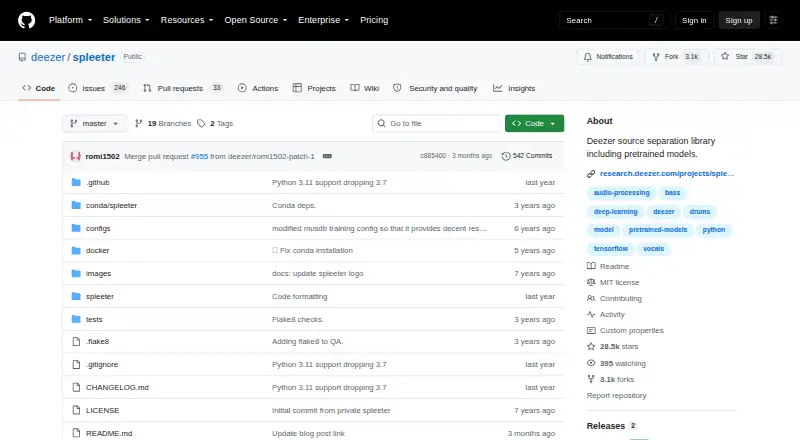
Spleeter is an open-source audio separation library from Deezer. It separates vocals and instruments from audio files and can reconstruct multitracks from a mixed recording. Its pre-trained models produce two stems (vocals and accompaniment), four stems (vocals, drums, bass, and other), or five stems (vocals, drums, bass, piano, and other). Developers with datasets of isolated sources can use the library to train separation models. Written in Python and built on TensorFlow, Spleeter is available through the command line or as a Python library, with installation through pip or use with Docker. Deezer says its four-stem model can process audio 100 times faster than real time on a GPU. Uses include making instrumental tracks, audio restoration and remastering, DJ mixes, and extracting voices for subtitling. The project offers batch processing, WAV export, and API access. Its code is MIT-licensed. A separate enterprise offer, Spleeter Pro, is available as an API and includes faster processing, more accurate separation, and dedicated professional support; companies must contact Deezer for details.
Who it suits
Spleeter Free suits developers who want source separation tools they can run from the command line or use in Python, including those able to install it with pip or Docker. Companies seeking an API integration and dedicated professional support can consider Spleeter Pro.
What it does well
- Pre-trained models create two-, four-, or five-stem outputs.
- Developers can train models using isolated-source datasets.
- Command-line and Python library access are available.
- Supports batch processing and WAV export.
- MIT-licensed code is available as open source.
What to know first
- Using the library requires a developer-oriented setup through pip or Docker.
- The README notes Apple M1 issues related mostly to TensorFlow compatibility.
- Users need rights-owner authorization before processing copyrighted material.
Limits
Spleeter Free is the source separation library with pre-trained models, CLI and Python access, and pip or Docker use. Spleeter Pro is an enterprise API with faster processing, more accurate separation, and dedicated professional support; contact Deezer for details.
Plans
| Plan | Billed and limits | Price |
|---|---|---|
| Spleeter Free | Free, open source · Source separation library · pre-trained models · CLI and Python library · pip or Docker | Free |
| Spleeter Pro | Contact Deezer for details · Enterprise version · available as an API · faster processing · more accurate separation · dedicated professional support | On request |
As github.com lists them, read 9 Oct 2026. The maker's own page has the final word.
Getting started
- Open the Spleeter project website.
- Install the library with pip or use Docker.
- Use Spleeter from the command line or as a Python library.
- Select a pre-trained model for two, four, or five stems, or train a model using isolated-source data.
Verdict
Choose Spleeter Free if you need an open-source library for separating vocals and instruments, with flexible stem counts and Python or command-line access. Companies that need an enterprise API, faster processing, more accurate separation, or dedicated support can ask Deezer about Spleeter Pro. Users processing copyrighted audio must obtain authorization from rights owners.
Questions
How much does Spleeter cost?
Spleeter Free costs nothing. Spleeter Pro pricing is available by contacting Deezer.
What stem types can Spleeter separate?
Its pre-trained models support vocals and accompaniment; vocals, drums, bass, and other; or vocals, drums, bass, piano, and other.
What platforms and access methods does it support?
Spleeter is listed for API, Linux, and self-hosted use. Developers can use it from the command line or as a Python library, and install it with pip or use Docker.
Can developers train their own separation models?
Yes. The library lets developers train models when they have a dataset of isolated sources.
Is Spleeter open source?
Yes. The code is MIT-licensed, and the free plan includes the library and pre-trained models.
Can I use Spleeter with copyrighted audio?
The README says users must obtain authorization from rights owners before processing copyrighted material.
Facts from Spleeter's own pages
- Deployment
- The maker says Spleeter can be installed with pip or used with Docker. · deezer-techservices.com, 9 Oct 2026
- Developer access
- Spleeter is written in Python, uses TensorFlow, and can be used from the command line or as a Python library. · github.com, 9 Oct 2026
- Enterprise offering
- Spleeter Pro is described as an enterprise version available as an API, with contact required to learn more about integration. · deezer-techservices.com, 9 Oct 2026
- Integrations
- The project README names Spleeter 4 Max for Ableton Live and lists professional audio products using its pre-trained models, including iZotope RX 8, Steinberg SpectraLayers 7, Acon Acoustica 7, VirtualDJ, and Algoriddim NeuralMix and djay Pro. · github.com, 9 Oct 2026
- Intended users
- Deezer presents the free library for developers and the Pro offer for companies seeking integration into company tools. · deezer-techservices.com, 9 Oct 2026
- License and rights
- The Spleeter code is MIT-licensed, and the README says users must obtain authorization from rights owners before processing copyrighted material. · github.com, 9 Oct 2026
- Limitations
- The project README notes known Apple M1 issues related mostly to TensorFlow compatibility and provides a workaround. · github.com, 9 Oct 2026
- Performance
- Deezer says the 4-stem separation can run 100 times faster than real time on a GPU. · github.com, 9 Oct 2026
- Purpose
- Spleeter separates vocals and instruments from audio files and can recreate multitracks from a flat audio file. · deezer-techservices.com, 9 Oct 2026
- Security and compliance
- The maker pages reviewed provide no Spleeter-specific security certification or compliance statement. · deezer-techservices.com, 9 Oct 2026
- Separation models
- Pre-trained models support 2 stems (vocals and accompaniment), 4 stems (vocals, drums, bass, and other), and 5 stems (vocals, drums, bass, piano, and other). · research.deezer.com, 9 Oct 2026
- Support
- The commercial offering advertises dedicated professional support, while Deezer says the open-source forks and websites built on Spleeter are not hosted, maintained, or directly supported by Deezer. · github.com, 9 Oct 2026
- Training
- The library lets developers train source separation models when they have a dataset of isolated sources. · research.deezer.com, 9 Oct 2026
- Use cases
- Deezer describes uses including generating instrumental tracks, audio restoration and remastering, DJ mixes, and extracting voice tracks to support subtitling. · deezer-techservices.com, 9 Oct 2026
Where Spleeter stands on Freedom251
- AI Stem Splitters#12 of 26
- Stem Separation Software#13 of 21