Freedom251 › Speaker Management Software

SpeakerWeave
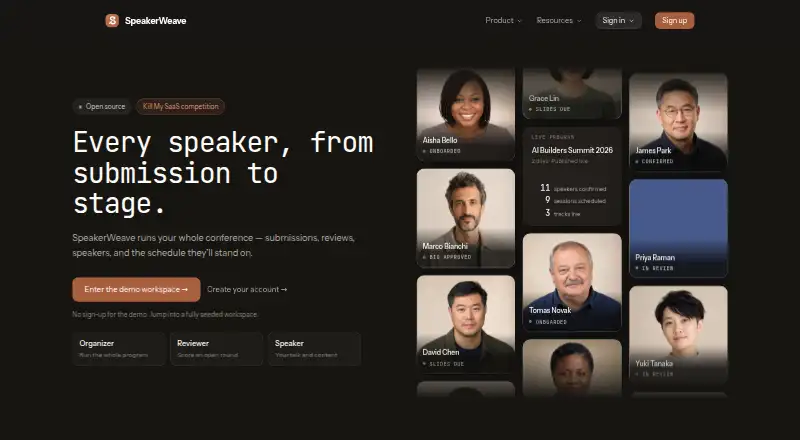
What SpeakerWeave is
SpeakerWeave is an open-source platform for managing conference submissions, reviews, speaker work, scheduling, and publication. Its multi-page form builder offers reusable fields, conditional rules, routing, drafts, and server-side enforcement. Review workflows support weighted, selection, and text criteria, track-aware reviewer assignments, and multiple or anonymized rounds. Optional AI triage allows human overrides, while the in-app AI agent stays off until an OpenAI or Anthropic API key is configured. Speaker records can include event rosters and an organization-wide directory with deduplication, notes, tags, custom fields, saved segments, history, and sourcing tools. The portal handles tasks, uploads, comments, approvals or requested changes, file versions, reminders, and ZIP or CSV exports. An agenda builder supports drag-and-drop scheduling across multi-day room grids, conflict detection, and automatic conflict-free placement. Public programs can include schedule and speaker pages, embeds, JSON feeds, session calendar downloads, and iCal subscriptions. Integrations include Airtable sync, a REST API, a hosted MCP server, and a Slack agent. The MIT-licensed project documents self-hosting with Python, Node.js, PostgreSQL, and Supabase or compatible components.
Who it suits
SpeakerWeave suits conference organizers who need tools for submissions, reviews, speaker coordination, scheduling, and public programs. Its documented self-hosting setup may suit teams prepared to use its listed technical components.
What it does well
- Forms support conditional rules and routing.
- Review workflows include multiple and anonymized rounds.
- Speaker portal tracks files, approvals, and reminders.
- Agenda tools detect and avoid scheduling conflicts.
- MIT License and live demo are available.
What to know first
- AI agent requires an OpenAI or Anthropic API key.
- One deployment binds to one Slack workspace and organization.
- Self-hosting setup uses several technical components.
Limits
The in-app AI agent is off until an OpenAI or Anthropic API key is configured. A deployment's current Slack implementation connects to one Slack workspace and one default organization.
Getting started
- Open the live demo to enter a seeded workspace without signing up
- For self-hosting, prepare Python, Node.js, and PostgreSQL
- Provide Supabase or compatible PostgREST and storage components
- Configure Airtable, REST API, hosted MCP, or Slack integrations as needed
- Add an OpenAI or Anthropic API key to enable the in-app AI agent
Verdict
SpeakerWeave covers a broad conference workflow, from proposals to published programs, with export and integration options. Teams considering self-hosting should account for its documented components and Slack deployment limit.
Questions
Is SpeakerWeave free?
Yes. It is free and open source under the MIT License.
Can I try it without signing up?
Yes. The project links to a live demo with a seeded workspace that visitors can enter without signing up.
What does the platform cover?
It covers calls for papers, reviews, speaker operations, scheduling, and publication, including forms, speaker portals, agendas, and public programs.
Which integrations are documented?
Documented integrations include Airtable sync, a REST API, a hosted MCP server, and a Slack agent.
How is AI enabled?
The in-app AI agent remains off until you configure an OpenAI or Anthropic API key; review triage can then include human overrides.
What is required for self-hosting?
The documented setup uses Python, Node.js, PostgreSQL, and Supabase or compatible PostgREST and storage components.
Facts from SpeakerWeave's own pages
- Agenda
- The agenda builder supports drag-and-drop scheduling, multi-day room grids, live conflict detection, and conflict-free auto-placement. · github.com, 5 Oct 2026
- AI requirements
- The in-app AI agent is off until an OpenAI or Anthropic API key is configured. · github.com, 4 Oct 2026
- API coverage
- Its stable integration API covers events, submissions and sessions, speakers and contacts, schedules, tracks, formats, rooms, content status, and evaluation summaries. · github.com, 5 Oct 2026
- API token handling
- The README says raw API tokens are shown once and only their SHA-256 hashes are stored. · github.com, 4 Oct 2026
- Content workflow
- Speaker portal tasks support uploads, approval and needs-changes states, comments, file version history and restore, reminders, and ZIP or CSV exports. · github.com, 5 Oct 2026
- Demo
- The project links to a live demo where visitors can enter a seeded workspace without signing up. · github.com, 5 Oct 2026
- Forms
- Its call-for-papers tools include a multi-page form builder with reusable fields, conditional rules, routing rules, drafts, and server-side enforcement. · github.com, 5 Oct 2026
- Integrations
- The project documents Airtable sync, a REST API, a hosted MCP server, and an AI agent available in-app and in Slack. · github.com, 5 Oct 2026
- License
- The repository states that SpeakerWeave is available under the MIT License. · github.com, 5 Oct 2026
- Public program
- Public program features include schedule and speaker pages, script and iframe widgets, read-only JSON feeds, per-session calendar downloads, and an iCal subscription feed. · github.com, 5 Oct 2026
- Purpose
- SpeakerWeave is an open-source platform for managing conference programs from calls for papers through review, speaker operations, content collection, scheduling, and publication. · github.com, 5 Oct 2026
- Reviews
- Review workflows support weighted criteria, track-aware reviewer assignment, review windows, multiple and anonymized rounds, decisions, and optional AI first-pass triage with human overrides. · github.com, 5 Oct 2026
- Scheduling and publishing
- The agenda builder offers drag-and-drop scheduling, multi-day room grids, conflict detection, and auto-placement; public programs include schedule and speaker pages, embeds, JSON feeds, and iCal. · github.com, 4 Oct 2026
- Security
- The repository describes organization-scoped API tokens whose raw value is shown once and whose SHA-256 hash is stored; it also says database row-level security is enabled as a backstop to application tenant scoping. · github.com, 5 Oct 2026
- Security architecture
- The README says tenant queries are scoped by organization ID in the application, with database row-level security enabled as a backstop. · github.com, 4 Oct 2026
- Self-hosting
- Self-hosting is documented and requires Python 3.12, Node.js 20, and PostgreSQL; the documented implementation uses Supabase Postgres, PostgREST, and Supabase Storage. · github.com, 5 Oct 2026
- Slack limit
- The current implementation binds one deployment to one Slack workspace and one default organization. · github.com, 4 Oct 2026
- Speaker content
- The speaker portal supports tasks, uploads, comments, approval or requested changes, file versioning, reminders, and ZIP or CSV exports. · github.com, 4 Oct 2026
- Speaker CRM
- The speaker CRM includes event rosters, an organization-wide people directory, deduplication and merge tools, notes, tags, custom fields, saved segments, history, and a sourcing pipeline. · github.com, 5 Oct 2026
- Submission forms
- Its form builder supports multiple pages, reusable fields, conditional rules, routing, drafts, and server-side enforcement. · github.com, 4 Oct 2026
Where SpeakerWeave stands on Freedom251
- Speaker Management Software#28 of 28