Freedom251 › Language learning apps
Sotto
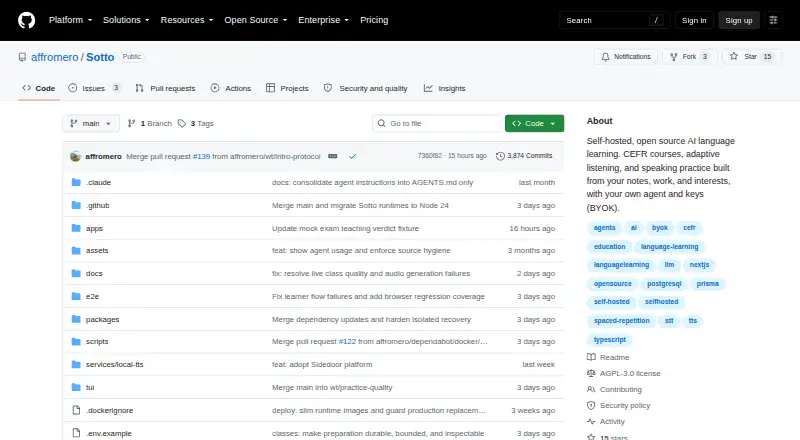
What Sotto is
Sotto is free, open-source, self-hosted language-learning software built around CEFR courses and private rehearsal. Its graded course develops grammar, reading, listening, speaking, and writing, with advancement based on demonstrated mastery; separate skill practice can be used without course gates. An SM-2 vocabulary and grammar memory graph schedules reviews and helps seed adaptive listening. Learners can create classes from articles, papers, YouTube links, or their own interests, with material leveled to a CEFR course and accompanied by citations. Sotto lets operators choose AI, text-to-speech, and speech-to-text providers, including OpenAI, Anthropic, Ollama, faster-whisper, and Kokoro. Gemini Live supports real-time spoken translation, while Claude Code or Codex can work as local agents through an MCP server. A documented configuration runs the language model, speech recognition, and speech generation on the user’s hardware without cloud services. Access includes a browser-installable PWA, Tauri desktop launcher for macOS, Windows, and Linux, terminal client, and iPad workbook PDF. The Self-hosted plan costs nothing under AGPL-3.0; configured AI and speech providers are paid directly by users.
Who it suits
Sotto suits language learners who want structured CEFR progression, adaptive review, and private practice before speaking with teachers, classmates, tutors, or strangers. It also fits operators comfortable running software on their own infrastructure and selecting their own AI and speech providers.
What it does well
- Covers grammar, reading, listening, speaking, and writing
- Uses SM-2 spaced repetition for adaptive review
- Builds leveled classes from personal source material
- Supports fully offline language-learning setups
- Offers web, desktop, terminal, and workbook access
- Licensed free under AGPL-3.0
What to know first
- Users pay configured AI and speech providers directly
- Cloud-sent content follows those providers’ terms
- Windows desktop setup uses WSL2
- Managed hosted offering is planned rather than available
Limits
The Self-hosted plan is free to run, modify, and redistribute, but users pay configured AI and speech providers directly. Mock exams provide practice feedback rather than official scores, and cloud-provider terms apply to content sent to those services.
Plans
| Plan | Billed and limits | Price |
|---|---|---|
| Self-hosted | Free to run, modify, and redistribute under AGPL-3.0 · You pay configured providers directly | Free |
As github.com lists them, read 13 Oct 2026. The maker's own page has the final word.
Getting started
- Open the Sotto GitHub project
- Run the application, database, and files on your own stack
- Configure language-model, speech-recognition, and speech-generation providers
- Choose a browser PWA, desktop launcher, terminal client, or workbook workflow
- Create local learner profiles and optionally enable WebAuthn passkeys
- Build a CEFR class from an article, paper, YouTube link, or topic
Overview
Sotto is an open-source language-learning app built around CEFR courses and practice on infrastructure you control. It will suit learners who want to connect study with their own reading and interests, and who are prepared to run the software themselves. Its structured curriculum and adaptable provider options are compelling; self-hosting and provider costs make it less suited to anyone seeking a ready-to-use service.
Key features
Courses cover grammar, reading, listening, speaking, and writing, with advancement gated by demonstrated mastery. That gives learners a defined path through core skills, while ungated practice lets them work on a particular area without waiting to pass a course milestone. A placement test helps establish a starting point.
Sotto tracks vocabulary and grammar in a per-course memory graph and uses SM-2 spaced repetition to schedule reviews and inform adaptive listening. The link between review and listening gives practice continuity, though the system’s value depends on having a course and practice routine to feed it.
Learners can create classes from articles, papers, YouTube links, or topics, with material leveled to their CEFR course and citations provided. This makes Sotto especially relevant to people who want language study grounded in their work or interests. Its mock exams follow Goethe, DELE, Cambridge English, or general CEFR formats, but provide practice feedback rather than official scores.
AI and speech services are configurable: options include OpenAI and Anthropic API keys, local Claude Code or Codex agents, and local Ollama, faster-whisper, and Kokoro components. Gemini Live supports real-time spoken translation, and an MCP server connects Claude Code or Codex workflows. The breadth is useful for technically confident learners who want control over providers; it also means choosing, configuring, and potentially paying providers is part of the experience.
The application, database, and files run on the operator’s stack. A fully offline setup can keep language-model, speech-recognition, and speech-generation components on the learner’s own hardware. Content sent to configured cloud providers is governed by their terms. Per-account API keys are encrypted at rest using BYOK_ENCRYPTION_KEY. Self-hosted access uses a shared password and local learner profiles, with optional WebAuthn passkeys that an administrator can revoke.
Pricing
| Plan | Price | What it means |
|---|---|---|
| Self-hosted | free | Free to run, modify, and redistribute under AGPL-3.0. Users pay configured AI and speech providers directly. |
There is no software charge for the self-hosted plan, but it is not necessarily cost-free if you use paid provider services. The license also requires redistributed versions to remain under the same terms. A managed hosted offering is planned, so the current choice is for users willing to operate their own setup.
Platforms
Sotto offers an installable browser PWA and a desktop launcher for macOS, Windows, and Linux; Windows setup uses WSL2. Mobile apps are supported, with the web app available on phones and tablets. The maker also provides an iPad workbook PDF for annotation in GoodNotes or another app, and a Rust terminal client with audio playback and microphone recording. The native iPad app targets iPadOS 18 or later.
Who it's for
Sotto is a strong fit for independent learners who want structured CEFR progression, speaking rehearsal, and lessons drawn from personal material without handing their entire application and database to a hosted platform. Its private practice also suits people who want to prepare before speaking with a teacher, tutor, classmate, or stranger. It is a weaker choice for learners who want minimal setup, do not want to manage provider accounts, or need official exam scores.
Pros and cons
- Pro: Mastery-gated courses span five skills, while ungated practice makes it possible to target a skill directly.
- Pro: Spaced repetition informs adaptive listening, and source-based classes connect study to material the learner chooses.
- Pro: Self-hosting and offline components give technically capable users substantial control over where the application and practice run.
- Con: Users must run the infrastructure themselves and may owe configured AI and speech providers directly.
- Con: Windows setup requires WSL2, adding a setup step for Windows learners.
- Con: Mock-exam feedback is for practice, not an official score.
Alternatives
Duolingo is worth choosing instead for a freemium app with Android, iOS, macOS, and web access, plus a free plan and a one-week free trial.
Busuu is another freemium option, with a free plan and Android, iOS, and web platforms; it may suit learners looking for a different app-based route.
Learning with Texts is a free, self-hosted alternative for Linux, macOS, Windows, and web users who can run a local web server with PHP and MySQL.
LingQ may be a better fit for learners who want Android, iOS, web, or browser-extension access and can work within its free membership limits of 20 saved words and phrases, five imported lessons, and one audio playlist.
mLearn offers a free option across mobile, desktop, and browser-extension platforms; its optional cloud features have usage limits, and voice mode with character cloning requires cloud quota.
TextLingo 2 is a freemium alternative across Android, iOS, Linux, macOS, web, and Windows, with a free tier capped by credits, article and novel counts, memorization quota, article segments, and novel size.
LearnEnglish Grammar is a narrower alternative for Android and iOS users looking for free grammar practice; its app includes ads and in-app purchases.
Talkpal may suit learners who want AI conversation practice on Android, iOS, or web, though its free Basic Plan has a 10-minute daily limit.
For more options, browse language learning apps.
Verdict
Choose Sotto if you want a mastery-based CEFR course, adaptive review, and speaking practice built around your own material—and are willing to operate a self-hosted setup. Its strongest advantage is the combination of learner-controlled infrastructure and configurable AI and speech. Look elsewhere if you need a hosted service that is ready without setup, or prefer not to manage provider accounts and possible service charges.
Verdict
Choose Sotto for self-hosted CEFR study with adaptive memory, source-based classes, and configurable speech or AI services. Consider another option if you want a ready-made hosted service or prefer not to manage provider accounts and infrastructure.
Questions
Is Sotto open source?
Yes. It is licensed under AGPL-3.0 and is described as free to run, modify, and redistribute under that license.
What does Sotto cost?
The Self-hosted plan costs nothing. Users pay their configured AI and speech providers directly.
Which platforms are supported?
Sotto documents Android, iOS, Linux, macOS, Windows, self-hosted deployment, web access, a terminal client, and a browser-installable PWA. Windows desktop setup uses WSL2.
Can it work offline?
Yes. A documented setup runs the LLM, speech recognition, and speech generation on the user’s own hardware.
Which providers and integrations are available?
Supported options include OpenAI, Anthropic, Ollama, faster-whisper, Kokoro, and Gemini Live. An MCP server connects Claude Code or Codex workflows.
Does Sotto offer official exam results?
Its practice exams follow Goethe, DELE, Cambridge English, or generic CEFR formats and provide mock feedback, not official scores.
Facts from Sotto's own pages
- Access controls
- Self-hosted setup uses a shared password and local learner profiles, with optional WebAuthn passkeys that an administrator can revoke. · github.com, 13 Oct 2026
- Adaptive practice
- A per-course vocabulary and grammar memory graph uses SM-2 spaced repetition to schedule reviews and seed adaptive listening. · github.com, 12 Oct 2026
- AI and speech providers
- Sotto supports provider-selected AI and speech, including OpenAI and Anthropic API keys, local Claude Code or Codex agents, and local Ollama, faster-whisper, and Kokoro components. · github.com, 12 Oct 2026
- Clients
- Sotto offers a browser-installable web app/PWA, a terminal client, and a desktop launcher for macOS, Windows, and Linux; Windows setup uses WSL2. · github.com, 13 Oct 2026
- Costs
- The software is described as free to run under AGPL-3.0, while users pay their configured AI and speech providers directly. · github.com, 12 Oct 2026
- Course skills
- Its graded classes cover grammar, reading, listening, speaking, and writing, with progression gated by mastery. · github.com, 12 Oct 2026
- Course structure
- Its course covers grammar, reading, listening, speaking, and writing, with progression gated by demonstrated mastery. · github.com, 13 Oct 2026
- Credential security
- The README says provider API keys are encrypted at rest with BYOK_ENCRYPTION_KEY and describes a networkless sidecar for refreshing local CLI credentials. · github.com, 13 Oct 2026
- Data and privacy
- Sotto runs its application, database, and files on the operator's stack; content sent to configured cloud providers is handled under those providers' terms. · github.com, 12 Oct 2026
- Data control
- Users run the application, database, and files on their own stack; content sent to configured cloud providers is subject to those providers’ terms. · github.com, 13 Oct 2026
- Desktop and mobile access
- The maker documents a Tauri desktop launcher for macOS, Windows, and Linux, plus an installable browser PWA for phones, tablets, and laptops. · github.com, 12 Oct 2026
- Free plan
- Yes · github.com, 19 Sept 2026
- Integrations
- The maker documents Gemini Live API for real-time spoken translation and an MCP server for connecting Claude Code or Codex workflows. · github.com, 12 Oct 2026
- Intended audience
- The maker describes Sotto as private rehearsal for learners who want to practice before speaking with a teacher, tutor, classmate, or stranger. · github.com, 12 Oct 2026
- iPad workbook
- The web app generates class workbook PDFs for annotation in GoodNotes or another app, and the README says the native iPad app targets iPadOS 18+. · github.com, 13 Oct 2026
- License and cost
- The project is licensed under AGPL-3.0 and says it is free to run, modify, and redistribute under the same terms; users pay their AI and speech providers directly. · github.com, 13 Oct 2026
- Mobile apps
- Yes · github.com, 19 Sept 2026
- Mock exams
- Practice exams follow Goethe, DELE, Cambridge English, or generic CEFR formats and provide mock feedback, not official scores. · github.com, 13 Oct 2026
- Offline lessons
- Yes · github.com, 19 Sept 2026
- Offline use
- The project documents an optional fully offline setup using a local LLM, speech recognition, and speech generation on the user’s hardware. · github.com, 13 Oct 2026
- Other learning surfaces
- Sotto provides an iPad workbook PDF for annotation and a Rust terminal client with audio playback and microphone recording. · github.com, 12 Oct 2026
- Personalized content
- Learners can build classes from articles, papers, YouTube links, or their interests, with content leveled to their CEFR course and citations provided. · github.com, 12 Oct 2026
- Personalized review
- Yes · github.com, 19 Sept 2026
- Placement test
- Yes · github.com, 19 Sept 2026
Where Sotto stands on Freedom251
- Language learning apps#11 of 278