snapd
What snapd is
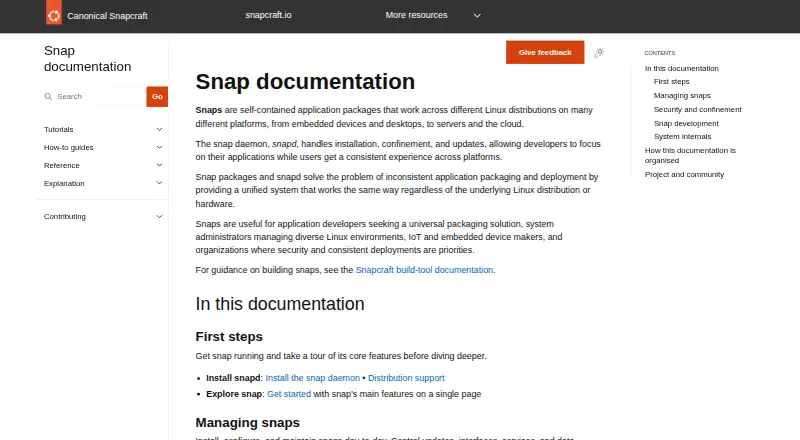
snapd is the background service that manages snaps, self-contained packages for desktop, cloud, and IoT applications. A snap can contain one or more applications and is intended to run across many Linux distributions without dependency changes. Documentation covers Ubuntu, Debian, Fedora, RHEL-family systems, openSUSE, Arch Linux, Manjaro, Gentoo, Solus, and Yocto-based systems; snapd is pre-installed on some systems, including Ubuntu 18.04 and later. Snaps can be installed through the Snap Store or graphical package managers, while advanced functions generally use the Linux shell. snapd handles automatic updates, with refresh settings, channels, revisions, and transactional updates for release control. Strict confinement limits access by default, while interfaces mediate access to resources. Security mechanisms include AppArmor, seccomp, namespaces, and cgroups. A local REST API is available through /run/snapd.socket. The project is free and open source.
Who it suits
It suits application developers, system administrators, IoT and embedded-device makers, and organizations seeking consistent Linux deployments.
What it does well
- Packages work across many Linux distributions
- Automatic updates include refresh controls
- Strict confinement limits system access
- Local REST API exposes daemon functions
- Snaps can be public, private, or unlisted
What to know first
- Ubuntu and Debian packages may lag the latest version
- Fedora does not support snapd re-execution
- Classic snaps require broad access and --classic
Verdict
snapd provides a cross-distribution package format with update controls, confinement, and a local management API. Its distribution policies and Fedora re-execution limitation should be considered when standardizing deployments.
Facts from snapd's own pages
- Automatic updates
- snapd manages snap updates, which can be controlled through refresh settings and related management commands. · snapcraft.io, 12 Oct 2026
- Classic confinement
- Classic snaps have broad system access, require the user to pass --classic when installing, and require store review before distribution through the Snap Store. · snapcraft.io, 12 Oct 2026
- Community support
- The project documentation points users to a Discourse forum and Matrix chat for community support. · snapcraft.io, 12 Oct 2026
- Confinement
- Strict confinement isolates snaps and limits system access by default; additional access can be requested through interfaces. · snapcraft.io, 12 Oct 2026
- Cross-distribution packages
- A snap bundles one or more applications and works without dependencies or modification across many Linux distributions. · snapcraft.io, 12 Oct 2026
- Cross-distribution use
- Snaps are intended to work across different Linux distributions and hardware platforms. · snapcraft.io, 12 Oct 2026
- Dependency resolution
- Yes · snapcraft.io, 21 Sept 2026
- Distribution caveat
- The documentation says snapd re-execution is not supported on Fedora because of ABI incompatibilities, build configuration differences, and distribution policy. · snapcraft.io, 12 Oct 2026
- Distribution version caveat
- Ubuntu and Debian distribution policies mean snapd is not regularly updated to the latest available version in their native packages. · snapcraft.io, 12 Oct 2026
- Installation
- The snap daemon is pre-installed on several distributions, including Ubuntu 18.04 and above, and installation instructions are available for many others. · snapcraft.io, 12 Oct 2026
- Interfaces
- Interfaces mediate access between strictly confined snaps and system resources or other snaps. · snapcraft.io, 12 Oct 2026
- Linux distribution coverage
- The installation guide lists distributions including Ubuntu, Debian, Fedora, Arch Linux, Linux Mint, openSUSE, and Raspberry Pi OS. · snapcraft.io, 12 Oct 2026
- Linux shell
- Snaps can be installed and removed with a graphical package manager, while most advanced functionality is available from the Linux command shell. · snapcraft.io, 12 Oct 2026
- Management API
- snapd provides a REST API for extending snap functionality and interacting with the daemon. · snapcraft.io, 12 Oct 2026
- Offline installation
- Yes · snapcraft.io, 21 Sept 2026
- Package format
- Snaps are self-contained application packages designed for desktop, cloud, and IoT environments. · snapcraft.io, 12 Oct 2026
- Package formats
- snap (.snap) · snapcraft.io, 21 Sept 2026
- Purpose
- snapd is the background service that manages and maintains snaps, which are app packages for desktop, cloud and IoT. · snapcraft.io, 12 Oct 2026
- REST API
- The REST API exposes snapd state and key functions through the local /run/snapd.socket UNIX socket. · snapcraft.io, 12 Oct 2026
- Security components
- snapd configures snap sandboxes using Linux kernel security modules including Seccomp, AppArmor and Cgroups. · snapcraft.io, 12 Oct 2026
- Security mechanisms
- Strict confinement uses Linux kernel security features including AppArmor, seccomp, and namespaces. · snapcraft.io, 12 Oct 2026
- Signed assertions
- Assertions are digitally signed documents used by snapd and the Snap Store for authentication, policy, identification, and validation. · snapcraft.io, 12 Oct 2026
- Snap Store
- Snaps are discoverable and installable through the Snap Store, described as a public app store with an audience of millions. · snapcraft.io, 12 Oct 2026
- Supported platforms
- Linux distributions including Ubuntu,Debian,Fedora,RHEL-family systems,openSUSE,Arch Linux,Manjaro,Gentoo,Solus,and Yocto-based systems · snapcraft.io, 21 Sept 2026
Where snapd stands on Freedom251
- Package Managers#91 of 93