Freedom251 › Online code documentation and reference sites
PEAR
by PEAR
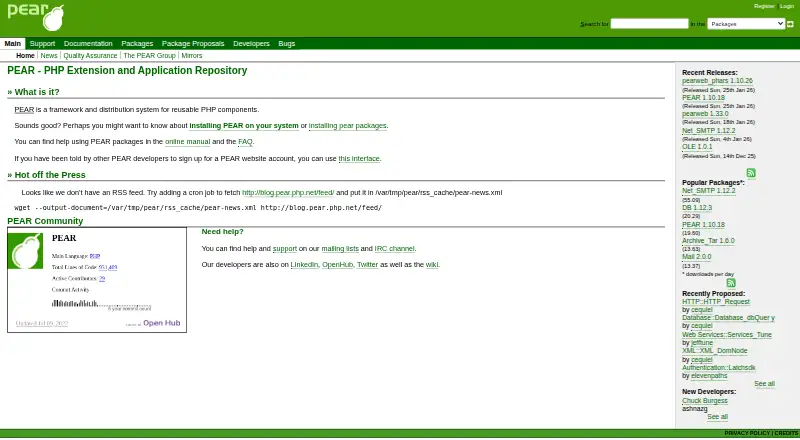
What PEAR is
PEAR is a free, open-source framework and distribution system for reusable PHP components. Its command-line package manager configures PEAR, installs PHP packages, shows package information, and works with distribution channels. The installer can resolve dependencies from a package definition file across development, testing, and production, authenticate to private registries, and install packages offline. Packages are available as PHAR, TAR, TGZ, and ZIP files for Windows, Unix/Linux/BSD, and macOS. The package directory lists 603 packages in areas such as databases, encryption, networking, payment, logging, file formats, XML, and web services. PEAR channels support third-party package distribution, with 80 channels listed. Documentation is centralized and downloadable for offline use in several formats. The project points to a manual, mailing lists, and IRC for support, and lists a Quality Assurance Initiative. The PEAR Group is the governing body. The homepage lists PEAR 1.10.18, released January 25, 2026. PEAR was founded in 1999.
Who it suits
PEAR suits PHP developers who need reusable components, package installation, dependency tracking, and channel-based distribution across supported desktop or self-hosted systems.
What it does well
- Command-line package manager handles installation and package information
- Dependency tracking spans development, test, and production environments
- Offline installation and private registry authentication are supported
- 603 packages cover databases, encryption, networking, and more
- Centralized documentation is downloadable for offline use
What to know first
- Package directory includes filters for older PHP versions
- Installation requires command-line package-manager setup
- Package availability depends on listed PEAR channels
Verdict
PEAR combines a PHP component framework with package management, dependency handling, and channel distribution. Its broad package catalog and offline capabilities suit developers managing reusable PHP code across multiple operating systems.
Facts from PEAR's own pages
- Command line
- The PEAR installer is used from the command line to install packages, get package information, and use channels. · pear.php.net, 11 Oct 2026
- Dependency resolution
- Yes · pear.php.net, 21 Sept 2026
- Dependency tracking
- The installer can track project dependencies from a simple package definition file across development, test, and production environments. · pear.php.net, 12 Oct 2026
- Distribution channels
- PEAR channels provide a way to distribute packages, and the site lists other PHP projects with packages installable through PEAR infrastructure. · pear.php.net, 12 Oct 2026
- Documentation
- PEAR documentation is a centralized place where developers can add package documentation, and offline copies are offered in several archive formats. · pear.php.net, 12 Oct 2026
- Founded
- 1999 · pear.php.net, 28 Sept 2026
- Governance
- The PEAR Group is identified as PEAR’s governing body. · pear.php.net, 11 Oct 2026
- Hosting channels
- The channels page lists software for hosting a PEAR channel, including Chiara_PEAR_Server, SimpleChannelServer, Pirum, and Pearfarm. · pear.php.net, 11 Oct 2026
- Installation
- The manual provides an installation chapter for the PEAR package manager and a separate chapter for Pyrus, the PEAR installer for PHP 5.3+. · pear.php.net, 12 Oct 2026
- Issue reporting
- The PEAR Bug Tracking System provides options to report new bugs and enhancements and links to support channels. · pear.php.net, 12 Oct 2026
- Maintainer organization
- The PEAR Group page describes the group as PEAR's governing body. · pear.php.net, 12 Oct 2026
- Maintenance
- The homepage lists PEAR 1.10.18 as a release dated January 25, 2026. · pear.php.net, 11 Oct 2026
- Offline installation
- Yes · pear.php.net, 21 Sept 2026
- Package catalog
- The package directory lists 603 packages across categories including databases, encryption, networking, and web services. · pear.php.net, 12 Oct 2026
- Package directory filters
- The package directory lets visitors filter packages by PHP 4, PHP 5+, or all PHP versions. · pear.php.net, 12 Oct 2026
- Package examples
- The package directory includes categories for encryption, payment, databases, and web services, among others. · pear.php.net, 12 Oct 2026
- Package formats
- phar,tar,tgz,zip · pear.php.net, 21 Sept 2026
- Package installer
- PEAR includes a command line installer for configuring PEAR, installing packages, viewing package information, and using channels. · pear.php.net, 12 Oct 2026
- Package manager
- PEAR provides a package manager for installing PHP packages. · pear.php.net, 11 Oct 2026
- Package scope
- The package directory includes components for areas such as payment, logging, file formats, and web services. · pear.php.net, 11 Oct 2026
- Private registry auth
- Yes · pear.php.net, 21 Sept 2026
- Purpose
- PEAR is a framework and distribution system for reusable PHP components. · pear.php.net, 12 Oct 2026
- Quality assurance
- The PEAR Quality Assurance Initiative says it is designed to promote quality within PEAR. · pear.php.net, 12 Oct 2026
- Support
- PEAR points users to its manual, mailing lists, and IRC channel for help. · pear.php.net, 12 Oct 2026
Where PEAR stands on Freedom251
- Online code documentation and reference sites#17 of 18
- Package Managers#92 of 93