Freedom251 › Core Banking Software
Skaleet Core Banking Platform
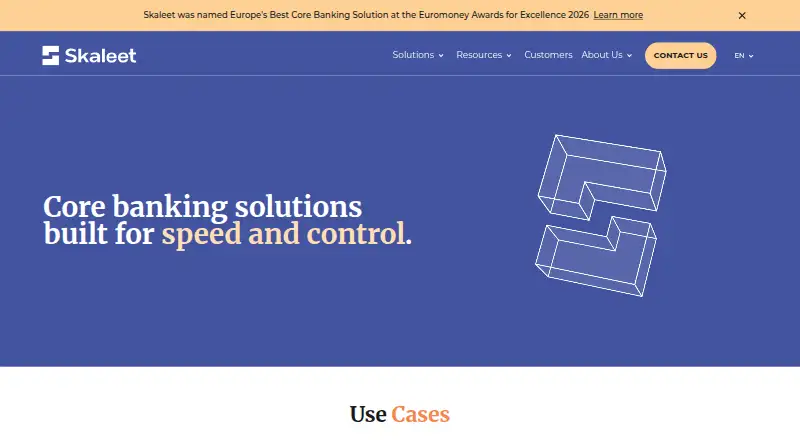
What Skaleet Core Banking Platform is
Skaleet Core Banking Platform is a configurable core banking system for traditional banks, neobanks, payment service providers, and Banking-as-a-Service providers. Its modules cover accounts and cards, payments, loans and savings, customer management, process automation, and connectors. It supports different account types, multi-currency balances, and transaction recording; account products have more than 50 configuration options and pre-integrated KYC solutions. Listed payment methods include credit transfers, direct debits, checks, and debit cards. Customers can use pre-integrated card processors or connect their own through a dedicated API. Skaleet describes the architecture as modular, API-centric, and event-driven, with real-time transaction triggers. White-label mobile and web application fronts are available, though clients may build their own. Deployment options include private cloud using EU-based data centers. Skaleet states that it is ISO 27001 certified and has recorded 99.99% uptime since launch. The advertised implementation window is 4–6 months, with timing dependent on scope and migration. Pricing is on request, and modules and features are tailored to customer needs.
Who it suits
The platform is aimed at banks, neobanks, payment service providers, and Banking-as-a-Service providers that need configurable core banking modules. It may suit organizations planning API integrations and a tailored implementation.
What it does well
- Supports multiple account types and multi-currency balances.
- Account products have more than 50 configuration options.
- Includes pre-integrated KYC solutions.
- Connects with card processors through a dedicated API.
- Offers private-cloud deployment using EU-based data centers.
What to know first
- Pricing is available only on request.
- Advertised implementation takes 4–6 months.
- Implementation timing depends on scope and migration.
Plans
| Plan | Billed and limits | Price |
|---|---|---|
| Custom Skaleet Core Banking Platform | Tailored modules and features selected to customer needs | On request |
As skaleet.com lists them, read 4 Oct 2026. The maker's own page has the final word.
Getting started
- Visit the Skaleet website.
- Contact Skaleet or request a demo to discuss pricing and requirements.
- Select modules and features for the customer configuration.
- Discuss deployment, including the private-cloud option using EU-based data centers.
- Plan implementation around the stated four-to-six-month window and project scope.
Skaleet Core Banking Platform is a configurable banking system for running accounts, payments, lending and related services. It is best suited to banks, neobanks, payment providers and Banking-as-a-Service operators that need modular core systems and application choices. Its breadth and API-led design are compelling, but custom pricing and scope-dependent implementation make it a substantial purchase to plan carefully.
Overview
Skaleet combines accounts and cards, payments, loans and savings, customer management, process automation and connectors in one platform. Its AI-ready positioning is secondary to the practical value of configurable modules, integration paths and deployment choices. That combination fits organizations modernizing core operations or assembling financial products, provided they can define requirements and migration work precisely.
Accounts can be created in different types, hold multi-currency balances and record transactions. More than 50 account-product configuration options and pre-integrated KYC solutions give product teams room to shape offerings without making every variation a bespoke build. The same flexibility means implementation planning matters: the company advertises a four-to-six-month implementation, while a standardized setup may bring a regulated fintech live within four months depending on scope and migration.
Key features
Accounts, lending and payments
The module set covers account and card products, loans, savings, customers, process automation and connectors. Loan management, regulatory reporting and multi-entity support are included in the stated plan. Payment support spans credit transfers, direct debits, checks and debit cards, giving institutions a broad transaction base rather than a single payment rail.
Integration and architecture
Skaleet uses a modular, API-centric and event-driven architecture, with real-time transaction triggers. Customers can adopt pre-integrated card processors or connect their own through a dedicated API. The approach suits institutions that must retain existing systems or assemble a partner ecosystem; it is less attractive to buyers seeking a narrowly scoped, off-the-shelf installation.
The partner ecosystem includes Algoan, AMLyze, ComplyAdvantage, Enfuce, Marqeta, Paymentology, Salt Edge and Sumsub. Skaleet also says the platform integrates with existing systems and third-party services. Updates are released every two months, which can help a long-lived deployment stay current but makes release governance part of operational planning.
Applications, deployment and resilience
The offering includes white-label mobile and web application fronts, while clients may build their own applications. It runs through web, Android and iOS access, APIs and self-hosted deployment; the stated plan is cloud-based. A private-cloud option uses EU-based data centers that Skaleet says are outside the scope of the US Cloud Act, a relevant choice for organizations with data-jurisdiction requirements.
Skaleet states ISO 27001 certification and 99.99% uptime since launch. Its security description includes risk-based controls for confidentiality, integrity and traceability, two production sites, a disaster-recovery site, two backup sites and the French EBIOS-RM method. These are meaningful resilience provisions, although buyers should still align them with their own continuity and regulatory obligations.
Pricing
Custom Skaleet Core Banking Platform
Custom pricing applies to a cloud deployment with tailored modules and features. The plan includes loan management, real-time processing, API access, regulatory reporting and multi-entity support. It fits banks, neobanks, payment service providers and BaaS providers whose product mix or regulatory footprint requires a configured core rather than a fixed package.
There is no published subscription price, seat allowance, usage quota, trial period or renewal term. Prospective customers must contact Skaleet and discuss scope, migration and implementation timing, so total cost cannot be compared directly with open-source alternatives from the plan information alone.
Platforms
Skaleet supports Android, iOS, web, API, self-hosted and cloud deployment options. The white-label fronts are useful for organizations that want customer apps without giving up the option to build their own; API and self-hosted choices support integration-led or controlled operating models.
Who it's for
The clearest fit is a regulated financial organization replacing or extending core systems: traditional banks, neobanks, payment service providers and Banking-as-a-Service providers. It is especially suitable when multi-currency accounts, configurable products, lending, real-time processing and third-party integrations must coexist. Smaller teams wanting a transparent, low-commitment price or a simple single-purpose banking component should look elsewhere.
Pros and cons
Pros
- Broad modular coverage: accounts, cards, payments, lending, savings, customer operations and automation can be combined in one core.
- Deep configuration: more than 50 account-product options and pre-integrated KYC support help tailor products across markets.
- Integration flexibility: APIs, event-driven processing and processor choices support existing-system and partner-led architectures.
- Deployment and resilience choices: cloud, self-hosted and private-cloud approaches sit alongside stated ISO 27001 certification and 99.99% uptime since launch.
Cons
- Budget uncertainty: pricing is custom, with no published seats, quotas, trial or renewal terms.
- Implementation demands: four-to-six-month delivery and scope-dependent migration require substantial planning and stakeholder involvement.
Alternatives
Apache Fineract is the stronger choice when free, open-source software with API, Linux, self-hosted and web support matters more than a vendor-configured service.
Mifos X suits teams wanting an open-source platform with Android, API, self-hosted and web access, plus a free trial sandbox.
Asseco def3000 is another paid option for Linux, web and Windows deployments, with implementation discussed directly with Asseco.
Avaloq is a paid alternative spanning Android, API, iOS, self-hosted and web environments.
CSI NuPoint is a paid platform across Android, API, iOS and web, with pricing handled by CSI.
FIS Data Integrity Manager is a paid, web-based option without a free plan.
Fusion Equation is a paid alternative offered for self-hosted and web deployment.
Oracle Financial Services Anti-Money Laundering is the better match for buyers focused specifically on AML and financial-crime requirements, with scalable pay-per-use subscription pricing.
For a broader comparison, browse the Core Banking Software list.
Verdict
Choose Skaleet when you need a configurable, integration-heavy core spanning accounts, payments, lending and regulatory operations, and can fund a scoped implementation. Look elsewhere if transparent pricing, a short deployment or an open-source foundation is the priority.
Verdict
Skaleet brings account, payment, lending, and automation capabilities into a configurable core banking platform. Buyers will need to contact the company for pricing and discuss implementation scope and timing.
Questions
How is Skaleet priced?
Pricing is on request. Modules and features are tailored to customer needs.
Which organizations is the platform for?
Skaleet identifies traditional banks, neobanks, payment service providers, and Banking-as-a-Service providers as customer segments.
What does the platform include?
Its modules cover accounts and cards, payments, loans and savings, customers, process automation, and connectors.
Can customers use their own card processor?
Yes. Customers can use pre-integrated processors or connect their own through a dedicated API.
What application options are available?
The offering includes white-label mobile and web application fronts. Clients may also build their own applications.
How long does implementation take?
Skaleet advertises implementation in four to six months. Timing depends on scope and migration.
Facts from Skaleet Core Banking Platform's own pages
- Accounts
- The platform supports different account types, multi-currency balances, and transaction recording. · skaleet.com, 4 Oct 2026
- Apps
- The FAQ says the offering includes white-label mobile and web application fronts, and clients may build their own applications. · skaleet.com, 4 Oct 2026
- Architecture
- The platform is described as modular, API-centric, and event-driven, with real-time transaction triggers. · skaleet.com, 4 Oct 2026
- Certification and availability
- The homepage states that Skaleet is ISO 27001 certified and reports 99.99% uptime since launch. · skaleet.com, 4 Oct 2026
- Company
- Skaleet's About page displays 2015 alongside company statistics. · skaleet.com, 4 Oct 2026
- Configuration
- Skaleet states that account products have more than 50 configuration options and pre-integrated KYC solutions. · skaleet.com, 4 Oct 2026
- Customer fit
- The site presents the platform for traditional banks, neobanks, payment service providers, and Banking-as-a-Service providers. · skaleet.com, 4 Oct 2026
- Customers
- The site identifies traditional banks, neobanks, payment service providers, and BaaS providers as customer segments. · skaleet.com, 4 Oct 2026
- Deployment
- Skaleet describes a private-cloud option using EU-based data centers it says are not subject to the US Cloud Act. · skaleet.com, 4 Oct 2026
- Founded
- 2015 · skaleet.com, 28 Sept 2026
- Go-live
- Skaleet says its standardized setup can bring regulated fintech companies live within four months, with timing dependent on scope and migration. · skaleet.com, 4 Oct 2026
- Headquarters
- Boulogne-Billancourt, France · skaleet.com, 28 Sept 2026
- Implementation
- Skaleet advertises implementation in 4–6 months. · skaleet.com, 4 Oct 2026
- Integration
- Skaleet says its API-centric platform integrates with existing systems and third-party services. · skaleet.com, 4 Oct 2026
- Integrations
- Skaleet says customers can use pre-integrated card processors or connect their own through a dedicated API. · skaleet.com, 4 Oct 2026
- Modules
- Its modules cover accounts and cards, payments, loans and savings, customers, process automation, and other connectors. · skaleet.com, 4 Oct 2026
- Partners
- Its partner page lists providers including Algoan, AMLyze, ComplyAdvantage, Enfuce, Marqeta, Paymentology, Salt Edge, and Sumsub. · skaleet.com, 4 Oct 2026
- Payments
- Supported payment methods listed include credit transfers, direct debits, checks, and debit cards. · skaleet.com, 4 Oct 2026
- Pricing
- The product pages reviewed direct visitors to contact Skaleet or request a demo and do not publish a price. · skaleet.com, 4 Oct 2026
- Product
- Skaleet describes its offering as configurable, AI-ready core banking solutions. · skaleet.com, 4 Oct 2026
- Security
- The FAQ describes risk-based security, protections for confidentiality, integrity and traceability, two production sites, a disaster recovery site, two backup sites, and use of the French EBIOS-RM method. · skaleet.com, 4 Oct 2026
- Security and reliability
- Skaleet states that it is ISO 27001 certified and has had 99.99% uptime since launch. · skaleet.com, 4 Oct 2026
- Support
- The site invites visitors to contact Skaleet and book a demo; it does not state support response times or service levels on the pages reviewed. · skaleet.com, 4 Oct 2026
- Updates
- Skaleet says it releases updates every two months. · skaleet.com, 4 Oct 2026
Where Skaleet Core Banking Platform stands on Freedom251
- Core Banking Software#9 of 24
- Banking Systems#9 of 20