Freedom251 › Vulnerability Scanning Software
Sirius
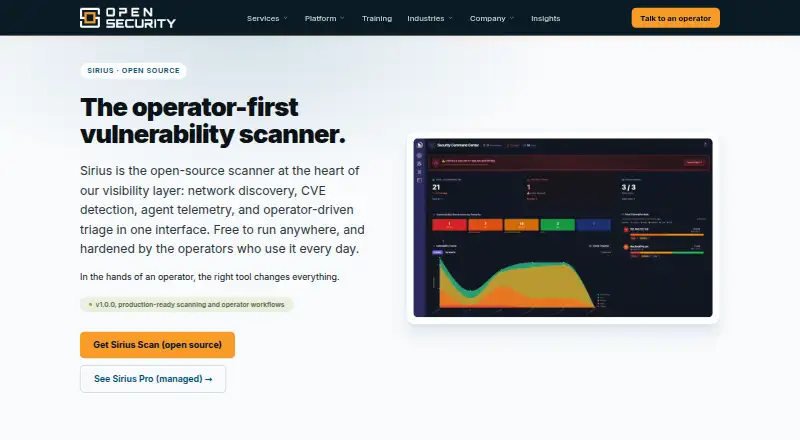
What Sirius is
Sirius is an open-source vulnerability scanner that combines network discovery, CVE detection, agent telemetry, and operator-led triage. Its Vulnerability Navigator organizes findings by severity, supports CVSS filtering and grouped views, and offers export options. The Operator Console supports command execution, command history, and active-agent management. Its scanning pipeline integrates Nmap, Naabu, and agent telemetry, while dashboards cover service health, infrastructure metrics, vulnerability trends, and centralized logging. Sirius can be deployed with Docker Compose in production or development modes. Minimum listed requirements are Docker Engine 20.10.0+ with Compose V2, 4 GB RAM, and 10 GB of free disk space. Supported host systems are Linux, macOS, and Windows through WSL2. REST endpoints on port 9001 are protected by an API key, and documentation links to a REST API reference and Go SDK. Sirius Scan costs nothing for self-hosted Docker use. Community support is available through Discord, GitHub Issues, and GitHub Discussions; enterprise priority support with dedicated channels and SLAs is also described. The project is MIT licensed.
Who it suits
Sirius is presented for security teams that want operator control over scanning and triage. It suits teams able to deploy Docker Compose and meet the stated host requirements.
What it does well
- Combines network discovery, CVE detection, and agent telemetry
- Navigator provides severity and CVSS-based views
- Supports Linux, macOS, and Windows through WSL2
- Self-hosted Sirius Scan costs nothing
What to know first
- Requires Docker Engine 20.10.0+ with Compose V2
- Minimum listed memory is 4 GB
- Minimum listed free disk space is 10 GB
Limits
Sirius Scan is free to run anywhere as a self-hosted Docker deployment. The listed minimum requirements are Docker Engine 20.10.0+ with Compose V2, 4 GB RAM, and 10 GB of free disk space; managed continuous scanning is listed under Sirius Pro.
Plans
| Plan | Billed and limits | Price |
|---|---|---|
| Sirius Scan | Open-source; free to run anywhere · self-hosted with Docker | Free |
| Sirius Pro | Managed continuous scanning · AI-assisted analysis · Active Directory auditing | On request |
As opensecurity.com lists them, read 8 Oct 2026. The maker's own page has the final word.
Getting started
- Open the Sirius website.
- Choose the free Sirius Scan plan for self-hosted Docker use.
- Use a supported host: Linux, macOS, or Windows through WSL2.
- Install Docker Engine 20.10.0+ with Compose V2 and meet the listed memory and disk requirements.
- Deploy with Docker Compose in production or development mode.
- For production, follow the maker's guidance on secrets, exposed ports, TLS, and image updates.
Verdict
Sirius brings scanning, triage, and operational dashboards into a self-hosted package. Check its Docker and host requirements and secure exposed services according to the maker's guidance.
Questions
Is Sirius free?
Sirius Scan costs nothing and is described as open-source and free to run anywhere as self-hosted Docker software.
What platforms does Sirius support?
Its listed platforms include API, Linux, macOS, self-hosted, web, and Windows. Supported host systems are Linux, macOS, and Windows through WSL2.
What are the system requirements?
The minimum requirements are Docker Engine 20.10.0+ with Compose V2, 4 GB RAM, and 10 GB of free disk space.
Is Sirius open source?
Yes. Sirius is described as open-source, and its source repository identifies the project as MIT licensed.
How can users get support?
Community support is available through Discord, GitHub Issues, and GitHub Discussions. Enterprise priority support with dedicated channels and SLA guarantees is also described.
Facts from Sirius's own pages
- API
- Sirius exposes REST endpoints on port 9001 protected by an API key, and the product documentation links to a REST API reference and Go SDK. · github.com, 8 Oct 2026
- Dashboards
- The product provides real-time service health monitoring, infrastructure metrics, vulnerability trends, and centralized logging. · sirius.opensecurity.com, 8 Oct 2026
- Deployment
- Sirius supports installer-first Docker Compose deployment, with production and development modes. · sirius.opensecurity.com, 8 Oct 2026
- Founded
- 2014 · opensecurity.com, 28 Sept 2026
- Headquarters
- San Antonio, Texas · opensecurity.com, 28 Sept 2026
- Intended users
- The product is presented as an operator-focused scanner for security teams that need speed, context, and control. · sirius.opensecurity.com, 8 Oct 2026
- License
- The source repository identifies the project as MIT licensed. · github.com, 8 Oct 2026
- Maker
- Open Security says its operators build and use Sirius and that the company is headquartered in San Antonio. · opensecurity.com, 8 Oct 2026
- Operator console
- The Operator Console supports command execution, command history, and management of active agents. · sirius.opensecurity.com, 8 Oct 2026
- Prioritization
- Its Vulnerability Navigator offers severity distribution, CVSS-based filtering, grouped views, and export options for triage. · sirius.opensecurity.com, 8 Oct 2026
- Purpose
- Sirius is an open-source vulnerability scanner that combines network discovery, CVE detection, agent telemetry, and operator-driven triage. · opensecurity.com, 8 Oct 2026
- Requirements
- The listed minimum requirements are Docker Engine 20.10.0+ with Compose V2, 4 GB RAM, and 10 GB of free disk space. · sirius.opensecurity.com, 8 Oct 2026
- Scanning stack
- The scanning pipeline integrates Nmap, Naabu, and agent telemetry. · sirius.opensecurity.com, 8 Oct 2026
- Security guidance
- The maker recommends rotating secrets, restricting exposed ports, using a reverse proxy with TLS, and keeping images updated for production deployments. · github.com, 8 Oct 2026
- Support
- Community support is available through Discord, GitHub Issues, and GitHub Discussions; the support page also describes enterprise priority support with dedicated channels and SLA guarantees. · sirius.opensecurity.com, 8 Oct 2026
- Supported systems
- The maker lists Linux, macOS, and Windows through WSL2 as supported host systems. · sirius.opensecurity.com, 8 Oct 2026
Where Sirius stands on Freedom251
- Vulnerability Scanning Software#10 of 35