Freedom251 › Container Registries
Singularity Registry Server
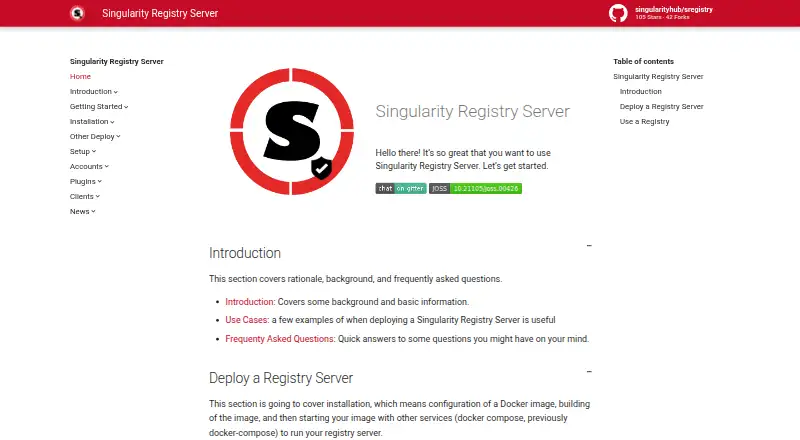
What Singularity Registry Server is
Singularity Registry Server is a free, open source registry for Singularity container images. Users can transfer images with Singularity clients, and the documentation also describes a Curl API. Its web interface supports work with collections. Registries can be kept private and configured to use expiring tokens that can be shared. The server is designed to accommodate different authentication, storage, and build plugins. Included authentication choices are LDAP, PAM, and SAML; other plugins support Globus transfers, Google Cloud build and storage, and a keystore for signing containers. The project describes the software as a non-enterprise option for research scientists. It is self-hosted and requires web access plus a machine able to install and run Docker and Docker Compose. The starter web server setup uses HTTP, and the documentation advises configuring HTTPS properly. The client documentation shows that an image can be pushed unsigned using the `-U` option. Backup planning is left to the deploying institution because storage choices vary. Immutable tags are supported, and the project directs people needing help to open an issue on GitHub.
Who it suits
It suits research scientists or institutions that want to run their own Singularity image registry and manage its storage and deployment. It is presented as a non-enterprise solution.
What it does well
- Free and open source.
- Private registries can use expiring shareable tokens.
- Includes LDAP, PAM, and SAML authentication plugins.
- Supports immutable tags.
What to know first
- Requires a host that can run Docker and Docker Compose.
- The starter web server configuration uses HTTP.
- Storage backup strategy is the institution’s responsibility.
Limits
The free registry is deployed and operated on your own server. The deploying institution handles storage backups, and the starter web server configuration uses HTTP pending proper HTTPS configuration.
Plans
| Plan | Billed and limits | Price |
|---|---|---|
| Singularity Registry Server | Open source registry; deploy and operate on your own server | Free |
As singularityhub.github.io lists them, read 5 Oct 2026. The maker's own page has the final word.
Getting started
- Open the Singularity Registry Server website
- Prepare web access and a host that can install and run Docker and Docker Compose
- Deploy the server on your own host
- Configure HTTPS for the web server
- Use Singularity clients or the documented Curl API to transfer images
Verdict
Singularity Registry Server offers a self-hosted registry with configurable integrations and private access options. Deployment, HTTPS configuration, and backup planning remain responsibilities of the operator.
Questions
Is Singularity Registry Server free?
Yes. It is free and open source, and the plan describes deployment and operation on your own server.
Is it self-hosted?
Yes. It needs web access and a host that can install and run Docker and Docker Compose.
Can a registry be private?
Yes. A registry can be entirely private and can use expiring tokens that can be shared.
Which authentication integrations are included?
Included authentication plugins support LDAP, PAM, and SAML.
How can users transfer container images?
Users can push and pull images with Singularity clients. The documentation also describes a Curl API.
What support does the project offer?
The About page directs users who need help to open an issue on GitHub.
Facts from Singularity Registry Server's own pages
- Authentication integrations
- Included plugins support LDAP, PAM, and SAML authentication. · singularityhub.github.io, 5 Oct 2026
- Backup responsibility
- The documentation leaves storage backup strategy to the deploying institution because storage options vary. · singularityhub.github.io, 5 Oct 2026
- Deployment requirements
- The server needs web access and a host that can install and run Docker and Docker Compose. · singularityhub.github.io, 5 Oct 2026
- Flexible deployment
- The registry is designed to support different authentication, storage, and building plugins. · singularityhub.github.io, 5 Oct 2026
- Image transfers
- Users can push and pull container images using Singularity clients, and the registry also documents a Curl API. · singularityhub.github.io, 5 Oct 2026
- Intended users
- The project describes the registry as a non-enterprise solution catered for research scientists. · singularityhub.github.io, 5 Oct 2026
- Other integrations
- Included plugins provide Globus transfers, Google Cloud build and storage, and a keystore for signing containers. · singularityhub.github.io, 5 Oct 2026
- Private registries
- A registry can be entirely private and can use expiring tokens that can be shared. · singularityhub.github.io, 5 Oct 2026
- Purpose
- Singularity Registry Server is an open source registry for Singularity containers. · singularityhub.github.io, 5 Oct 2026
- Security configuration
- The starter web server configuration uses HTTP, and the documentation advises configuring HTTPS properly. · singularityhub.github.io, 5 Oct 2026
- Signing caveat
- The client documentation shows an unsigned image push using the `-U` option. · singularityhub.github.io, 5 Oct 2026
- Support
- The About page directs users who need help to open an issue on GitHub. · singularityhub.github.io, 5 Oct 2026
- Web interface
- The documentation describes using the interface to interact with collections. · singularityhub.github.io, 5 Oct 2026
Where Singularity Registry Server stands on Freedom251
- Container Registries#21 of 60