Freedom251 › Code Signing Software

SignPath
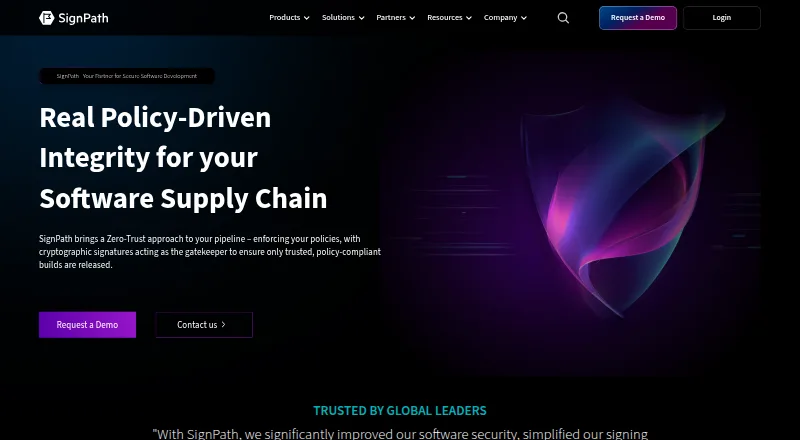
What SignPath is
SignPath provides code signing and software integrity tools to enforce policies across software builds and releases. Its format-aware signing covers executables, packages, installers, containers, scripts, manifests, SBOMs, and configuration files. Before a release is trusted, the platform can check its source repository, branch, build system, approvals, and CI/CD context. It can generate signed, machine-readable attestations, including SLSA provenance, validation summaries, and signed SBOMs. Listed integrations include plugins and REST APIs for GitHub Actions, GitLab, Jenkins, Azure DevOps, and TeamCity. SignPath says private keys stay in FIPS-compliant hardware security modules and are never exposed or shared. Role-based controls specify who may sign particular artifacts, when, and with which certificate. Logs capture the user, file, certificate, policy, and result; reports can be exported, with optional WORM-style archiving. Deployment choices are SaaS, self-hosted, or hybrid. The free Open Source Code Signing plan has eligibility conditions: projects must be actively maintained and released, use an OSI-approved open source license, and have no proprietary components.
Who it suits
SignPath suits development teams and enterprises that need signing policies and integrity checks across builds and releases. Its free plan is specifically for eligible open source projects.
What it does well
- Supports signing across many artifact formats.
- Checks repository, build, approval, and CI/CD context.
- Private keys are held in FIPS-compliant HSMs.
- Offers SaaS, self-hosted, and hybrid deployment.
What to know first
- Free plan requires an eligible open source project.
- Eligible projects must have no proprietary components.
Limits
The free Open Source Code Signing plan is limited to actively maintained, released projects using an OSI-approved open source license without proprietary components.
Plans
| Plan | Billed and limits | Price |
|---|---|---|
| Open Source Code Signing | OSI-approved license · no proprietary code or malware · actively maintained, released and documented project · manual approval for every release | Free |
| Software Integrity Platform | Pricing not published · quote required | On request |
| Code Governance | Pricing not published · quote required | On request |
As signpath.io lists them, read 15 Oct 2026. The maker's own page has the final word.
Getting started
- Visit https://signpath.io/.
- Choose SaaS, self-hosted, or hybrid deployment.
- For the free Open Source Code Signing plan, confirm that the project meets the eligibility conditions.
- Connect a listed CI/CD integration or use the REST API.
- Set signing access controls and approval workflows for artifacts.
Overview
SignPath is a code-signing and release-integrity platform for teams that need signing to depend on build context and approval rules. It is best suited to organizations with CI/CD pipelines and formal release controls; eligible open-source projects can use its free plan. Its strength is connecting signatures with policy checks and traceable records, rather than treating signing as a standalone step.
Key features
Signing for varied artifacts
SignPath supports Windows PE files, PowerShell, MSI, CAB, catalog files, APPX, MSIX, NuGet, Java archives, containers, Linux packages, macOS code, and custom artifacts. Its format-aware signing also covers scripts, manifests, SBOMs, and configuration files. A certificate, cloud signing, and trusted timestamping are included capabilities. That range is useful for teams distributing software in several formats; those with a single, simple signing need may find the policy-focused platform more than they require.
Release policy and access controls
Before trusting a release, SignPath can verify its source repository, branch, build system, approvals, and CI/CD context. Role-based controls set who may sign which artifacts, at what time, and with which certificate. CI/CD signing and approval workflows are supported, with plugins and REST API integrations for GitHub Actions, GitLab, Jenkins, Azure DevOps, and TeamCity. These controls help make signing consistent with a team's release process, but they are most valuable where that process is already defined.
Attestations, keys, and audit records
SignPath can produce signed, machine-readable attestations, including SLSA provenance, validation summaries, and signed SBOMs. The company says private keys remain in FIPS-compliant HSMs and are never exposed or shared. Signing logs record the user, file, certificate, policy, and result; exportable reports and optional WORM-style archiving give compliance teams a way to retain those records. This combination supports traceability, though teams that do not need attestations or audit controls may prefer a narrower signing tool.
Deployment and support
Deployment options are SaaS, self-hosted, and hybrid, giving teams different ways to fit signing into their environment. SignPath provides a support portal and lists [email protected] as a contact address.
Pricing
Open Source Code Signing
The Open Source Code Signing plan costs nothing. It includes a certificate, cloud signing, HSM key protection, trusted timestamping, CI/CD signing, and approval workflows, with support for the artifact types described above. It is a strong fit for qualifying open-source maintainers who want managed signing and release controls without a subscription charge.
Eligibility is limited: the project must be actively maintained and released, use an OSI-approved open-source license, and contain no proprietary components. That makes the free plan unsuitable for proprietary software and not a general free tier for commercial teams. No other plan price is stated; paid requirements call for custom pricing.
Platforms
SignPath supports API, Linux, macOS, self-hosted, web, and Windows environments. The platform's SaaS, self-hosted, and hybrid deployment choices are useful for teams with different infrastructure requirements, while its integrations target several common CI/CD systems.
Who it's for
SignPath suits development and security teams that want artifact signatures governed by build provenance, approvals, and role-based access. Its audit records and attestations also make it relevant to organizations that need evidence of how releases were authorized. Eligible open-source projects are the clearest fit for the free plan. A team looking only for a basic signing command, or a proprietary project seeking free signing, should consider alternatives instead.
Pros and cons
- Pros: Format-aware support spans installers, packages, containers, scripts, SBOMs, and custom artifacts, which suits teams shipping across varied targets.
- Pros: Build-context checks, approval workflows, and role-based access can tie signing permission to release policy.
- Pros: HSM-protected keys, signed attestations, and detailed logs support controlled and auditable releases.
- Pros: SaaS, self-hosted, and hybrid deployment options accommodate different infrastructure choices.
- Cons: The free plan is restricted to actively maintained, released projects with an OSI-approved license and no proprietary components.
- Cons: Teams that need only straightforward signing may not benefit enough from its policy and audit capabilities to justify adopting a broader platform.
Alternatives
Code Signing Software is the broader directory category for comparing signing tools. For an AWS-centered workflow, consider AWS Signer: it is a paid service with a free plan and has no additional charge for use with AWS IoT Device Management, AWS Lambda, Amazon ECR, Amazon EKS, or third-party container services. Teams seeking an open-source tool without a stated hosted service or usage limits can consider Cosign, which is free and has no trial.
OpenPubkey is a free Apache 2.0 reference implementation. SignServer offers a freemium Community plan with basic code, document, and container signing and timestamping, deployed from source code or a container; its free trial may suit readers who want to evaluate that option. Notation is a free Apache 2.0-licensed CLI project. Sigstore is free to use for developers and software providers. For an eligible open-source project requiring manual signing for each release, SignPath Foundation offers a free SignPath.io subscription. Aujas Automated Code Signing Platform uses signing-based licenses with custom pricing.
Verdict
Choose SignPath if your team needs signatures governed by build context, controlled approvals, and auditable release evidence, especially across multiple artifact formats. Eligible open-source projects can get those capabilities at no charge. Look elsewhere if you need free signing for proprietary software or a minimal tool without the policy and compliance layer.
Verdict
SignPath ties artifact signing to build and release policies, with attestations, access controls, and audit logs. Its free plan is restricted to qualifying open source projects.
Questions
How much does SignPath cost?
The Open Source Code Signing plan is free.
Who can use the free plan?
It is for actively maintained, released projects with an OSI-approved open source license and no proprietary components.
Which platforms does SignPath support?
Listed platforms are API, Linux, macOS, self-hosted, web, and Windows.
Does SignPath support CI/CD integrations?
It lists plugins and REST API integrations for GitHub Actions, GitLab, Jenkins, Azure DevOps, and TeamCity.
How does SignPath protect signing keys?
SignPath says private keys are stored in FIPS-compliant HSMs and are never exposed or shared.
Facts from SignPath's own pages
- Access controls
- Role-based access controls define who can sign which artifacts, when, and with which certificate. · signpath.io, 29 Sept 2026
- Attestation
- SignPath can generate signed, machine-readable attestations including SLSA provenance, validation summaries, and signed SBOMs. · signpath.io, 29 Sept 2026
- Audience
- The company says it serves customers worldwide, from small development teams to large enterprises. · signpath.io, 29 Sept 2026
- Auditability
- The service keeps audit trails covering signing operations, approvals, artifact information and policy history. · signpath.io, 15 Oct 2026
- Audit and compliance
- The platform logs signing requests with the user, file, certificate, policy, and result, and offers exportable reports and optional WORM-style log archiving. · signpath.io, 29 Sept 2026
- CI/CD integrations
- Documented trusted build connectors support Jenkins, GitHub, GitLab, Azure DevOps, TeamCity and AppVeyor. · docs.signpath.io, 15 Oct 2026
- Company history
- LinkedIn states that SignPath was founded in 2017 by RUBICON IT and is headquartered in Vienna. · linkedin.com, 15 Oct 2026
- Company legal name
- The provider is SignPath GmbH, registered in Vienna, Austria. · signpath.io, 15 Oct 2026
- Company size
- LinkedIn lists SignPath GmbH as a privately held company with 51–200 employees. · linkedin.com, 15 Oct 2026
- Container signing
- Container images can be signed through Notation, Cosign, GPG or the REST API, with OCI layout and registry workflows documented. · docs.signpath.io, 15 Oct 2026
- Crypto providers
- Crypto providers expose PKCS#11 on Windows/Linux, Windows KSP and macOS CryptoTokenKit so standard signing tools can use SignPath keys. · docs.signpath.io, 15 Oct 2026
- Deployment
- SignPath describes its deployment options as SaaS, self-hosted, or hybrid. · signpath.io, 29 Sept 2026
- Deployment models
- SignPath is offered as managed SaaS, self-hosted software or a hybrid deployment. · signpath.io, 15 Oct 2026
- Documentation scope
- The documentation covers certificates, users, projects, artifact configuration, containers, build integrations, provenance, pipeline policies, attestations, PowerShell and crypto providers. · docs.signpath.io, 15 Oct 2026
- Downloads
- Official downloads include Linux and Windows x64 packages, a Windows MSI provider, a Notation plugin and a macOS DMG. · docs.signpath.io, 15 Oct 2026
- Foundation key custody
- For qualifying open-source projects, the Foundation generates and stores the certificate private key in an HSM and provides the service without charge. · signpath.org, 15 Oct 2026
- Founded
- 2017 · signpath.io, 23 Sept 2026
- Funding
- Nordic9 reported a €5 million Series A led by TIN Capital on December 10, 2024. · nordic9.com, 15 Oct 2026
- Headquarters
- Vienna, Austria · signpath.io, 23 Sept 2026
- Integrations
- The company lists plugins and REST API integrations for GitHub Actions, GitLab, Jenkins, Azure DevOps, and TeamCity. · signpath.io, 29 Sept 2026
- Key protection
- Private keys remain in SignPath-managed or customer-managed HSMs; the architecture page states FIPS 140-2 Level 3 compliance. · signpath.io, 15 Oct 2026
- Key security
- SignPath says private keys are stored in FIPS-compliant HSMs and are never exposed or shared. · signpath.io, 29 Sept 2026
- Limit: API use
- SignPath terms allow suspension of API access for abuse or excessive request frequency. · signpath.io, 15 Oct 2026
- Limit: billing
- Paid subscriptions are billed in advance and are stated to be non-refundable. · signpath.io, 15 Oct 2026
Where SignPath stands on Freedom251
- Code Signing Software#7 of 28