Freedom251 › Container Build Tools
Shipwright
What Shipwright is
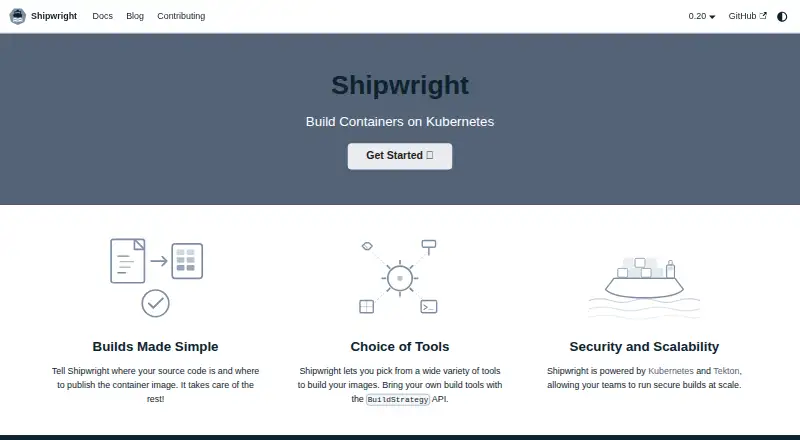
Shipwright is an open-source framework for building container images on Kubernetes. A Build specifies source code, an output image, and a build strategy, while a BuildRun invokes that build. Sources can come from Git, OCI, or local locations. Documented strategies include Buildah, Buildpacks-v3, BuildKit, Kaniko, ko, and Source-to-Image, and teams can define shared strategies with BuildStrategy and ClusterBuildStrategy resources. Generated images can be pushed to a container registry using an existing secret, and builds can enable vulnerability scanning. Kubernetes secrets can also handle Git authentication and registry credentials. Shipwright supports tools such as Kaniko, Cloud Native Buildpacks, and Buildah, and is powered by Kubernetes and Tekton. Installation requires Kubernetes 1.32 or later and Tekton Pipelines 0.68 or later. APIs and controllers can be installed from a release deployment or operator; direct manifest installation requires cluster administrator permissions. CLI installation instructions cover Windows, Mac, and Linux.
Who it suits
It suits teams building container images within Kubernetes and needing selectable or custom build strategies. It is also relevant to users managing registry credentials, image scanning, or multi-architecture builds.
What it does well
- Supports Git, OCI, and local sources
- Several documented build strategies
- Custom strategies can be shared
- Registry output using existing secrets
- Multi-architecture builds and multiple cache backends
What to know first
- Requires Kubernetes 1.32 or later
- Requires Tekton Pipelines 0.68 or later
- Direct manifest installation needs administrator permissions
- No SBOM generation
Limits
Shipwright requires Kubernetes 1.32 or later and Tekton Pipelines 0.68 or later. Installing directly from a Kubernetes manifest requires cluster administrator permissions, and SBOM generation is unavailable.
Getting started
- Prepare a Kubernetes 1.32-or-later cluster with Tekton Pipelines 0.68-or-later
- Install the Build APIs and controllers from a release deployment or operator
- Choose a CLI installation path for Windows, macOS, or Linux if needed
- Define a Build with source, output image, strategy, and invocation
- Create or select a BuildRun to invoke the build
- Provide Kubernetes secrets for Git access or registry credentials when required
Verdict
Shipwright provides Kubernetes-native APIs for repeatable container image builds with flexible strategies and secret handling. Its prerequisites and administrator requirement matter when planning deployment.
Questions
Is Shipwright open source?
Yes. Shipwright is offered as open-source software.
Which platforms are supported?
The listed platforms are API, Linux, macOS, self-hosted, and Windows.
What source types can builds use?
Builds can take Git, OCI, or local sources.
Can it push images to a registry?
Yes. A build can push its generated image using an existing secret for registry access.
Does Shipwright support vulnerability scanning?
A build can enable vulnerability scanning for its generated image.
How can it be installed?
The APIs and controllers can come from a release deployment or an operator.
Facts from Shipwright's own pages
- Authentication
- Builds can use Kubernetes secrets for Git authentication and container registry credentials. · shipwright.io, 9 Oct 2026
- Build APIs
- Its core APIs define Builds, BuildStrategies, ClusterBuildStrategies, and BuildRuns. · shipwright.io, 9 Oct 2026
- Build configuration
- A build is configured with source code, an output image, a build strategy, and an invocation. · shipwright.io, 9 Oct 2026
- Build strategies
- Documented strategies include Buildah, Buildpacks-v3, BuildKit, Kaniko, ko, and Source-to-Image. · shipwright.io, 9 Oct 2026
- Build tools
- The documented build strategies include Buildah, Buildpacks-v3, BuildKit, Kaniko, ko, and Source-to-Image. · shipwright.io, 9 Oct 2026
- Build workflow
- A Build defines the source code, output image, and build strategy, while a BuildRun invokes the build. · shipwright.io, 9 Oct 2026
- CLI platforms
- The project documents CLI installation instructions for Windows, Mac, and Linux. · shipwright.io, 9 Oct 2026
- Custom strategies
- Shipwright lets teams define and share build tools through BuildStrategy and ClusterBuildStrategy resources. · shipwright.io, 9 Oct 2026
- Deployment requirement
- Installing Shipwright directly from its Kubernetes manifest requires cluster administrator permissions. · shipwright.io, 9 Oct 2026
- Installation
- Shipwright Build APIs and controllers can be installed from a release deployment or with an operator. · shipwright.io, 9 Oct 2026
- Integrations
- Installation requires Kubernetes 1.32 or later and Tekton Pipelines v0.68 or later. · shipwright.io, 9 Oct 2026
- Kubernetes requirement
- The installation documentation lists Kubernetes 1.32 or later and Tekton Pipelines v0.68 or later as prerequisites. · shipwright.io, 9 Oct 2026
- Project identity
- The site identifies Shipwright as a project of a Series of LF Projects, LLC. · shipwright.io, 9 Oct 2026
- Purpose
- Shipwright is an extensible framework for building container images on Kubernetes. · shipwright.io, 9 Oct 2026
- Registry output
- Builds can push generated images to a container registry using an existing secret for registry access. · shipwright.io, 9 Oct 2026
- Security feature
- A build can enable vulnerability scanning for its generated image. · shipwright.io, 9 Oct 2026
- Sources and outputs
- Builds can use Git, OCI, or local sources and specify a destination image. · shipwright.io, 9 Oct 2026
- Source types
- Supported build source types include Git, OCI, and Local. · shipwright.io, 9 Oct 2026
- Support
- The project lists a user mailing list, developer mailing list, and Kubernetes Slack as community channels. · shipwright.io, 9 Oct 2026
- What it does
- Shipwright is an extensible framework for building container images on Kubernetes. · shipwright.io, 9 Oct 2026
Where Shipwright stands on Freedom251
- Container Build Tools#32 of 34