Freedom251 › AI Image Annotation Tools
Segments.ai
What Segments.ai is
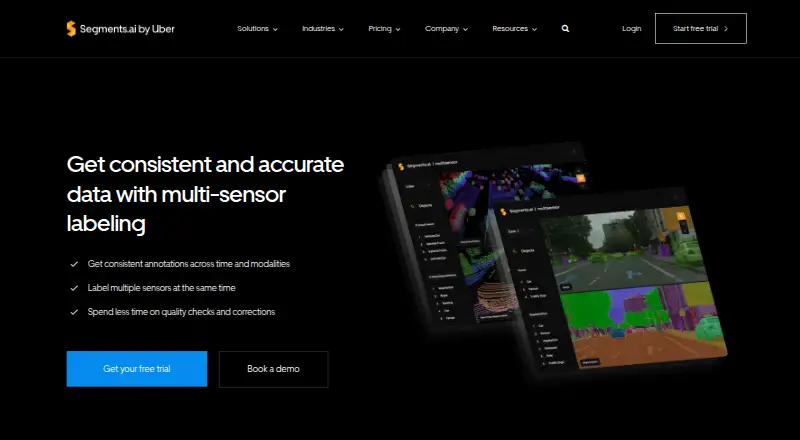
Segments.ai is a multi-sensor data labeling platform for robotics and autonomous vehicle teams. It supports image and point-cloud annotation with segmentation, cuboids, bounding boxes, keypoints, polygons, and polylines. Users can view 2D images and 3D point clouds together and project labels between sensors. For sequences, Batch Mode, merged point clouds, interpolation, and automated tracking support labeling across objects and frames. Image tools include Superpixel, Autosegment, hover-and-click segmentation, and model predictions that teams can review and correct. Its Python SDK supports uploads, label downloads, dataset management, and webhooks; TensorFlow and PyTorch are named integrations. Segments.ai is available through web and API access. The company describes it as designed for computer vision engineers and data scientists working in autonomous robotics and driving, and says it launched in 2020. A free academic license is available for non-commercial research; Core, Fusion, and Enterprise use custom quotes. Core point clouds are limited to 500,000 points each; Fusion allows unlimited size and resolution.
Who it suits
Segments.ai suits computer vision engineers and data scientists working in autonomous robotics and driving. Its multi-sensor and sequence tools are relevant to teams labeling image and point-cloud datasets.
What it does well
- Annotates images and point clouds
- Projects labels between sensors
- Includes sequence labeling tools
- Python SDK supports webhooks
- Free academic license for non-commercial research
What to know first
- Core point clouds limited to 500,000 points each
- Core, Fusion, and Enterprise require custom quotes
- Academic license requires a license request
Limits
The free academic license is for non-commercial academic research and requires a license request. Core starts at 3,600 labeling hours per year and limits each point cloud to 500,000 points; Fusion starts at 5,000 hours per year and includes point clouds and images of unlimited size and resolution. Enterprise includes 150,000 additional labeling hours per year.
Plans
| Plan | Billed and limits | Price |
|---|---|---|
| Academic license | 100% free for non-commercial academic research · For students and researchers with non-commercial academic use · License request required | Free |
| Core | Custom quote; starting at 3,600 hours/year (equivalent to $2.67/hour) · Unlimited seats · Unlimited projects · Unlimited images and point clouds · Unlimited API and SDK access · Point clouds up to 500,000 points each · ML labeling tools · Cloud bucket integrations · QA and organization management | On request |
| Fusion | Custom quote; starting at 5,000 hours/year · Unlimited seats · Unlimited projects · Unlimited images and point clouds · Unlimited API and SDK access · Unlimited-size point clouds and images · Sensor fusion interfaces · Webhooks · Priority support · Metrics dashboard · Labeling workforce access · Mail, Slack and Discord support | On request |
| Enterprise | Custom quote; includes 150,000+ hours/year · Unlimited seats · Unlimited projects · Unlimited images and point clouds · Unlimited API and SDK access · Custom interfaces · Custom pipelines and workflows · Technical-roadmap influence · Custom security solutions | On request |
As segments.ai lists them, read 8 Oct 2026. The maker's own page has the final word.
Getting started
- Visit https://segments.ai/.
- Request the free academic license if your work is non-commercial academic research.
- Request a custom quote for Core, Enterprise or Fusion.
- Use the web platform or API to work with datasets.
- Use the Python SDK for programmatic uploads, label downloads, dataset management and webhooks.
Verdict
Segments.ai combines image and point-cloud annotation with tools for multi-sensor and sequence workflows. Teams should weigh the Core point-cloud limit and request a quote for commercial plans.
Questions
Is Segments.ai free?
A free academic license is available for students and researchers doing non-commercial academic research. A license request is required.
How much do the paid plans cost?
Core, Enterprise and Fusion are offered by custom quote. Core starts at 3,600 labeling hours per year, and Fusion starts at 5,000 hours per year.
Does Segments.ai offer a trial?
Yes. A 14-day trial is offered.
Which platforms can I use?
The listed access options are web and API.
What annotation types does it support?
It supports segmentation, bounding boxes, polygons, polylines, keypoints and cuboids for image and point-cloud labeling.
What integrations and exports are available?
The integrations page names TensorFlow and PyTorch. Dataset exports include JSON, PyTorch, TensorFlow and Hugging Face formats.
Facts from Segments.ai's own pages
- 2D and 3D annotation
- The platform supports image and point-cloud labeling with segmentation, cuboids, bounding boxes, keypoints, polygons, and polylines. · segments.ai, 8 Oct 2026
- 2D annotation tools
- Image labeling supports semantic, instance and panoptic segmentation plus bounding boxes, polygons, polylines, keypoints, superpixels, Autosegment and hover-and-click tools. · segments.ai, 15 Oct 2026
- 3D point-cloud tools
- 3D workflows include cuboids, segmentation, keypoints, polygons, polylines, merged point-cloud mode, batch mode and automated tracking. · segments.ai, 15 Oct 2026
- 3D sequence tools
- Batch Mode, merged point clouds, interpolation, and automated tracking support labeling objects across sequences. · segments.ai, 8 Oct 2026
- API scope
- The documented API covers datasets, samples, labels, labelsets and releases for programmatic annotation workflows. · docs.segments.ai, 15 Oct 2026
- Asset upload limit
- The platform's own asset-storage service limits uploaded files to 100 MB and stores them in an AWS S3 bucket in London. · docs.segments.ai, 15 Oct 2026
- Cloud integrations
- Documentation describes AWS S3 cross-account access, Azure Blob Link Service and keeping assets in customer-managed cloud buckets. · docs.segments.ai, 15 Oct 2026
- Cloud storage
- The Core plan includes cloud bucket integrations. · segments.ai, 8 Oct 2026
- Company history
- Segments.ai says it launched in 2020 as a data labeling solution designed for segmentation. · segments.ai, 8 Oct 2026
- Company size and base
- LinkedIn lists Segments.ai by Uber as a Leuven, Belgium software-development company with 11–50 employees and a 2020 founding year. · linkedin.com, 15 Oct 2026
- Customer-controlled storage
- For production, documentation recommends retaining data in the customer's own bucket and sending URLs, including presigned or cross-account URLs. · docs.segments.ai, 15 Oct 2026
- Documentation coverage
- The documentation includes getting-started tutorials, API reference, API-key setup, import guidance, cloud integrations and Python SDK instructions. · docs.segments.ai, 15 Oct 2026
- Enterprise access
- Enterprise includes SSO and MFA, custom security solutions, and a dedicated solutions ML engineer. · segments.ai, 8 Oct 2026
- Founded
- 2020 · segments.ai, 28 Sept 2026
- Founders
- Y Combinator identifies Otto Debals and Bert De Brabandere as founders; Crunchbase also lists Davy Neven among the founders. · ycombinator.com, 15 Oct 2026
- Funding
- Y Combinator says the company was funded in 2021 by Y Combinator, Merus Capital and Volta Ventures. · ycombinator.com, 15 Oct 2026
- GetApp listing
- GetApp's October 2026 listing shows no user reviews and a 0.0 score for ease of use, features, value and support. · getapp.com, 15 Oct 2026
- Integrations
- The Python SDK supports programmatic data upload, label downloads, dataset management, and webhooks; the integrations page names TensorFlow and PyTorch. · segments.ai, 8 Oct 2026
- Intended users
- The company describes the product as designed for computer vision engineers and data scientists working in autonomous robotics and driving. · segments.ai, 8 Oct 2026
- Legal entity
- Crunchbase identifies the legal name as Segments.ai BV and lists Leuven, Belgium as headquarters. · crunchbase.com, 15 Oct 2026
- Limit: heavy 3D workloads
- Individual G2 reviews report slow or stuck 3D visualization on computationally heavy or large point-cloud sequences. · g2.com, 15 Oct 2026
- Limit: learning curve
- G2 review summaries repeatedly mention a steep learning curve for newcomers, complex features and insufficient guidance. · g2.com, 15 Oct 2026
- Limit: training and exports
- G2 reviewers report limited tutorials, a lack of training material and a desire for better direct web export options. · g2.com, 15 Oct 2026
- ML-assisted labeling
- Image tools include Superpixel, Autosegment, hover-and-click segmentation, and uploaded model predictions for review and correction. · segments.ai, 8 Oct 2026
Where Segments.ai stands on Freedom251
- AI Image Annotation Tools#12 of 24
- Image Annotation Software#16 of 28
- Data Labeling Software#15 of 24