Freedom251 › Container Tracking Software

SeaRates Container Tracking
What SeaRates Container Tracking is
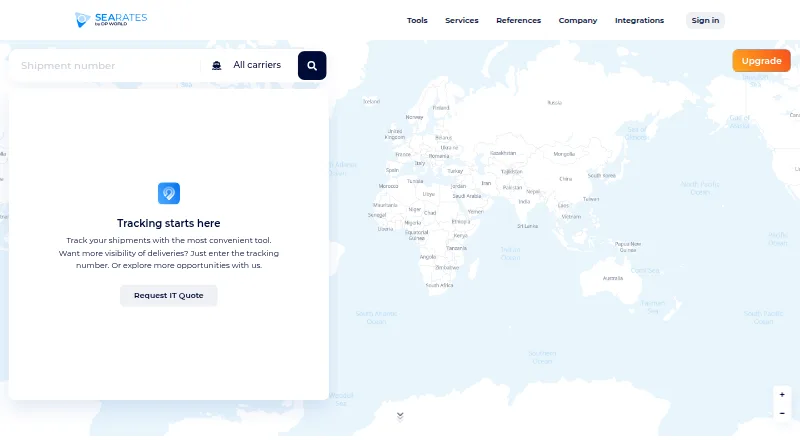
SeaRates Container Tracking helps follow sea shipments using a container number, Bill of Lading, or booking reference. It displays shipment status and location on a world map, with estimated arrival insights. The system calculates storage time in transshipment ports and can send alerts for logistics status events, departures, arrivals, delays, and early delivery. SeaRates says it uses Automatic Identification System data from ships, satellites, and port stations to support shipment visibility and arrival estimates. The online tracking tool is available to try free, and the listing includes a free plan and a 72-day trial. Platforms include web, Android, and iOS. For business workflows, the API can connect tracking data to a TMS, ERP, or other software, or pass status events to a website. The tracking system can be embedded on a website using an HTML element and JavaScript widget with a platform ID. The API uses HTTPS endpoints and API keys, with a documented general quota of 100 requests per 20 seconds per organization. SeaRates provides daily updates; customers can contact an account manager for more frequent updates. SeaRates was founded in August 2005 and advertises logistics expert support around the clock, every day of the year.
Who it suits
SeaRates Container Tracking suits people who need to check sea shipment location, status, port storage time, or estimated arrival. Logistics providers and businesses can use its API or website integration to offer tracking to customers and connect shipment data with a TMS, ERP, or other software.
What it does well
- Track shipments by container number, Bill of Lading, or booking reference.
- View positions on a world map and calculate transshipment port storage time.
- Receive alerts for delays, early delivery, departures, arrivals, and status events.
- Connect tracking data to websites, TMS, ERP, or other software.
- Use the service on web, Android, and iOS.
- SeaRates advertises support 24 hours a day, every day of the year.
What to know first
- Tracking updates are provided daily; more frequent updates require contacting an account manager.
- The API has a documented general quota of 100 requests per 20 seconds per organization.
- API access is usage-based, and no price is provided here.
Limits
The online tool is described as free to try, with a free plan and a 72-day trial. API use is usage-based; the documented general quota is 100 requests per 20 seconds per organization, and updates are daily unless more frequent updates are arranged with an account manager.
Plans
| Plan | Billed and limits | Price |
|---|---|---|
| Container Tracking API | Monthly or yearly billing periods are offered; pricing is per-container usage, with volume discounts for annual commitments. · Usage-based; additional frequency available by contacting an account manager | On request |
As searates.com lists them, read 30 Sept 2026. The maker's own page has the final word.
Getting started
- Open the SeaRates Container Tracking website.
- Choose web, Android, iOS, or API access for your use case.
- For a shipment lookup, enter its container number, Bill of Lading, or booking reference.
- For API use, obtain an API key and send requests over HTTPS.
- For website tracking, embed the system with an HTML element and JavaScript widget using a platform ID, or pass status events to the site.
SeaRates Container Tracking is a sea-freight visibility service that follows containers, bookings, and bills of lading from a browser, phone, or connected business system. It is best suited to shippers and logistics providers that need map-based status, port-storage context, alerts, or a branded tracking experience for customers. Its broad integration options are a strength, while daily updates and usage-based API pricing can be limiting for high-frequency or budget-sensitive operations.
Overview
Enter a container number, Bill of Lading, or booking reference to see shipment status and location. The service combines route visibility, world-map positioning, port activity, and estimated arrival information for ocean and intermodal movements. SeaRates says its estimates use Automatic Identification System data from ships, satellites, and port stations, and its coverage claim spans 97% of worldwide shipping through more than 180 providers, including carriers, NVOCCs, ports, terminals, and leasing companies.
A storage-time calculation for transshipment ports adds practical context when cargo is between sailings. SeaRates also advertises logistics-expert support 24 hours a day, 7 days a week, 365 days a year. The company says it was founded in August 2005. Its privacy policy identifies DP World Logistics FZE as the GDPR data controller.
Key features
Tracking and operational context
Lookups are flexible because a team can use a container, booking, or bill-of-lading reference. Map positioning and route information make a status easier to interpret than a text-only event stream. ETA predictions and intermodal tracking help when a shipment involves more than the ocean leg, although SeaRates describes standard updates as daily; customers needing more frequent data must contact an account manager.
Alerts
Notifications cover logistics status events, departures, arrivals, delays, and early delivery. That range favors teams managing exceptions and customer promises, but daily source updates may leave time-critical users wanting a faster cadence.
Website and API integration
The API can send container or Bill of Lading events to a website, TMS, ERP, or other software. A documented HTML element and JavaScript widget support an embedded, white-label tracking experience, useful for logistics providers trying to retain customers inside their own portal. HTTPS-only endpoints and API-key authentication provide a straightforward security model. The general quota is 100 requests per 20 seconds per organization, and SeaRates notes that quotas can change.
SeaRates says a request needs only a container, booking, or Bill of Lading number, without requiring sensitive business information to be received or stored. That reduces the data a basic integration must pass, but implementation still depends on your own platform and usage design.
Pricing
SeaRates uses a freemium model. The online tracker is free to try and includes a 72-day trial. The Container Tracking API has custom pricing rather than a published amount, with monthly or yearly billing periods and usage-based, per-container charges. Annual commitments can receive volume discounts, and additional update frequency is available by contacting an account manager.
The free web access fits occasional lookups and teams evaluating coverage. API buyers should budget around shipment volume and confirm the price of higher-frequency updates before building a customer-facing workflow. Because the API price is not shown, it is harder to compare total cost in advance than with a fixed-credit service.
Platforms
Access is available on web, Android, and iOS, with API connectivity for software integrations. The mobile app synchronizes with a laptop and provides live updates and instant notifications, while SaaS and white-label web options support customer portals.
Who it's for
SeaRates is a strong fit for logistics service providers that want to add multi-tracking to their websites, connect events to a TMS or ERP, and give customers branded visibility. Shippers with mixed ocean and intermodal moves also benefit from the combination of ETA, map location, port-storage calculations, and exception alerts. It is a weaker fit for operations that require sub-daily updates by default or need a public API price before committing.
Pros and cons
- Pro: Multiple reference types—container, Bill of Lading, or booking—make shipment lookup practical across different workflows.
- Pro: Map positions, AIS-backed estimates, and transshipment storage calculations provide more operational context than basic status tracking.
- Pro: Website widgets, white-label integrations, and API connections let logistics providers expose tracking under their own service.
- Pro: Alerts include delays, early delivery, departure, arrival, and other logistics events.
- Con: Standard updates are daily, so users needing more frequent visibility must negotiate with an account manager.
- Con: API pricing is usage-based and unpublished, making cost planning difficult until SeaRates supplies a subscription offer.
- Con: API quotas may change, so high-volume integrations need ongoing capacity checks.
Alternatives
Choose Hapag-Lloyd Live Position if you prefer a carrier-specific live-position service with a free Carrier Haulage option and paid Merchant Haulage pricing. Mati Logistics suits smaller users wanting a free tier for 10 shipments, while API access requires a paid arrangement.
Panvaya Ocean Container Tracking is worth considering for five free ocean shipments plus AIS vessel tracking, congestion monitoring, and route planning. Terminal49 fits teams that can stay within 10 active containers, three users, and basic notifications on its free-forever plan. Tracktainer offers three free tracking credits forever, with volume pricing from $1.00 per month and a 10-credit minimum.
project44 Ocean Visibility, Shippeo, and GoComet are paid alternatives for organizations evaluating broader visibility platforms.
Verdict
Choose SeaRates Container Tracking when you need ocean or intermodal shipment visibility that can be embedded in a website or connected to business software, with map locations, ETA insight, storage calculations, and broad event alerts. Look elsewhere if frequent updates are essential or if you need transparent API pricing and fixed quotas before purchase.
Verdict
Choose SeaRates Container Tracking if you need sea shipment visibility with map locations, arrival insights, port storage calculations, or customer-facing website and API integration. Its web and mobile access and shipment alerts cover common tracking needs. Businesses that need more frequent updates should contact an account manager, and API buyers should account for usage-based pricing and the documented request quota.
Questions
What does SeaRates Container Tracking track?
It tracks sea shipments and shows their location and status using a container number, Bill of Lading, or booking reference.
Which platforms are available?
The listed end-user platforms are web, Android, and iOS; API access is also available.
Is there a free option?
Yes. The listing includes a free plan and a 72-day trial, and SeaRates describes its online tracking tool as free to try.
How much does API access cost?
API pricing is usage-based, but no price is provided here. The Container Tracking API plan lists monthly or yearly billing periods and volume discounts for annual commitments.
Can tracking data be added to a business system or website?
Yes. The API can connect tracking data to a TMS, ERP, or other software, and can pass container status events to a website. The tracking system can be embedded on a website using an HTML element and JavaScript widget with a platform ID.
How often does shipment data update?
SeaRates provides daily updates. For more frequent updates, customers can contact an account manager.
Facts from SeaRates Container Tracking's own pages
- AIS data
- SeaRates says it uses AIS vessel movement information from ships, satellites, and port stations to support tracking visibility and estimated arrival times. · searates.com, 30 Sept 2026
- API and website integration
- The tracking API can pass container status events to a website and display them by container number or Bill of Lading. · searates.com, 29 Sept 2026
- API quota
- The documented general quota is 100 requests per 20 seconds per organization, and the documentation says quotas may change. · docs.searates.com, 30 Sept 2026
- API security
- The tracking API documentation says endpoints are HTTPS-only and API requests use an API key. · docs.searates.com, 30 Sept 2026
- Business integrations
- The API can connect tracking data to a TMS, ERP, or other software, and the product page also describes passing status events to a website. · searates.com, 30 Sept 2026
- Company founding
- SeaRates states that it was founded in August 2005. · searates.com, 30 Sept 2026
- Company history
- SeaRates says it launched in 2005; its site footer specifies August 2005. · searates.com, 29 Sept 2026
- Coverage
- The API page claims 97% worldwide shipping coverage and data from more than 180 providers, including carriers, NVOCCs, ports, terminals, and leasing companies. · searates.com, 30 Sept 2026
- Founded
- 2005 · searates.com, 28 Sept 2026
- Free access
- SeaRates describes its online tracking tool as free to try, while API pricing is usage-based and subject to a subscription offer. · searates.com, 30 Sept 2026
- Integration formats
- SeaRates says its digital logistics tools are available through SaaS access, APIs, and white-label web integrations. · searates.com, 29 Sept 2026
- Intended users
- SeaRates presents multi-tracking as a tool for logistics service providers to offer tracking on their websites and improve customer retention. · searates.com, 29 Sept 2026
- Map and port activity
- The tracking system shows container positions on a world map and calculates storage time at transshipment ports. · searates.com, 30 Sept 2026
- Map tracking
- The system can show a container’s current position on a world map after the user enters its number and shipping line. · searates.com, 29 Sept 2026
- Mobile app
- The tracking product page describes a mobile app with synchronization with a laptop, live updates, and instant notifications. · searates.com, 30 Sept 2026
- Port storage
- The tracking system calculates storage time in transshipment ports. · searates.com, 29 Sept 2026
- Pricing availability
- The product page links to credits and pricing, but the pricing links opened during this research redirected to the SeaRates homepage without showing tracking prices. · searates.com, 29 Sept 2026
- Privacy and data controller
- SeaRates’ privacy policy identifies DP World Logistics FZE as the data controller for GDPR purposes and describes personal-data handling for its site and apps. · searates.com, 29 Sept 2026
- Purpose
- SeaRates Container Tracking provides real-time sea shipment tracking, container status, route visibility, port activity, and estimated arrival insights. · searates.com, 29 Sept 2026
- Sensitive data
- SeaRates says a tracking request needs only a Bill of Lading, container, or booking number and does not require sensitive business information to be received or stored. · searates.com, 30 Sept 2026
- Shipment alerts
- The product lists status events from booked to delivered, departure and arrival notices, and delay or early-delivery alerts. · searates.com, 30 Sept 2026
- Support
- SeaRates says its team handles integration and troubleshooting, and its API integration FAQ offers a free guide intended to help users get started in under 48 hours. · searates.com, 30 Sept 2026
- Supported references
- The tracking FAQ says users can enter a container number, Bill of Lading, or booking reference to check shipment status. · searates.com, 29 Sept 2026
- Update frequency
- SeaRates says it provides tracking updates daily and asks customers to contact an account manager for more frequent updates. · searates.com, 30 Sept 2026
Where SeaRates Container Tracking stands on Freedom251
- Container Tracking Software#3 of 25