Freedom251 › Kubernetes Backup Software

Retour
What Retour is
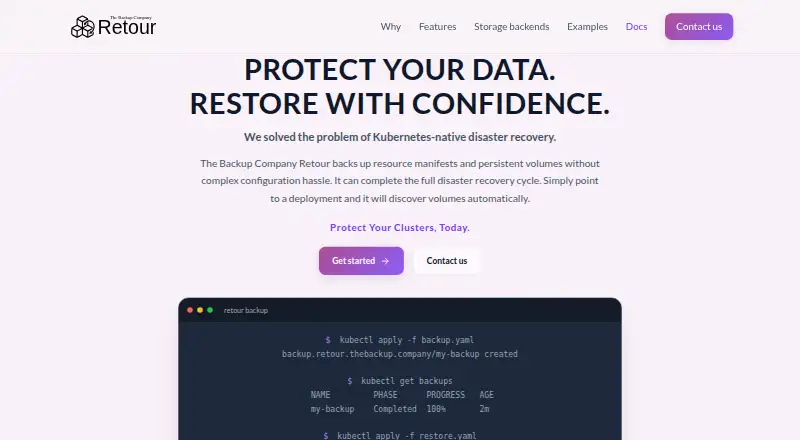
Retour is proprietary software for backing up Kubernetes resource manifests and persistent volumes, with support for disaster recovery. It is installed through a Kubernetes operator; backups and restores are defined as Kubernetes custom resources, and a web UI is optional. When backing up a deployment, Retour discovers the associated volumes automatically. It can use CSI volume snapshots if the cluster has a driver that supports CSI snapshots.
Backups can run on cron schedules with configurable retention. By default, Retour checks backups after upload and restores after copying. Scheduled restore drills put the newest backup in a scratch namespace, check restored volumes, and report results in status, an event, and a Prometheus metric. The product lists more than 60 storage backends, including Amazon S3, Ceph, Google Cloud Storage, Azure Blob, Dropbox, SFTP, and local storage. Its optional Kopia engine deduplicates data and uploads only changes on supported backends.
Restore choices include selective resource and file-level restores, as well as migration between clusters. Ready-made application-consistency profiles are listed for PostgreSQL, MySQL, MongoDB, Redis, and qemu-guest freeze. Backup data can be encrypted at rest using custom keys with rclone crypt remotes, with AWS KMS or Vault Transit able to wrap encryption material. S3 Object Lock retention can be applied to uploaded volume data, metadata, and manifests.
Who it suits
Retour suits teams running Kubernetes that need scheduled backups and recovery for resource manifests and persistent volumes. It may be a fit for operators who want configurable retention, restore checks, multiple storage options, and selective or cross-cluster recovery.
What it does well
- Automatically discovers deployment volumes during backup.
- Supports cron schedules with configurable retention.
- Checks backups after upload and restores after copying by default.
- Lists more than 60 storage backends.
- Supports selective resource restores, file-level restores, and cluster migration.
- Restore drills report results through status, an event, and a Prometheus metric.
What to know first
- Designed for Kubernetes and installed with a Kubernetes operator.
- CSI snapshots require a cluster driver that supports CSI snapshots.
- Retour is proprietary software; licensing requires contacting the maker.
Limits
The product is proprietary, and the maker asks users to contact it for licensing options. CSI volume snapshots require a Kubernetes cluster with a driver that supports CSI snapshots.
Plans
| Plan | Billed and limits | Price |
|---|---|---|
| Retour license | Proprietary software; contact the maker for licensing options | On request |
As thebackup.company lists them, read 8 Oct 2026. The maker's own page has the final word.
Getting started
- Visit https://thebackup.company/.
- Contact [email protected] for licensing options.
- Deploy Retour with its Kubernetes operator.
- Define backups and restores as Kubernetes custom resources.
- Add the optional web UI if needed.
- Use CSI volume snapshots only when the cluster has a compatible CSI snapshot driver.
Verdict
Choose Retour if you need Kubernetes-focused backup and disaster recovery for manifests and persistent volumes, particularly with scheduled restore drills or cross-cluster migration. Look elsewhere if you do not run Kubernetes or need licensing terms available without contacting the maker.
Questions
How much does Retour cost?
Pricing is on request. The maker asks users to contact it for a license or licensing options.
What platforms does Retour support?
Retour is designed for Kubernetes and is deployed with a Kubernetes operator. Its web UI is optional.
Where can backups be stored?
The site lists more than 60 storage backends, including Amazon S3, Ceph, Google Cloud Storage, Azure Blob, Dropbox, SFTP, and local storage.
Does Retour support scheduled backups and retention?
Yes. Backups can run on cron schedules with configurable retention settings.
Can Retour restore to another cluster?
Yes. It supports migration between clusters, as well as selective resource and file-level restores.
Does it support application-consistent backups?
Ready-made application-consistency profiles are listed for PostgreSQL, MySQL, MongoDB, Redis, and qemu-guest freeze.
Facts from Retour's own pages
- Automatic discovery
- Point Retour at a Deployment or StatefulSet and it discovers associated volumes automatically. · thebackup.company, 8 Oct 2026
- Backup scheduling
- Backups can run on a cron schedule with configurable retention. · thebackup.company, 8 Oct 2026
- Database support
- Ready-made application-consistency profiles are listed for PostgreSQL, MySQL, MongoDB, Redis, and qemu-guest freeze. · thebackup.company, 8 Oct 2026
- Encryption
- Backup data can be encrypted at rest with custom keys using rclone crypt remotes; AWS KMS or Vault Transit can wrap encryption material. · thebackup.company, 8 Oct 2026
- Headquarters
- Warsaw, Poland · thebackup.company, 28 Sept 2026
- Identity integrations
- The web UI supports OIDC and SAML authentication with multiple identity providers. · thebackup.company, 8 Oct 2026
- Immutability
- S3 Object Lock retention can be applied to uploaded volume data, metadata, and manifests. · thebackup.company, 8 Oct 2026
- Immutable backups
- Retour can apply S3 Object Lock retention to uploaded backup objects. · thebackup.company, 8 Oct 2026
- Incremental backups
- The optional Kopia engine deduplicates data and uploads only changes on supported backends. · thebackup.company, 8 Oct 2026
- License
- Retour is proprietary software; the maker asks users to contact it for a license or licensing options. · thebackup.company, 8 Oct 2026
- Maker and location
- The site says Retour is owned and operated by Andante Bernard Pietraga in Warsaw, Poland. · thebackup.company, 8 Oct 2026
- Notable requirement
- CSI volume snapshots require a Kubernetes cluster with a driver that supports CSI snapshots. · thebackup.company, 8 Oct 2026
- Platform and configuration
- Retour is deployed with a Kubernetes operator and defines backups and restores as Kubernetes custom resources; its web UI is optional. · thebackup.company, 8 Oct 2026
- Platform requirement
- Retour is designed for Kubernetes and uses CSI snapshots when the cluster has a supporting CSI driver. · thebackup.company, 8 Oct 2026
- Purpose
- Retour backs up Kubernetes resource manifests and persistent volumes and supports disaster recovery. · thebackup.company, 8 Oct 2026
- Restore drills
- A schedule can restore its newest backup to a scratch namespace and run a check on its own cron. · thebackup.company, 8 Oct 2026
- Restore options
- Retour supports selective resource restores, file-level restores, and migration between clusters. · thebackup.company, 8 Oct 2026
- Scheduling
- BackupSchedule supports cron-based backups with retention settings. · thebackup.company, 8 Oct 2026
- Snapshots
- It uses CSI volume snapshots when the Kubernetes cluster has a supporting driver. · thebackup.company, 8 Oct 2026
- Storage integrations
- The site lists 60+ storage backends, including Amazon S3, Ceph, Google Cloud Storage, Azure Blob, Dropbox, SFTP, and local storage. · thebackup.company, 8 Oct 2026
- Support contact
- The site lists [email protected] for inquiries. · thebackup.company, 8 Oct 2026
- Verification
- Backups are checked after upload and restores after copy by default. · thebackup.company, 8 Oct 2026
Where Retour stands on Freedom251
- Kubernetes Backup Software#23 of 31
- Container Backup Software#21 of 28