Freedom251 › AI DevOps Assistants

Resolve AI
What Resolve AI is
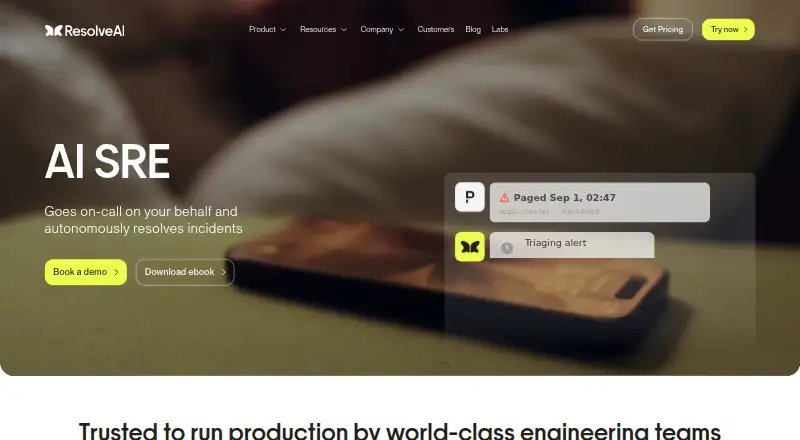
Resolve AI is an AI SRE platform for teams managing production systems. Its agents investigate alerts and decide whether to close, fix, or escalate them. For critical alerts and incidents, agents can work to restore service and investigate root causes, including recurring or latent failures. They can also carry out operational work such as deployment monitoring, drift detection, and reports run on a schedule or trigger. Resolve AI’s Hivemind gives agents real-time production context, investigation skills, actions, and memory. The platform connects to production tools through MCP, APIs, and webhooks, with support for custom tools and bespoke systems. Listed integrations include Google Cloud, Grafana, Kubernetes, Datadog, GitHub, Splunk, Slack, AWS, Claude, Codex, Cursor, and Notion. It supports AWS, GCP, and Microsoft Azure, as well as Kubernetes and runbook automation. Resolve AI describes limiting access to the minimum data needed for agent work and says it does not store or persist raw data. Deployment options include shared multi-tenant and dedicated single-tenant cloud; dedicated deployment supports bring-your-own keys. The company says the platform is designed to meet standards including SOC 2 Type II, GDPR, and HIPAA. Pricing is credit-based, but visitors must request pricing rather than view a published rate.
Who it suits
Resolve AI suits organizations that need agents to investigate production alerts, respond to incidents, and handle scheduled or triggered operational tasks. Its integrations, cloud support, deployment choices, and enterprise access controls are relevant to teams operating production infrastructure.
What it does well
- Agents triage alerts and can close, fix, or escalate them.
- Can investigate incidents and work to restore service.
- Supports scheduled or triggered production tasks.
- Connects through MCP, APIs, and webhooks, including custom tools.
- Offers shared and dedicated cloud deployment options.
What to know first
- Pricing is available only by request.
- Pricing is credit-based for defined agent work.
Plans
| Plan | Billed and limits | Price |
|---|---|---|
| Credit-based pricing | Credits used for defined agent work · covers chats, alert triage, investigations, incidents, background tasks, and other production workflows | On request |
As resolve.ai lists them, read 5 Oct 2026. The maker's own page has the final word.
Getting started
- Visit the Resolve AI website.
- Request pricing for the credit-based model.
- Choose shared multi-tenant or dedicated single-tenant cloud deployment.
- Connect production tools using MCP, APIs, or webhooks; custom tools and bespoke systems are supported.
- Configure access controls and the production tasks agents should handle.
Verdict
Consider Resolve AI if you want an AI SRE platform that can investigate alerts, help mitigate incidents, and perform production tasks across connected tools. Look elsewhere if you need a published price before contacting the company.
Questions
How does Resolve AI pricing work?
Pricing is credit-based and covers defined agent work, including chats, alert triage, investigations, incidents, background tasks, and other production workflows. The price is available by request.
Which tools does it integrate with?
Listed integrations include Google Cloud, Grafana, Kubernetes, Datadog, GitHub, Splunk, Slack, AWS, Claude, Codex, Cursor, and Notion. It also supports custom tools and bespoke systems.
Which cloud platforms does Resolve AI support?
It lists AWS, GCP, and Microsoft Azure, as well as Kubernetes support.
What deployment options are available?
Resolve AI describes shared multi-tenant and dedicated single-tenant cloud deployment. Dedicated deployment supports bring-your-own keys.
What access and security measures does it describe?
Resolve AI says it limits access to the data needed for task execution and does not store or persist raw data. It describes SSO, role-based access control, service accounts, secure tokens, and data-scoping options.
Facts from Resolve AI's own pages
- Access controls
- The integrations page describes read-only access to the minimum data needed for agents to understand, reason, and act. · resolve.ai, 5 Oct 2026
- Company founding
- Resolve AI’s about page states that it was founded in October 2024. · resolve.ai, 5 Oct 2026
- Compliance
- Resolve AI says it is designed to meet compliance standards including SOC 2 Type II, GDPR, and HIPAA. · resolve.ai, 5 Oct 2026
- Deployment
- The security page describes shared multi-tenant and dedicated single-tenant cloud deployment models; dedicated deployment supports bring-your-own keys. · resolve.ai, 5 Oct 2026
- Enterprise controls
- The security page describes SSO, role-based access control, service accounts, secure tokens, and options to scope data by role, environment, or namespace. · resolve.ai, 5 Oct 2026
- Founded
- 2024 · resolve.ai, 28 Sept 2026
- Headquarters
- San Francisco, California, United States · resolve.ai, 28 Sept 2026
- Incident response
- Agents mitigate critical alerts and incidents by restoring service, and investigate root causes of recurring or latent failures. · resolve.ai, 5 Oct 2026
- Integration methods
- Resolve AI connects to production tools using MCP, APIs, and webhooks, and supports custom tools and bespoke systems. · resolve.ai, 5 Oct 2026
- Integrations
- The integrations page lists tools including Google Cloud, Grafana, Kubernetes, Datadog, GitHub, Splunk, Slack, AWS, Claude, Codex, Cursor, and Notion. · resolve.ai, 5 Oct 2026
- Operational tasks
- Agents can run production work such as deploy monitoring, drift detection, and reports on a schedule or trigger. · resolve.ai, 5 Oct 2026
- Pricing availability
- Pricing is credit-based, but the pricing page asks visitors to request pricing and does not show a price. · resolve.ai, 5 Oct 2026
- Product
- Resolve AI describes itself as an AI SRE platform whose agents go on-call, investigate incidents, and autonomously resolve production issues. · resolve.ai, 5 Oct 2026
- Security
- The security page says Resolve AI does not store or persist raw data and limits access to what is needed for task execution. · resolve.ai, 5 Oct 2026
- Shared context
- Resolve AI says its Hivemind provides agents with real-time production context, investigation skills, actions, and memory. · resolve.ai, 5 Oct 2026
- Triage
- Agents investigate alerts and decide whether to close, fix, or escalate them. · resolve.ai, 5 Oct 2026
Where Resolve AI stands on Freedom251
- AI DevOps Assistants#26 of 26