Freedom251 › Insider Threat Management
Red Vector FULCRUM
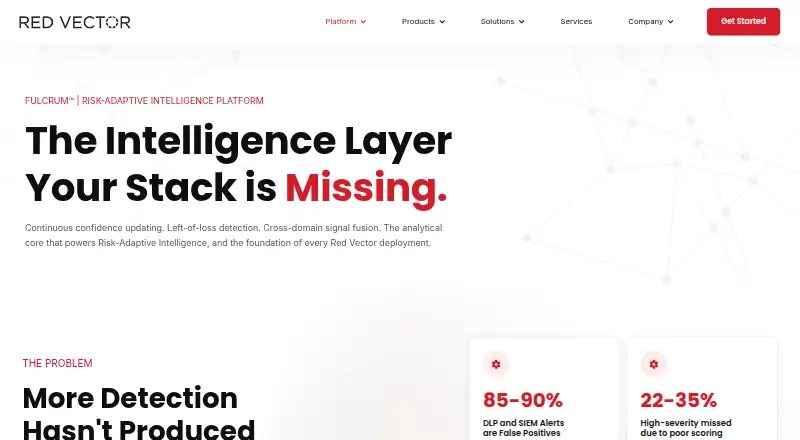
What Red Vector FULCRUM is
Red Vector FULCRUM is a risk-adaptive intelligence platform for insider risk management. It builds contextual baselines across identities, detects behavioral drift, and updates confidence as evidence changes. Its risk signals track magnitude, direction, velocity, and acceleration. FULCRUM correlates cyber, physical, HR, identity, financial, and public data, then gives analysts a prioritized lead queue, person-level context, case notes, and status tracking. It is designed to add an intelligence layer to existing SIEM, UEBA, and DLP investments rather than replace them. Named integrations include Microsoft Purview, Sentinel, Defender, Splunk, ServiceNow, Jira, Vanta, and OneTrust. Privacy controls include identity masking, separation of duties, audit logging, and configurable retention. The Trust Center describes encryption at rest and in transit, role-based access, immutable audit logging, and continuous security monitoring. Named frameworks include SOC 2 Type II, ISO 27001 alignment, CMMC, and FedRAMP. The CONTEXT+ option is API-native, requires no new agents or endpoint instrumentation, and is described as becoming operational in 30 days. Mission Support is an ongoing operational partnership for organizations running FULCRUM in production. Pricing is on request.
Who it suits
FULCRUM is aimed at CISOs, security architects, and SOC and investigations leads managing insider risk. It is designed for teams using SIEM, UEBA, or DLP tools.
What it does well
- Correlates data across six listed domains.
- Provides prioritized leads and case tracking.
- Includes identity masking and configurable retention.
- Named integrations include Sentinel, Splunk, and ServiceNow.
What to know first
- Pricing is on request.
- It is designed to enhance existing tools, not replace them.
Limits
Pricing is available on request. The CONTEXT+ option is described as becoming operational in 30 days.
Getting started
- Visit the FULCRUM overview page.
- Contact Red Vector for pricing.
- Review the integrations and API documentation for your environment.
- Consider CONTEXT+ if you want the API-native option described as requiring no new agents or endpoint instrumentation.
- Use Mission Support for ongoing operational partnership when running FULCRUM in production.
Red Vector FULCRUM is an insider-risk intelligence platform for organizations that need to connect security, business, and identity signals. It suits CISOs, security architects, and SOC or investigations leads with established tools and a case-handling process. Its strongest use is prioritizing and contextualizing investigations rather than replacing a SIEM, UEBA, or DLP deployment.
Overview
FULCRUM builds contextual baselines around identities, watches for behavioral drift, and adjusts confidence as evidence changes. Its risk model follows magnitude, direction, velocity, and acceleration, making it better suited to tracking how a situation develops than relying on a single static score.
The platform correlates cyber, physical, HR, identity, financial, and public data. That breadth can give investigators a more complete view of a person or event, provided the organization can connect the relevant systems and govern the resulting data appropriately.
Key features
User risk scoring, insider-risk workflows, data-exfiltration detection, and case management are core capabilities. A prioritized lead queue helps teams decide which matters first, while person-level context puts activity in an investigative frame instead of presenting isolated alerts.
Structured case notes and status tracking support a repeatable handoff from detection to investigation and resolution. These features are particularly relevant to SOC and investigations teams managing many concurrent cases; organizations looking only for endpoint blocking or basic alerting will find the platform's intelligence-layer role less directly useful.
FULCRUM is designed to enhance existing SIEM, UEBA, and DLP investments. Named integrations include Microsoft Purview, Microsoft Sentinel, Splunk, Microsoft Defender, ServiceNow, Jira, Vanta, and OneTrust. Red Vector describes wider coverage across endpoint and EDR/XDR, cloud and network security, user activity monitoring, collaboration, AI and agent security, case management, and GRC.
Privacy controls include identity masking, separation of duties, audit logging, and configurable retention. Security controls include encryption in transit and at rest, role-based access, immutable audit logs, and continuous monitoring. Red Vector names SOC 2 Type II, ISO 27001 alignment, CMMC, and FedRAMP among its compliance frameworks.
The CONTEXT+ option is API-native, requires no new agents or endpoint instrumentation, and is described as becoming operational in 30 days. Technical documentation, API references, and integration guides are paired with Mission Support, an ongoing operational partnership for production deployments.
Pricing
FULCRUM uses custom pricing, with pricing available on request. That model is appropriate for organizations whose deployment depends on data sources, integrations, and investigation scope, but it makes straightforward budget comparison difficult.
There are no published self-service tiers, seat allowances, quotas, trial period, or renewal terms. Buyers should therefore clarify implementation scope, supported connectors, retention, user access, and Mission Support terms before committing.
Platforms
FULCRUM is offered through web and API access. The API-native CONTEXT+ approach is a fit for teams that want to connect existing infrastructure without adding endpoint agents or instrumentation.
Who it's for
FULCRUM is aimed at CISOs, security architects, and SOC and investigations leads. It makes the most sense for organizations with existing SIEM, UEBA, DLP, and related systems that need cross-domain context and a managed investigation queue. Smaller teams without those data sources or a dedicated case workflow may not gain enough from an intelligence layer to justify a custom engagement.
Pros and cons
Pros
- Contextual risk progression: tracking magnitude, direction, velocity, and acceleration helps teams assess changing risk instead of a score alone.
- Broad correlation: cyber, physical, HR, identity, financial, and public data can support person-level investigations.
- Investigation workflow: prioritized leads, case notes, and status tracking connect detection with follow-through.
- Governance controls: masking, separation of duties, retention settings, and immutable audit logging address sensitive insider-risk operations.
- Existing-stack orientation: integrations and API-native deployment can extend current investments without new endpoint agents.
Cons
- Custom pricing: buyers cannot compare published tiers or estimate cost without engaging sales.
- Dependence on connected data: the value of cross-domain modeling is lower when an organization cannot provide broad, governed inputs.
- Not a replacement platform: teams seeking a standalone SIEM, UEBA, or DLP product will need other systems.
Alternatives
Compare insider risk management software if you want a wider shortlist.
Cyberhaven Insider Risk Management is a paid alternative available through API, browser extension, Linux, macOS, web, and Windows.
DTEX Insider Risk Management is a paid option for Linux, macOS, web, and Windows; its plan uses request-a-demo sales.
FortiDLP is a paid Linux, macOS, web, and Windows alternative whose listed plans require at least 100 endpoints.
NetClean ProActive is a paid API, web, and Windows alternative.
Behavox Falcon is a paid API and web alternative with commercial options discussed with sales.
Mimecast Data Leak Prevention is a web-based paid alternative with Professional and Enterprise offerings.
SATARK is a free API and Linux alternative.
Varonis Data Discovery and Classification is a paid Linux, self-hosted, and web option priced by quote.
Verdict
Choose FULCRUM when your security organization needs evolving, cross-domain insider-risk context and a structured analyst workflow layered onto existing tools. Its main reason to choose it is the combination of behavioral-drift modeling, broad correlation, and investigation operations. Look elsewhere if you need transparent pricing, a small-team self-service product, or a replacement for core SIEM, UEBA, or DLP capabilities.
Verdict
FULCRUM combines risk signals from multiple data sources with analyst-focused investigation workflows. Its stated role is to augment existing security investments, so organizations should consider their current stack and request pricing.
Questions
What is FULCRUM used for?
It is a risk-adaptive intelligence platform for insider risk management that models contextual baselines, detects behavioral drift, and updates confidence as evidence evolves.
How much does FULCRUM cost?
Pricing is available on request.
What systems does FULCRUM integrate with?
Named integrations include Jira and Jira Service Management, Microsoft Sentinel and Defender, ServiceNow Security Incident Response, Vanta, OneTrust, and Diligent One. Other listed examples include Microsoft Purview and Splunk.
Does FULCRUM replace SIEM, UEBA, or DLP tools?
FULCRUM is positioned as an intelligence layer that enhances existing SIEM, UEBA, and DLP investments.
What is CONTEXT+?
It is described as an API-native option that needs no new agents or endpoint instrumentation and becomes operational in 30 days.
Which security and compliance controls are described?
The Trust Center describes encryption at rest and in transit, role-based access, immutable audit logging, and continuous security monitoring. Named frameworks include SOC 2 Type II, ISO 27001 alignment, CMMC, and FedRAMP.
Facts from Red Vector FULCRUM's own pages
- Analyst workflow
- The platform includes a prioritized lead queue, person-level context, case notes, and status tracking. · redvector.ai, 7 Oct 2026
- Company
- Red Vector says it is headquartered in Valley Forge, Pennsylvania; the about page describes twelve years of foundational research but gives no founding date. · redvector.ai, 7 Oct 2026
- Compliance
- The Trust Center names SOC 2 Type II, ISO 27001 alignment, CMMC, and FedRAMP among its compliance frameworks. · redvector.ai, 7 Oct 2026
- Data sources
- FULCRUM correlates cyber, physical, HR, identity, financial, and public data. · redvector.ai, 7 Oct 2026
- Deployment
- The CONTEXT+ option is described as API-native, requiring no new agents or endpoint instrumentation, and becoming operational in 30 days. · redvector.ai, 7 Oct 2026
- Documentation and support
- Red Vector describes technical documentation, API references, integration guides, and ongoing operational partnership through Mission Support. · redvector.ai, 7 Oct 2026
- Existing tools
- FULCRUM is designed to enhance existing SIEM, UEBA, and DLP investments rather than replace them. · redvector.ai, 7 Oct 2026
- Headquarters
- Valley Forge, Pennsylvania, USA · redvector.ai, 28 Sept 2026
- Integration examples
- Listed integrations include Microsoft Purview, Microsoft Sentinel, Splunk, Microsoft Defender, ServiceNow, Jira, Vanta, and OneTrust. · redvector.ai, 7 Oct 2026
- Integrations
- The integration page names Jira and Jira Service Management, Microsoft Sentinel and Defender, ServiceNow Security Incident Response, Vanta, OneTrust, and Diligent One. · redvector.ai, 7 Oct 2026
- Integration scope
- The maker says FULCRUM integrates across DLP, SIEM, endpoint and EDR/XDR, UEBA, cloud security, network security, user activity monitoring, collaboration, AI and agent security, case management, and GRC. · redvector.ai, 7 Oct 2026
- Intended users
- The product page identifies CISOs, security architects, and SOC and investigations leads as audiences for FULCRUM. · redvector.ai, 7 Oct 2026
- Privacy controls
- The overview lists identity masking, separation of duties, audit logging, and configurable retention. · redvector.ai, 7 Oct 2026
- Product
- FULCRUM is described as a risk-adaptive intelligence platform for insider risk management. · redvector.ai, 7 Oct 2026
- Purpose
- It models contextual baselines across identities, detects behavioral drift, and updates confidence as evidence evolves. · redvector.ai, 7 Oct 2026
- Risk modeling
- Its risk signals track magnitude, direction, velocity, and acceleration. · redvector.ai, 7 Oct 2026
- Security
- The Trust Center states that FULCRUM uses encryption at rest and in transit, role-based access controls, immutable audit logging, and continuous security monitoring. · redvector.ai, 7 Oct 2026
- Stack fit
- The platform is positioned as an intelligence layer that enhances existing SIEM, UEBA, and DLP investments. · redvector.ai, 7 Oct 2026
- Support
- Red Vector describes Mission Support as an ongoing operational partnership for organizations running FULCRUM in production. · redvector.ai, 7 Oct 2026
- Who it serves
- The overview identifies CISOs, security architects, and SOC and investigations leads as intended stakeholders. · redvector.ai, 7 Oct 2026
- Workflow
- It provides a prioritized lead queue, person-level context, structured case notes, and status tracking. · redvector.ai, 7 Oct 2026
Where Red Vector FULCRUM stands on Freedom251
- Insider Threat Management#7 of 14
- Insider Risk Management Software#20 of 26