Freedom251 › Data Loss Protection Software

FortiDLP
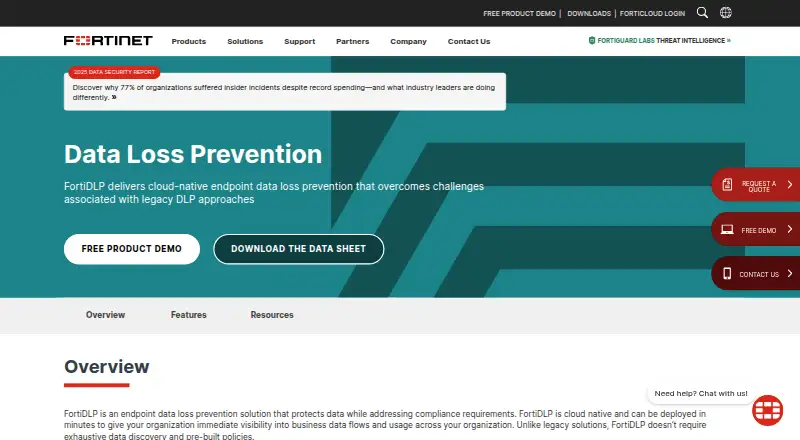
What FortiDLP is
FortiDLP is cloud-deployed software for data loss prevention, with controls for endpoints and cloud apps. Its listed capabilities also include data discovery, removable media control, and incident workflows. The software is listed for Linux, macOS, web, and Windows. Four plans are available: Core, Advanced, Advanced with Premium Hosting, and Advanced with Managed Service. Each plan has a 100-endpoint minimum, so organizations need to account for that threshold when considering fit. Pricing is on request, and no plan prices are listed. FortiDLP is associated with a company headquartered in Sunnyvale, California, United States, which was founded in 2000. Organizations can weigh its endpoint, cloud app, discovery, removable media, and incident workflow functions against their needs, while also checking whether the minimum endpoint count works for their deployment.
Who it suits
FortiDLP may suit organizations seeking cloud-based data loss prevention across endpoints and cloud apps. Its 100-endpoint minimum means it is intended for deployments meeting that threshold.
What it does well
- Includes endpoint controls and cloud app controls.
- Provides data discovery capabilities.
- Includes removable media control and incident workflows.
- Listed for Linux, macOS, web, and Windows.
What to know first
- Every plan has a 100-endpoint minimum.
- Pricing is on request; no prices are listed.
Limits
All four listed plans require a minimum of 100 endpoints. Plan prices are available on request.
Plans
| Plan | Billed and limits | Price |
|---|---|---|
| Core | 100 endpoint minimum | On request |
| Advanced | 100 endpoint minimum | On request |
| Advanced with Premium Hosting | 100 endpoint minimum | On request |
| Advanced with Managed Service | 100 endpoint minimum | On request |
As fortinet.com lists them, read 20 Sept 2026. The maker's own page has the final word.
Getting started
- Visit the FortiDLP product website.
- Contact Fortinet to request pricing.
- Choose among Core, Advanced, Advanced with Premium Hosting, or Advanced with Managed Service, each with a 100-endpoint minimum.
FortiDLP is a cloud-deployed data loss prevention product for organizations seeking controls across endpoints, cloud apps, and removable media. Its broad mix of controls, discovery, and incident workflows is compelling for larger estates; the 100-endpoint minimum rules out smaller deployments.
Overview
FortiDLP brings data discovery together with endpoint and cloud app controls, removable media control, and incident workflows. That range can give security teams several ways to address data loss and respond to incidents within one product. It is best suited to organizations that need this combination, rather than teams looking for a single-purpose control.
Deployment is cloud-based, which fits organizations choosing that model but not those requiring self-hosted software.
Key features
Controls, discovery, and response
Endpoint and cloud app controls cover two distinct parts of a data-loss program, while data discovery adds the ability to locate data. Removable media control addresses transfers through removable devices, and incident workflows support handling events. This breadth is the main reason to consider FortiDLP; it may be more than a team needs if its priority is only one of these areas.
Pricing
FortiDLP is paid, with custom pricing. Core, Advanced, Advanced with Premium Hosting, and Advanced with Managed Service are all subject to a 100-endpoint minimum. That minimum is a substantial qualification for smaller teams, and the request-based model means organizations must seek a quote to assess fit.
The plan names distinguish a Core tier from Advanced options, including versions with premium hosting or managed service. Each has the same endpoint minimum; organizations should compare the custom-priced options against their hosting and service requirements before choosing. The available plan facts do not establish feature differences between tiers, so no lower-tier trade-off can be assumed.
Platforms
FortiDLP supports Linux, macOS, web, and Windows. That platform range gives organizations using these environments options for coverage, though the deployment model remains cloud-based.
Who it's for
FortiDLP is a stronger fit for organizations with at least 100 endpoints that want discovery, endpoint and cloud app controls, removable media governance, and incident workflows together. Smaller teams, or organizations that require self-hosting, should look elsewhere.
Pros and cons
- Pros: Combines discovery, endpoint and cloud app controls, removable media control, and incident workflows, reducing the need to seek those capabilities separately.
- Pros: Supports Linux, macOS, web, and Windows.
- Cons: The 100-endpoint minimum on every plan excludes smaller deployments.
- Cons: Custom pricing requires a quote before buyers can evaluate cost.
- Cons: Cloud deployment is unsuitable for organizations that require self-hosting.
Alternatives
For a broader comparison, browse Insider Risk Management Software and Data Loss Prevention Software.
Cyberhaven Insider Risk Management is another paid option, with platforms including API and browser extension as well as Linux, macOS, web, and Windows. Consider it when that platform mix is a better match.
DTEX Insider Risk Management is paid and supports Linux, macOS, web, and Windows; its plan is also price-on-request. It may suit buyers comparing another option across those platforms.
Behavox Falcon is a paid option for API and web platforms, with commercial options discussed with sales. Consider it if those are the platforms you need.
Mimecast Data Leak Prevention is a web-based paid alternative. Its Professional plan includes one SaaS/cloud exfiltration detector and 30 days of historical activity, while Enterprise offers custom pricing; it is worth comparing if web-based SaaS/cloud exfiltration detection is your priority.
NetClean ProActive is another paid option, available across API, web, and Windows platforms.
Red Vector FULCRUM is another paid option, available for API and web platforms.
Varonis Data Discovery and Classification is paid, supports Linux, self-hosted, and web, and is priced by quote. Consider it if self-hosted deployment is important.
Bottomline Internal Threat Management is a paid web-based enterprise fraud and insider risk management solution with custom pricing.
Verdict
Choose FortiDLP if your organization has at least 100 endpoints and wants discovery, endpoint and cloud app controls, removable media control, and incident workflows in a cloud deployment. Its main advantage is that breadth; its clearest reasons to look elsewhere are the endpoint minimum, custom pricing, or a requirement for self-hosting.
Verdict
FortiDLP combines endpoint and cloud app controls with discovery, removable media control, and incident workflows. Organizations should confirm that a 100-endpoint minimum and request-based pricing fit their requirements.
Questions
How much does FortiDLP cost?
FortiDLP is paid software, with pricing available on request.
What platforms does FortiDLP support?
It is listed for Linux, macOS, web, and Windows.
What plans are available?
The listed plans are Core, Advanced, Advanced with Premium Hosting, and Advanced with Managed Service.
Is there a minimum deployment size?
Each listed plan has a 100-endpoint minimum.
What controls and workflows does FortiDLP include?
Its listed capabilities include endpoint controls, cloud app controls, data discovery, removable media control, and incident workflows.
Who makes FortiDLP?
Fortinet was founded in 2000 and is headquartered in Sunnyvale, California, United States.
Facts from FortiDLP's own pages
- Founded
- 2000 · fortinet.com, 23 Sept 2026
- Headquarters
- Sunnyvale, California, United States · fortinet.com, 23 Sept 2026
Where FortiDLP stands on Freedom251
- Data Loss Protection Software#8 of 18
- Data Loss Prevention Software#15 of 27
- Insider Risk Management Software#16 of 26