Freedom251 › AI Security Testing Tools
Red Team LLM Lab
What Red Team LLM Lab is
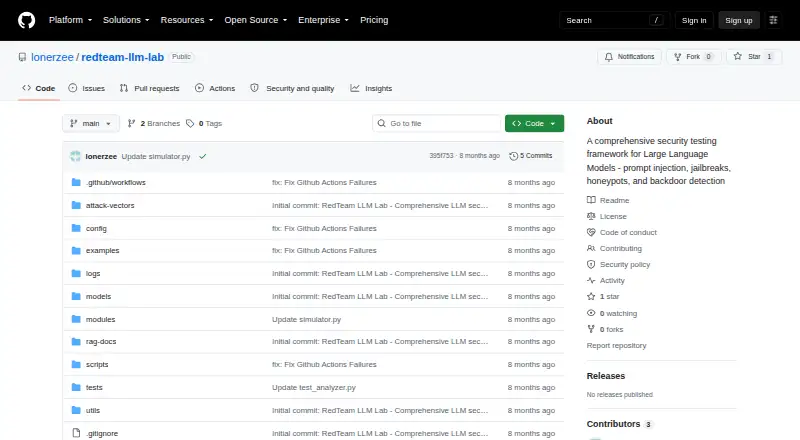
Red Team LLM Lab is a free, open-source framework for testing large language model security. It checks prompt injection, jailbreaks using 14 or more techniques, hidden backdoor triggers including Unicode, and retrieval-augmented generation poisoning. Defensive tests cover input validation, sanitization, pattern-based injection detection, and output filtering for information leaks. Modules provide prompt risk scoring, jailbreak simulation, honeypot orchestration, backdoor testing, and a master dashboard. Intentionally vulnerable honeypot agents help study attack patterns. The framework saves JSON logs with metadata and produces security posture scores, category-based vulnerability analysis, and automated recommendations. Installation downloads a quantized Phi-3 Mini model, and the project uses llama-cpp-python. It runs self-hosted on Windows and requires Python 3.8 or newer, at least 4GB of RAM (8GB recommended), and about 4GB of disk space for models. The project is MIT licensed and directs bug reports to GitHub Issues, with Discussions for conversation.
Who it suits
This framework suits security researchers, secure AI application developers, educators, and organizations performing internal security audits. It is intended for self-hosted Windows use.
What it does well
- Tests prompt injection, jailbreaks, backdoors, and RAG poisoning
- Includes honeypot agents for studying attack patterns
- Provides risk scores, logs, analysis, and recommendations
- Supports custom test cases and self-hosted deployment
- MIT license and free plan
What to know first
- Requires Windows for the listed deployment
- Needs at least 4GB RAM and model disk space
- Several roadmap items are still planned
Verdict
Red Team LLM Lab offers a focused, self-hosted toolkit for adversarial LLM checks and reporting. Its Windows requirements and planned roadmap features matter when evaluating deployment scope.
Facts from Red Team LLM Lab's own pages
- Analysis modules
- Its modules include a prompt analyzer with risk scoring, a jailbreak simulator, a honeypot orchestrator, a backdoor tester, and a master dashboard. · github.com, 7 Oct 2026
- Attack testing
- It includes prompt injection testing, jailbreak simulation with 14+ techniques, honeypot agents, backdoor detection, prompt analysis, and RAG poisoning tests. · github.com, 7 Oct 2026
- Backdoor detection
- Its backdoor tester checks for hidden triggers, including Unicode triggers. · github.com, 7 Oct 2026
- Defense testing
- The framework tests input validation and sanitization, pattern-based injection detection, and output filtering for information leaks. · github.com, 7 Oct 2026
- Honeypots
- It provides intentionally vulnerable honeypot agents for studying attack patterns. · github.com, 7 Oct 2026
- Integrations
- Support for OpenAI and Anthropic API testing is listed on the project roadmap. · github.com, 7 Oct 2026
- Intended users
- The project names security researchers, secure AI application developers, educators, and organizations conducting internal security audits as intended users. · github.com, 7 Oct 2026
- Jailbreak simulation
- It tests guardrail effectiveness using 14 or more jailbreak techniques. · github.com, 7 Oct 2026
- License
- The project states that it is licensed under the MIT License. · github.com, 7 Oct 2026
- Model setup
- The installation instructions download a quantized Phi-3 Mini model, and the project is built with llama-cpp-python. · github.com, 7 Oct 2026
- Notable limits
- The roadmap also lists a web UI, Docker support, GPU acceleration, function-calling tests, and CI/CD examples as planned items. · github.com, 7 Oct 2026
- Platforms
- The setup instructions show a virtual environment command for Windows and describe running the lab with Python scripts; they do not list supported operating systems as a formal platform matrix. · github.com, 7 Oct 2026
- Prompt injection
- It tests for vulnerabilities to prompt manipulation and includes static prompt analysis with risk scoring. · github.com, 7 Oct 2026
- Purpose
- Red Team LLM Lab is an open-source framework for testing large language model robustness against security attacks. · github.com, 7 Oct 2026
- RAG security
- It can test retrieval-augmented generation poisoning attacks. · github.com, 7 Oct 2026
- Reporting
- It saves JSON logs with metadata and provides security posture scoring, category-based vulnerability analysis, and automated recommendations. · github.com, 7 Oct 2026
- Requirements
- The stated prerequisites are Python 3.8 or higher, 4GB RAM minimum (8GB recommended), and about 4GB disk space for models. · github.com, 7 Oct 2026
- Security guidance
- The project recommends isolated or offline test environments, authorization, careful handling of results, and responsible vulnerability disclosure. · github.com, 7 Oct 2026
- Support
- The repository directs users to GitHub Issues for bugs or feature requests and Discussions for conversation. · github.com, 7 Oct 2026
Where Red Team LLM Lab stands on Freedom251
- AI Security Testing Tools#23 of 29