Freedom251 › Read-It-Later Apps
Readr
What Readr is
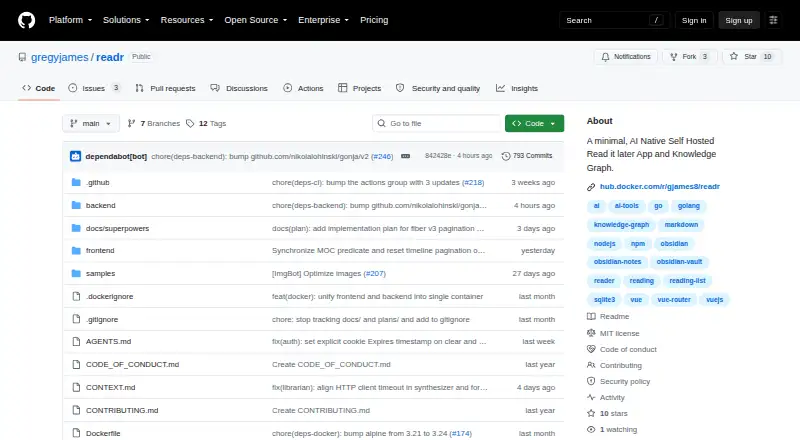
Readr is a self-hosted read-it-later app and knowledge graph engine that uses AI features to help organize and explore a reading collection. It saves articles as Markdown files on disk and tracks them in SQLite. Users can query their collection with OpenRouter models and refer to notes using @ mentions. During ingestion, background agents can add Open Knowledge Format YAML frontmatter, find semantic connections, and insert wikilinks. Global and per-article graph views map relationships among articles, tags, and links. An optional graph context setting lets AI follow those connections and use related notes and backlinks as context. Readr also supports bidirectional wikilinks, backlinks, aliases, and hover previews. Site-specific Jinja templates and domain matching can shape saved article structure. Articles and chat histories can be backed up or synced with Obsidian and Logseq. The project describes a Vue frontend, Go backend, and full dark mode, and provides a Docker Compose example with a mounted data directory. It is free and MIT-licensed. The security policy says 1.x.x receives security updates and earlier versions are unsupported.
Who it suits
Readr may suit readers who want to keep articles and notes locally in Markdown and connect them through a knowledge graph. Its self-hosted setup and syncing options may also fit users of Obsidian or Logseq.
What it does well
- Stores articles locally as Markdown and tracks them in SQLite.
- Graph views show article, tag, and link relationships.
- Can sync or back up content with Obsidian and Logseq.
- MIT-licensed and free.
What to know first
- Self-hosted deployment is required.
- Versions below 1.0 are unsupported for security updates.
- AI collection queries use OpenRouter models.
Getting started
- Open the Readr project website
- Deploy the Docker Compose example with the gjames8/readr:latest image
- Mount a data directory for local storage
- Open the web interface and save articles for Markdown storage
Verdict
Readr combines local article storage, AI-assisted organization, and graph-based navigation. It is worth considering for readers comfortable with self-hosting who want Markdown-based portability.
Questions
Is Readr free?
Yes. Readr uses a free pricing model and provides a free plan.
Where does Readr run?
Readr is self-hosted and web-based. Its deployment example uses Docker Compose, the gjames8/readr:latest image, and a mounted data directory.
How are saved articles stored?
Articles are saved as Markdown files on disk, with a SQLite database tracking them. Metadata and chat histories are stored locally as well.
Can Readr work with Obsidian or Logseq?
Yes. Locally saved Markdown articles and chat histories can be backed up or synchronized with Obsidian and Logseq.
What license does Readr use?
The repository releases Readr under the MIT License.
Who makes Readr?
The repository identifies Greg James as the copyright holder.
Facts from Readr's own pages
- AI chat
- Users can query their reading collection with OpenRouter models and reference notes using @ mentions. · github.com, 11 Oct 2026
- Background agents
- Background agents extract Open Knowledge Format YAML frontmatter and discover semantic links to existing articles. · github.com, 11 Oct 2026
- Deployment
- The README provides a Docker Compose example using the gjames8/readr:latest image and a mounted data directory. · github.com, 11 Oct 2026
- Free plan
- Yes · github.com, 22 Sept 2026
- Graph context
- An optional setting lets AI traverse graph connections and include connected notes and backlinks in its context. · github.com, 11 Oct 2026
- Integrations
- Locally saved Markdown articles and chat histories can be backed up or synced with Obsidian and Logseq. · github.com, 11 Oct 2026
- Interface
- The project describes a Vue frontend, Go backend, and full dark mode support. · github.com, 11 Oct 2026
- Knowledge graph
- Global and per-article graph views map relationships between articles, tags, and wikilinks. · github.com, 11 Oct 2026
- License
- The repository states that Readr is released under the MIT License. · github.com, 11 Oct 2026
- Live updates
- Server-sent events send background-agent completions and graph changes to the browser without a page refresh. · github.com, 11 Oct 2026
- Maker
- The repository identifies Greg James as the copyright holder; the maker's GitHub profile lists Chicago. · github.com, 11 Oct 2026
- Markdown links
- Readr supports bidirectional wikilinks and backlinks, including aliased links and hover previews. · github.com, 11 Oct 2026
- Portability
- Articles, metadata, and chat histories are stored locally as Markdown and can be backed up or synced with Obsidian and Logseq. · github.com, 11 Oct 2026
- Product
- Readr is a self-hosted, AI-native read-it-later app and knowledge graph engine. · github.com, 11 Oct 2026
- Security policy
- The security policy lists 1.x.x as supported for security updates, marks versions below 1.0 as unsupported, and asks users to report vulnerabilities through a GitHub issue. · github.com, 11 Oct 2026
- Security reporting
- The security policy says to report vulnerabilities by opening a GitHub issue. · github.com, 11 Oct 2026
- Storage
- Articles are saved as Markdown files on disk and tracked in a SQLite database. · github.com, 11 Oct 2026
- Templates
- Users can customize saved article structure with site-specific Jinja templates and automatic domain matching. · github.com, 11 Oct 2026
Where Readr stands on Freedom251
- Read-It-Later Apps#22 of 28
- Read-later apps#22 of 28