Freedom251 › Internal Developer Portals
Ravion
What Ravion is
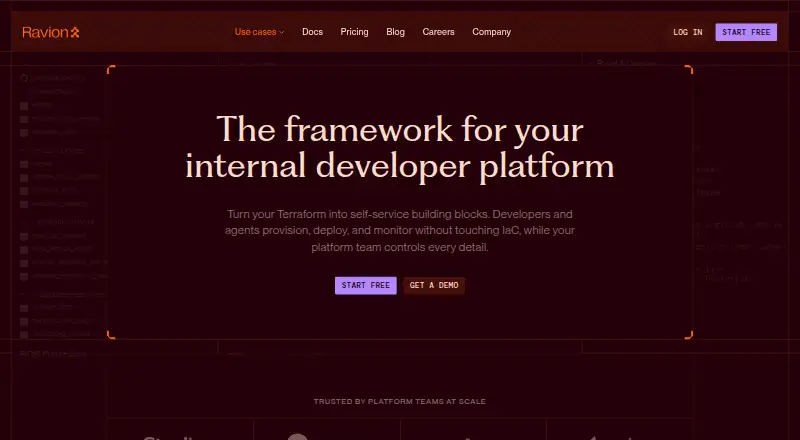
Ravion is a framework and governed execution layer for internal developer platforms. Developers and AI agents can use it to provision, deploy, and operate applications in a customer's AWS account. Platform teams can turn existing Terraform into reusable modules with typed inputs, which developers provision through forms. Each module instance is tracked as a stack with reviewable plans, approval gates, managed state, and versioned resource history. Ravion supports deployments for containers, Lambdas, and static sites, including rollbacks and deployment visibility. It works with Terraform providers and connects to AWS CloudWatch logs and metrics, Systems Manager Parameter Store and Secrets Manager, and external CI through its API and CLI. Ravion says it uses short-lived, operation-scoped AWS STS and OIDC credentials rather than asking for or storing AWS access keys. Infrastructure and operational materials stay in the customer's AWS account. AI agents can propose changes and review dry-run differences, subject to plans, policies, and approval gates. AWS is supported today; other cloud support is planned.
Who it suits
Ravion suits platform teams that want developers or AI agents to provision and operate applications in AWS through governed Terraform modules. It may also fit teams seeking stack-level plans, approvals, and deployment visibility.
What it does well
- Terraform modules can be provisioned through forms.
- Tracks stacks with plans, approval gates, and versioned history.
- Supports containers, Lambdas, and static-site deployments.
- Customer infrastructure and operational data stay in its AWS account.
What to know first
- AWS is the only supported cloud today.
- Kubernetes support is marked as coming soon.
- Team plan pricing varies by module and pipeline minutes.
Limits
Individuals is free for one user and includes up to 50 modules, 2,000 pipeline minutes, and $20 in AI tokens. Team includes 50,000 pipeline minutes per month and a $25 monthly credit; pipeline minutes cost $0.002 per minute, and module prices vary by type. Kubernetes, role-based access control, cost tracking by stack and resource, and notifications are marked as coming soon.
Plans
| Plan | Billed and limits | Price |
|---|---|---|
| Individuals | Free for as long as it is just you. · 1 user · up to 50 modules · 2,000 pipeline minutes · community support · $20 AI tokens | Free |
| Enterprise | Custom volume pricing and terms. · Custom contracts and invoicing · SLA and priority support · custom RBAC · on-prem deployments · security and compliance agreements | On request |
| Team | Pay as you go; modules are priced per module/month: Small stack-only Free, Standard $5/mo, Container $30/mo; pipeline minutes $0.002/min. · No platform fee · no user limit · 50,000 pipeline minutes/month included · $25 monthly credit · standard support | On request |
As ravion.com lists them, read 8 Oct 2026. The maker's own page has the final word.
Getting started
- Visit the Ravion website.
- Choose the Individuals, Team, or Enterprise plan.
- Use Ravion’s API or CLI to connect external CI, if needed.
- Package Terraform as reusable modules with typed inputs.
- Provision from modules through forms, then review plans and approvals.
Ravion is an internal developer platform framework for teams operating applications and infrastructure in AWS. It suits platform teams that want developers and AI agents to use reusable Terraform modules without bypassing governance. The trade-off is a workflow centered on AWS, with several broader capabilities still marked as coming soon.
Overview
Platform teams can turn existing Terraform into reusable modules with typed inputs, then expose those modules through developer-facing forms. Every module instance is tracked as a stack with managed state, reviewable plans, approval gates and versioned resource history. In practice, this creates a controlled self-service path: developers can request infrastructure without receiving unrestricted infrastructure credentials, while platform owners retain checkpoints and an audit trail.
Ravion also covers application delivery for containers, Lambdas and static sites. Deployment visibility and rollbacks make it more than a catalog of infrastructure templates, particularly for teams that want provisioning and delivery in one operating model. AWS is the supported cloud today; Cloudflare, GCP and Azure support is planned rather than current.
Key features
Terraform-based self-service
Typed inputs and forms make established Terraform components consumable by developers who should not have to author every change directly. The approach is strongest where a platform team already maintains modules and wants consistent interfaces. Teams that prefer unconstrained, user-authored infrastructure may find the required module structure restrictive.
Governed stacks and deployments
Plans, approval gates, managed state and versioned resource history provide review points before infrastructure changes are applied and help explain how a stack reached its current state. For application releases, support for containers, Lambdas and static sites is paired with rollbacks and deployment visibility, covering several common AWS delivery patterns.
Integrations and security model
Ravion supports Terraform providers and connects with CloudWatch logs and metrics, Systems Manager Parameter Store, Secrets Manager, and external CI through its API and CLI. It says it neither requests nor stores AWS access keys, instead obtaining short-lived, operation-scoped credentials through AWS STS and OIDC. Infrastructure, application traffic, runtime secrets, builds, Terraform runs and pipeline runners remain in the customer's AWS account, which is a meaningful fit for organizations that require customer-account control.
AI-assisted changes
AI agents can use the CLI and API to propose configuration changes and inspect dry-run diffs. Plans, policies and approval gates still govern execution, so the AI workflow is an acceleration layer rather than an automatic path to production.
Pricing
Individuals
The free Individuals plan is billed free for as long as it is just you. It includes one user, up to 50 modules, 2,000 pipeline minutes, community support and $20 in AI tokens. It is a practical way for a solo builder to establish a small catalog, but the single-user limit makes it unsuitable for a collaborative platform team.
Team
Team uses pay-as-you-go billing with no platform fee and no user limit. Modules are priced per module per month: Small stack-only is free, Standard is $5/mo, and Container is $30/mo. The plan includes 50,000 pipeline minutes each month and a $25 monthly credit; additional pipeline minutes cost $0.002/min. Standard support is included. This is the relevant tier for growing teams, although costs can rise with the number and type of modules and with pipeline usage.
Enterprise
Enterprise has custom volume pricing and terms, with custom contracts and invoicing, SLA and priority support, custom RBAC, on-premises deployments, and security and compliance agreements. It is the option for organizations that need procurement flexibility, stronger support commitments or deployment and access controls beyond the other plans.
A 14-day trial is offered. Kubernetes, role-based access control, cost tracking by stack and resource, and notifications are marked as coming soon, so those requirements should not be treated as current plan capabilities.
Platforms
Ravion is offered through an API and web interface, supports Linux, and can be self-hosted. Its deployment model is both hosted and self-hosted. AWS is the current cloud scope, while Kubernetes support is not yet available.
Who it's for
Ravion is best for AWS-focused platform engineering teams that already have Terraform assets and need governed self-service for developers or AI agents. It is also a strong fit when keeping infrastructure and operational data in the customer's AWS account matters. Solo users can explore the model on Individuals, while multi-user teams should budget around module and pipeline consumption. It is not the right choice today for a Kubernetes-first organization or a team that must provision across GCP, Azure or Cloudflare.
Pros and cons
Pros
- Governed Terraform self-service: typed modules, reviewable plans and approval gates reduce the need to grant direct infrastructure access.
- End-to-end AWS workflow: provisioning, container/Lambda/static-site deployments, rollbacks and operational integrations sit in one platform.
- Customer-account control: short-lived STS/OIDC credentials and customer-account data residency support tighter security boundaries.
- AI with human controls: agents can propose changes and review diffs without bypassing policies and approvals.
Cons
- Cloud scope is narrow today: AWS is supported; Cloudflare, GCP and Azure are only planned.
- Several controls are pending: Kubernetes, RBAC, cost tracking and notifications are coming soon.
- Team costs vary with usage: module charges and pipeline-minute billing require ongoing consumption management.
- Free access is limited: Individuals allows one user and 2,000 pipeline minutes.
Alternatives
Choose Internal Developer Portals for a broader directory of portal options. Northflank is worth considering when you want a freemium platform with a free Sandbox covering two services, one database and two cron jobs. Pick Backstage for a free, open-source framework. Gantry is the free Apache 2.0 self-hosted option. OpenChoreo is a free, self-hosted Kubernetes platform. Skyhook suits teams seeking a freemium service with a free tier for up to three Git-connected users, three services and one cluster. Cycloid offers a free SaaS workspace for up to five users with blueprints, forms and orchestration. WSO2 Developer Platform is a paid platform with a free trial. configure8 is a freemium catalog-focused alternative with a free per-user plan.
Verdict
Choose Ravion if your platform team wants governed AWS provisioning and deployments built around reusable Terraform, with customer-account control and approval gates that also constrain AI-assisted changes. Look elsewhere if Kubernetes or multi-cloud support is a current requirement, or if you need RBAC and cost tracking now rather than on a coming-soon roadmap.
Verdict
Ravion provides governed provisioning and deployment workflows centered on AWS and Terraform. Its current cloud scope and coming-soon Kubernetes support matter for teams with broader infrastructure needs.
Questions
Is Ravion free?
Yes. The Individuals plan costs nothing and is billed free for as long as it is just you. Ravion also offers a 14-day trial.
What does the free plan include?
Individuals includes one user, up to 50 modules, 2,000 pipeline minutes, community support, and $20 in AI tokens.
How much does the Team plan cost?
Team has no platform fee or user limit. Modules are priced per module per month: Small stack-only is free, Standard is $5/mo, and Container is $30/mo; pipeline minutes cost $0.002/min.
Which platforms and cloud does Ravion support?
Its listed platforms are API, Linux, self-hosted, and web. AWS is supported today; Cloudflare, GCP, and Azure support is planned.
Who makes Ravion, and what compliance does it state?
Ravion is built by Blitz Revolution Inc., which was founded in 2021. Ravion states that it is SOC 2 Type II compliant and HIPAA ready; its SOC 2 report is available under an Enterprise contract.
What does Enterprise include?
Enterprise has custom volume pricing and terms, with custom contracts and invoicing, SLA and priority support, custom RBAC, on-prem deployments, and security and compliance agreements.
Facts from Ravion's own pages
- AI workflows
- AI agents can use Ravion's CLI and API to propose configuration changes and review dry-run diffs, while changes remain subject to plans, policies, and approval gates. · ravion.com, 8 Oct 2026
- Cloud support
- AWS is the supported cloud today; Ravion says Cloudflare, GCP, and Azure support is planned. · ravion.com, 8 Oct 2026
- Company
- Ravion is built by Blitz Revolution Inc. (doing business as Ravion), founded in 2021. · ravion.com, 8 Oct 2026
- Compliance
- Ravion states it is SOC 2 Type II compliant and HIPAA ready; its security page says the SOC 2 report is available under Enterprise contract. · ravion.com, 8 Oct 2026
- Customer data
- Ravion says infrastructure, application traffic, runtime secrets, builds, Terraform runs, and pipeline runners stay in the customer's AWS account. · ravion.com, 8 Oct 2026
- Deployments
- Ravion supports application deployments for containers, Lambdas, and static sites, with rollbacks and deployment visibility. · ravion.com, 8 Oct 2026
- Founded
- 2021 · ravion.com, 28 Sept 2026
- Infrastructure management
- Each module instance is tracked as a stack with reviewable plans, approval gates, managed state, and versioned resource history. · ravion.com, 8 Oct 2026
- Integrations
- Ravion supports Terraform providers and integrates with AWS CloudWatch logs and metrics, AWS Systems Manager Parameter Store and Secrets Manager, and external CI through its API and CLI. · ravion.com, 8 Oct 2026
- Limits
- The pricing page marks Kubernetes, role-based access control, cost tracking by stack and resource, and notifications as coming soon. · ravion.com, 8 Oct 2026
- Product
- Ravion is a framework and governed execution layer for internal developer platforms that lets developers and AI agents provision, deploy, and operate applications in a customer AWS account. · ravion.com, 8 Oct 2026
- Security
- Ravion says it does not ask for or store AWS access keys and instead uses short-lived, operation-scoped credentials obtained through AWS STS and OIDC. · ravion.com, 8 Oct 2026
- Support
- The Individuals plan includes community support, Team includes standard support, and Enterprise includes priority support, SLAs, architecture review, and onboarding. · ravion.com, 8 Oct 2026
- Terraform modules
- Platform teams can package existing Terraform into reusable modules with typed inputs, and developers provision from those modules through forms. · ravion.com, 8 Oct 2026
Where Ravion stands on Freedom251
- Internal Developer Portals#8 of 27