Freedom251 › Internal Developer Portals
OpenChoreo
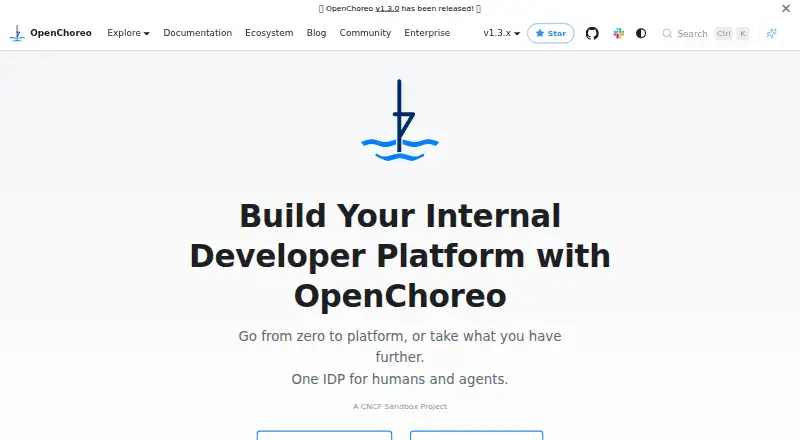
What OpenChoreo is
OpenChoreo is a modular, open-source developer platform for building and operating applications on Kubernetes. It brings together developer abstractions, a Backstage-powered portal, CI/CD, GitOps, and observability. Programmable abstractions and golden paths help developers build, deploy, and operate applications without directly managing Kubernetes complexity. Its multi-plane architecture separates control, runtime data, workflows, and observability, and supports deployment across multiple clusters and cloud providers.
Teams can install OpenChoreo on Kubernetes in cloud or on-premises environments, including hybrid and edge infrastructure. Git repositories can serve as the source of truth for platform configuration and application deployments. CI can use Argo Workflows or external pipelines such as Jenkins and GitHub Actions through the API. Flux CD is the default GitOps module, while Argo CD is listed as a community module. Integrated observability covers logs, metrics, traces, and alerts mapped to the application model. The platform also includes SRE and FinOps agents, MCP servers and skills for AI-assisted delivery and operations, role-based authorization, and tenancy boundaries. The OpenChoreo plan costs nothing and is self-hosted. The quick start recommends Docker Engine 26.0 or newer, at least 4 GB RAM and 2 CPUs, or 8 GB RAM and 4 CPUs when installing with WorkflowPlane for optimal performance.
Who it suits
OpenChoreo is designed for platform and software engineers, architects, technical leads, SREs, operations teams, and technology leaders working with Kubernetes. It suits teams seeking governed developer self-service and a platform they can deploy across cloud, on-premises, hybrid, or edge infrastructure.
What it does well
- Golden paths let developers deliver applications without directly managing Kubernetes complexity.
- Supports deployments across multiple clusters and cloud providers.
- Combines built-in Argo Workflows CI with support for external CI pipelines.
- Maps logs, metrics, traces, and alerts to the application model.
- Includes role-based authorization and tenancy boundaries.
- Open-source platform with a free plan.
What to know first
- The platform is self-hosted on Kubernetes.
- The quick start recommends Docker Engine 26.0 or newer.
- WorkflowPlane installation recommends 8 GB RAM and 4 CPUs for optimal performance.
Limits
The OpenChoreo plan is self-hosted, so deployment requires a Kubernetes cluster. The quick start recommends at least 4 GB RAM and 2 CPUs, with 8 GB RAM and 4 CPUs for optimal performance when installing with WorkflowPlane.
Plans
| Plan | Billed and limits | Price |
|---|---|---|
| OpenChoreo | Open-source Kubernetes platform · self-hosted | Free |
As openchoreo.dev lists them, read 7 Oct 2026. The maker's own page has the final word.
Getting started
- Visit the OpenChoreo website and review the quick start.
- Prepare a Kubernetes cluster in a cloud or on-premises environment.
- Meet the quick start's Docker Engine 26.0 or newer recommendation and resource requirements.
- Install OpenChoreo on the cluster; allow 8 GB RAM and 4 CPUs when using WorkflowPlane for optimal performance.
- Use the portal, abstractions, and workflows to build, deploy, and operate applications.
OpenChoreo is a modular, open-source platform for building and operating applications on Kubernetes. It suits teams with platform and operations expertise that want to give developers governed self-service. Its integrated delivery and observability capabilities are substantial, but adopting it means deploying and maintaining the platform yourself.
Overview
OpenChoreo brings a Backstage-powered portal, developer abstractions, CI/CD, GitOps, and observability into a Kubernetes-focused platform. Its multi-plane architecture separates control, runtime data, workflows, and observability, and supports deployment across clusters and cloud providers. That gives platform teams room to organize capabilities for different environments; it also makes Kubernetes operations a prerequisite rather than an implementation detail.
Key features
Programmable abstractions and golden paths let developers build, deploy, and operate applications without directly managing Kubernetes complexity. Role-based authorization and tenancy boundaries help platform teams keep that self-service governed and least-privilege, which matters when multiple teams share a platform.
OpenChoreo supports built-in CI through Argo Workflows, or external pipelines such as Jenkins and GitHub Actions connected through its API. Git repositories can be the source of truth for platform configuration and application deployments. Flux CD is the default GitOps module, with Argo CD available as a community module. These options accommodate different delivery setups, though teams must choose and operate the modules and integrations that fit their workflows.
Integrated observability maps logs, metrics, traces, and alerts to the application model, giving teams a connected view of application operations. SRE and FinOps agents, along with MCP servers and skills, support AI-assisted delivery and operations within platform guardrails. The ecosystem catalog includes modules, integrations, agents, skills, component types, and workflows, including Backstage, Crossplane, and Apache APISIX; its breadth offers flexibility, but also leaves teams to decide what to adopt.
The project directs users to CNCF Slack for real-time support and questions, as well as GitHub Discussions and issue reporting. The quick start recommends Docker Engine 26.0 or newer, with at least 4 GB of RAM and 2 CPUs; installing with WorkflowPlane calls for 8 GB and 4 CPUs for optimal performance. Those requirements make OpenChoreo a more serious operational commitment than a lightweight hosted service.
Pricing
OpenChoreo is free: its OpenChoreo plan costs nothing and is an open-source Kubernetes platform that is self-hosted. It includes a software catalog, self-service workflows, and Kubernetes support. There is no paid tier in the plan information provided, so cost is not the main trade-off; teams need to account for hosting and platform operations themselves.
Platforms
OpenChoreo supports API, Linux, macOS, self-hosted, web, and Windows environments. Its deployment model is self-hosted on Kubernetes clusters in cloud or on-premises environments, with the project also describing support for hybrid and edge infrastructure. The broad infrastructure scope is useful for organizations with varied environments, but every deployment still depends on a team able to run Kubernetes.
Who it's for
Platform engineers can use OpenChoreo to define abstractions, golden paths, and governed access; software engineers get self-service workflows without direct Kubernetes management. Architects, technical leads, SREs, operations teams, and technology leaders are also among its intended users. It is best suited to organizations standardizing delivery on Kubernetes and able to operate a self-hosted platform, not teams seeking a managed deployment service.
Pros and cons
- Pros: Developer self-service, delivery workflows, GitOps, and observability sit within one Kubernetes platform, reducing the need to assemble those capabilities as separate products.
- Pros: Multi-plane architecture, multiple CI paths, and support for deployment across clusters and providers give platform teams room to fit the system to their environment.
- Pros: Role-based authorization and tenancy boundaries provide governance for shared self-service.
- Cons: Self-hosting on Kubernetes puts deployment and ongoing platform operations on the adopting team.
- Cons: The recommended resource requirements—especially with WorkflowPlane—may be a substantial starting point for smaller teams.
- Cons: The catalog and modular choices offer flexibility, but teams must select, integrate, and operate the pieces that suit their needs.
Alternatives
For teams comparing internal developer portals, the right fit depends on whether Kubernetes-based self-hosting or a different operating model matters more.
- Northflank is worth considering if a freemium option with always-on compute is a priority; its free Sandbox includes 2 services, 1 database, and 2 cron jobs.
- Backstage is another free, open-source-framework option for teams focused on an internal developer portal rather than OpenChoreo's broader combination of platform capabilities.
- Gantry is a free, Apache 2.0, self-hosted alternative to consider if that open-source licensing and deployment profile better fits the team.
- Skyhook may suit teams wanting a freemium offering with a Free plan capped at 3 Git-connected users, 3 services, and 1 cluster.
- Cycloid has a free SaaS plan for up to 5 users and one workspace, with blueprints, forms, orchestration, native RBAC, SSO, and MFA; consider it if SaaS and those access controls are priorities.
- Ravion offers a free Individuals plan for one user, with up to 50 modules and 2,000 pipeline minutes, making it an option for an individual rather than a shared platform team.
- WSO2 Developer Platform is a paid option with a free plan and trial for teams considering an open-source, API-first, and AI-enabled technology provider.
- configure8 offers a freemium plan with unlimited catalog users, items, and integrations, subject to a data cap; it may fit teams prioritizing those catalog allowances.
Verdict
Choose OpenChoreo if your organization wants an open-source Kubernetes platform that combines governed developer self-service with CI/CD, GitOps, and application-mapped observability. Its modular architecture and delivery options are persuasive for teams standardizing Kubernetes work across environments. Look elsewhere if you need hosted operations or cannot commit the Kubernetes infrastructure and platform effort that self-hosting entails.
Verdict
Choose OpenChoreo if your team wants an open-source Kubernetes platform with developer self-service, delivery workflows, GitOps, and integrated observability. It requires a Kubernetes deployment and self-hosting, so teams seeking a hosted service should look elsewhere.
Questions
How much does OpenChoreo cost?
The OpenChoreo plan costs nothing. It is an open-source, self-hosted Kubernetes platform.
Is OpenChoreo open source?
Yes. OpenChoreo is described as an open-source platform.
Which platforms does it support?
Its listed platforms are API, Linux, macOS, self-hosted, web, and Windows. The deployment model is self-hosted on Kubernetes clusters.
Which CI and GitOps options are available?
CI can use Argo Workflows or external pipelines such as Jenkins and GitHub Actions through the API. Flux CD is the default GitOps module, and Argo CD is a community module.
What does the quick start recommend for resources?
It recommends Docker Engine 26.0 or newer, at least 4 GB RAM and 2 CPUs, and 8 GB RAM and 4 CPUs when installing with WorkflowPlane for optimal performance.
Where can users get support?
The project points users to CNCF Slack for real-time support and questions, as well as GitHub Discussions and issue reporting.
Facts from OpenChoreo's own pages
- Access control
- OpenChoreo includes role-based authorization and tenancy boundaries for governed, least-privilege self-service. · openchoreo.dev, 7 Oct 2026
- AI features
- The platform includes SRE and FinOps agents and provides MCP servers and skills for AI-assisted delivery and operations within platform guardrails. · openchoreo.dev, 7 Oct 2026
- Architecture
- Its multi-plane architecture separates control, runtime data, workflows, and observability and supports deployment across multiple clusters and cloud providers. · openchoreo.dev, 7 Oct 2026
- CI options
- OpenChoreo supports built-in CI with Argo Workflows or external CI pipelines such as Jenkins and GitHub Actions through its API. · openchoreo.dev, 7 Oct 2026
- Deployment
- OpenChoreo can be installed on Kubernetes clusters in cloud or on-premises environments, and its site describes self-hosting across cloud, on-premises, hybrid, and edge infrastructure. · openchoreo.dev, 7 Oct 2026
- Developer self-service
- Programmable abstractions and golden paths let developers build, deploy, and operate applications without directly managing Kubernetes complexity. · openchoreo.dev, 7 Oct 2026
- GitOps
- Git repositories can serve as the source of truth for platform configuration and application deployments; the modules overview lists Flux CD as the default GitOps module and Argo CD as a community module. · openchoreo.dev, 7 Oct 2026
- Integrations
- The ecosystem catalog lists modules, integrations, agents, skills, component types, and workflows, including Backstage, Crossplane, and Apache APISIX. · openchoreo.dev, 7 Oct 2026
- Observability
- Integrated observability covers logs, metrics, traces, and alerts mapped to the application model. · openchoreo.dev, 7 Oct 2026
- Requirements
- The quick start recommends Docker Engine 26.0 or newer, at least 4 GB RAM and 2 CPUs, and 8 GB RAM and 4 CPUs when installing with WorkflowPlane for optimal performance. · openchoreo.dev, 7 Oct 2026
- Support
- The project points users to CNCF Slack for real-time support and questions, and to GitHub Discussions and issue reporting. · openchoreo.dev, 7 Oct 2026
- Users
- The platform is designed for platform engineers, software engineers, architects and technical leads, SREs and operations teams, and technology leaders. · openchoreo.dev, 7 Oct 2026
- What it does
- OpenChoreo is a modular, open-source developer platform for Kubernetes that combines developer abstractions, a Backstage-powered portal, CI/CD, GitOps, and observability. · openchoreo.dev, 7 Oct 2026
Where OpenChoreo stands on Freedom251
- Internal Developer Portals#6 of 27
- Internal Developer Platforms#8 of 27