Freedom251 › Disk Benchmark Software
Quickbench
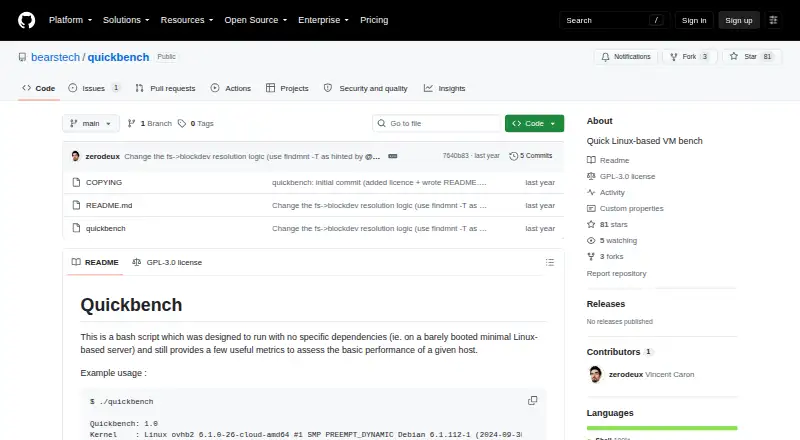
What Quickbench is
Quickbench is a free Bash script for getting a quick performance snapshot of Linux servers and virtual machines. It reports CPU configuration and runs busy-loop benchmarks at different parallel job counts, returning loop rates. It also reports the memory Linux can allocate and measures memory bandwidth with a simple test; that result may reflect L1 or L2 cache performance.
For storage, Quickbench runs parallel read and write transfers using 4k and 1M blocks, then reports bandwidth and I/O rates. The test runs on the filesystem in the current working directory. To measure a different device, mount its filesystem and run Quickbench from that mount point. The script is designed for minimal Linux servers and needs no specific dependencies. It takes one parameter: the maximum duration, in seconds, for each benchmark loop. The project recommends at least 30 seconds for statistically meaningful results and cautions that runs under 10 seconds may be unreliable. CPU loop results are not calibrated, so comparisons call for matching Quickbench, kernel, Bash, and dd versions. The storage check is not thorough and cannot measure I/O completion latency. Quickbench is available under the GPL-3.0 license.
Who it suits
Quickbench suits people who want a basic performance check of a Linux-based server or virtual machine, including on a minimal server. It can help compare CPU loop rates, memory measurements, and storage throughput when the relevant software versions are matched.
What it does well
- Free Bash script with no specific dependencies.
- Reports CPU configuration and loop rates at multiple job counts.
- Includes allocatable memory and memory-bandwidth measurements.
- Measures storage throughput and I/O rates with 4k and 1M blocks.
- Lets users choose the maximum duration for each benchmark loop.
What to know first
- Only supports Linux.
- CPU loop measurements are not calibrated.
- Storage testing is described as non-thorough and cannot measure completion latency.
- Storage tests use the current working directory's filesystem.
Limits
The project recommends runs of at least 30 seconds for statistically meaningful results and says durations under 10 seconds may be unreliable. CPU measurements are not calibrated, and the storage test is not thorough and cannot measure I/O completion latency.
Plans
| Plan | Billed and limits | Price |
|---|---|---|
| Quickbench | Bash script · Linux-based server · no specific dependencies | Free |
As github.com lists them, read 7 Oct 2026. The maker's own page has the final word.
Getting started
- Open the Quickbench repository on GitHub.
- Use a Linux-based server; the script is designed for minimal servers without specific dependencies.
- Choose the maximum duration in seconds for each benchmark loop; the project recommends at least 30 seconds.
- Run Quickbench from the filesystem you want to measure, mounting another device there first if needed.
Verdict
Choose Quickbench for a free, lightweight snapshot of CPU, memory, and storage performance on a Linux host. Its results have limits: CPU comparisons require matching versions, and the storage test does not measure I/O completion latency.
Questions
How much does Quickbench cost?
Quickbench is free. Its listed plan is free.
Which systems can run Quickbench?
Quickbench is for Linux-based hosts, including servers and virtual machines.
What does Quickbench measure?
It reports CPU configuration and loop rates, Linux-allocatable memory and a simple bandwidth result, plus storage bandwidth and I/O rates.
Does it need dependencies?
The script is designed to run without specific dependencies on a minimal Linux server.
Where does its storage test run?
It tests the filesystem in the current working directory. To test another device, mount a filesystem there and run the script from that location.
What license does Quickbench use?
The repository identifies the license as GPL-3.0.
Facts from Quickbench's own pages
- Benchmark limits
- The project describes its storage benchmark as non-thorough and says it cannot measure I/O completion latency. · github.com, 7 Oct 2026
- Benchmark location
- The storage benchmark runs on the filesystem in the current working directory. · github.com, 7 Oct 2026
- Comparability
- The README says CPU loop measurements are not calibrated and recommends matching Quickbench, kernel, Bash, and dd versions when comparing hosts. · github.com, 7 Oct 2026
- CPU benchmark
- It runs a CPU busy-loop with configurable parallel jobs and reports loop rates. · github.com, 7 Oct 2026
- CPU measurements
- It reports CPU configuration and runs a busy-loop benchmark at different job counts. · github.com, 7 Oct 2026
- Dependencies
- The script is designed to run without specific dependencies on a minimal Linux server. · github.com, 7 Oct 2026
- Intended users
- The README describes Quickbench as a quick Linux-based VM benchmark for assessing host performance. · github.com, 7 Oct 2026
- License
- The repository identifies the project license as GPL-3.0. · github.com, 7 Oct 2026
- Limitations
- Quickbench says it cannot currently measure storage I/O completion latency and describes its storage test as not thorough. · github.com, 7 Oct 2026
- Maker location
- The maker's GitHub organization profile lists Paris, France. · github.com, 7 Oct 2026
- Memory measurements
- It reports Linux allocatable memory and runs a simple memory bandwidth test that may reflect L1 or L2 cache performance. · github.com, 7 Oct 2026
- Memory metrics
- It reports Linux-allocatable memory and a simple memory bandwidth measurement that may reflect L1/L2 cache performance. · github.com, 7 Oct 2026
- Parameter
- The script accepts one parameter: the maximum duration in seconds for each benchmark loop. · github.com, 7 Oct 2026
- Purpose
- Quickbench is a Bash script that measures basic performance on Linux-based hosts. · github.com, 7 Oct 2026
- Recommended duration
- The README advises using at least 30 seconds for statistically meaningful results and says values below 10 seconds may be unreliable. · github.com, 7 Oct 2026
- Run duration
- Quickbench accepts one parameter, the loop delay in seconds, and recommends at least 30 seconds for statistically meaningful results. · github.com, 7 Oct 2026
- Storage measurements
- It benchmarks storage with parallel dd transfers using 4k and 1M blocks, reporting bandwidth and I/O rates. · github.com, 7 Oct 2026
- Storage metrics
- It measures storage read and write throughput using 4k and 1M blocks with multiple parallel jobs. · github.com, 7 Oct 2026
- Storage scope
- Storage benchmarks run on the filesystem in the current working directory; to benchmark another device, the user must mount a filesystem there and change to its mount point. · github.com, 7 Oct 2026
Where Quickbench stands on Freedom251
- Disk Benchmark Software#24 of 29