Freedom251 › Database Proxy Software
QueryMesh
What QueryMesh is
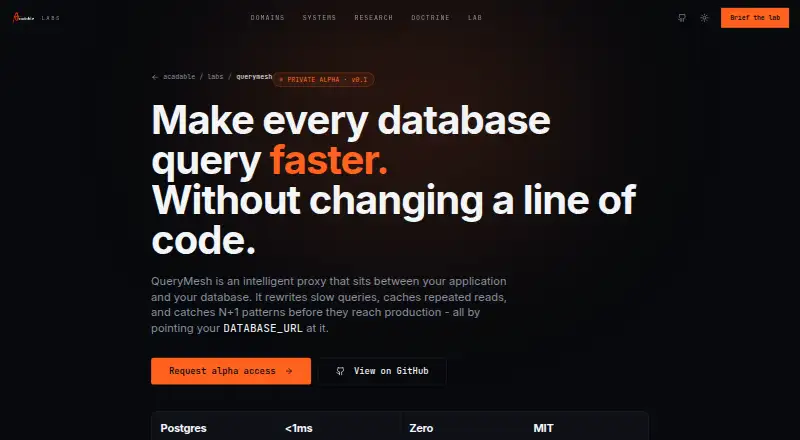
QueryMesh is a self-hosted database proxy for Postgres applications. Positioned between an application and its database, it rewrites slow queries, caches repeated reads, and detects N+1 patterns across a request boundary. When multiple round trips can become a JOIN, it folds them together; writes trigger row-level cache invalidation. A CI mode flags slower queries, new N+1 patterns, and query-plan changes before a pull request merges. Query plans, regressions, and slow queries can be exported as OpenTelemetry. Setup uses the native Postgres wire protocol: point DATABASE_URL at QueryMesh without adding an SDK or performing a migration. Examples cover Docker, Node.js, Django, and Rails, while the wire protocol is intended for any language and ORM. QueryMesh is MIT-licensed open source with a free pricing model. It is currently private alpha v0.1, with access available by request. Postgres is supported; MySQL is marked as coming soon.
Who it suits
QueryMesh suits development teams running Postgres that want query rewriting, caching, N+1 detection, and CI regression checks without changing application code. It is intended for self-hosted deployments and teams able to use a private-alpha release.
What it does well
- Open source under the MIT license
- Native Postgres wire-protocol setup
- No SDK or migration required
- CI flags query regressions before merges
- OpenTelemetry export for query diagnostics
What to know first
- Private alpha v0.1 availability
- MySQL is marked as coming soon
- Self-hosted deployment required
- Benchmark results may vary by workload
Limits
The product is private alpha v0.1, with access requested from the maker. MySQL is marked as coming soon, while Postgres is the supported database.
Getting started
- Request private-alpha access from the QueryMesh product page
- Deploy QueryMesh in your self-hosted environment
- Point DATABASE_URL at the proxy
- Connect using the native Postgres wire protocol
- Use the Docker, Node.js, Django, or Rails setup examples
Verdict
QueryMesh focuses on Postgres query behavior, combining proxy-based rewriting and caching with CI checks and OpenTelemetry output. Its open-source, self-hosted model may appeal to development teams, but private-alpha access and limited database support remain important constraints.
Questions
Is QueryMesh free?
Its pricing model is free, and the project is open source under the MIT license.
Which database does it support?
Postgres is supported. MySQL is labeled as coming soon.
How does an application connect?
Point DATABASE_URL at QueryMesh and use the native Postgres wire protocol. No SDK or migration is required.
What languages and frameworks can connect?
The wire protocol is intended for every language, ORM, and driver. Examples cover Docker, Node.js, Django, and Rails.
Is QueryMesh generally available?
The product page labels it private alpha v0.1 and invites teams to request access.
Facts from QueryMesh's own pages
- Availability
- The product page labels QueryMesh “PRIVATE ALPHA · v0.1” and invites teams to request alpha access. · acadable.com, 5 Oct 2026
- Benchmark caveat
- The published benchmark figures are described as alpha results from a controlled workload, and the page cautions that workloads differ. · acadable.com, 11 Oct 2026
- Caching
- The page says read results are cached and writes trigger row-level invalidation. · acadable.com, 11 Oct 2026
- Company stage
- Acadable Labs describes QueryMesh as alpha v0.1 among its systems and says the lab has one system in private alpha. · acadable.com, 5 Oct 2026
- Compatibility
- The page says QueryMesh uses the native Postgres wire protocol and works with every driver, ORM, and language. · acadable.com, 11 Oct 2026
- Database support
- The page describes native Postgres wire-protocol support and lists MySQL as “soon.” · acadable.com, 11 Oct 2026
- Headquarters
- Indore, India · acadable.com, 28 Sept 2026
- Integration
- The product page says integration requires pointing DATABASE_URL at the proxy, with no SDK or migration, and shows Docker run instructions. · acadable.com, 11 Oct 2026
- Integrations
- The setup section shows Docker and examples for Node.js, Django, and Rails; the page also says any language and ORM can connect through the wire protocol. · acadable.com, 5 Oct 2026
- License
- The product page identifies QueryMesh as MIT-licensed. · acadable.com, 11 Oct 2026
- Maker and location
- The product page attributes QueryMesh to ACADABLE Labs and lists Indore, India in its footer. · acadable.com, 5 Oct 2026
- Observability
- The page says query plans, regressions, and slow queries are exported as OpenTelemetry. · acadable.com, 11 Oct 2026
- Pricing
- The alpha access section says “No credit card”; the page lists no product price. · acadable.com, 5 Oct 2026
- Product
- QueryMesh is a database proxy that rewrites slow queries, caches repeated reads, and catches N+1 patterns by routing the application’s DATABASE_URL through it. · acadable.com, 11 Oct 2026
- Query rewriting
- QueryMesh says it detects N+1 patterns across a request boundary and folds multiple round-trips into one JOIN. · acadable.com, 11 Oct 2026
- Regression detection
- The page says CI use can flag slower queries, new N+1 patterns, and query plan changes before a pull request merges. · acadable.com, 11 Oct 2026
- Stage
- The product page labels QueryMesh “PRIVATE ALPHA · v0.1” and invites teams to request alpha access. · acadable.com, 11 Oct 2026
- Support
- The maker says it is onboarding teams one at a time so it can help when problems occur. · acadable.com, 11 Oct 2026
Where QueryMesh stands on Freedom251
- Database Proxy Software#29 of 31