Freedom251 › Database Proxy Software
Cetus
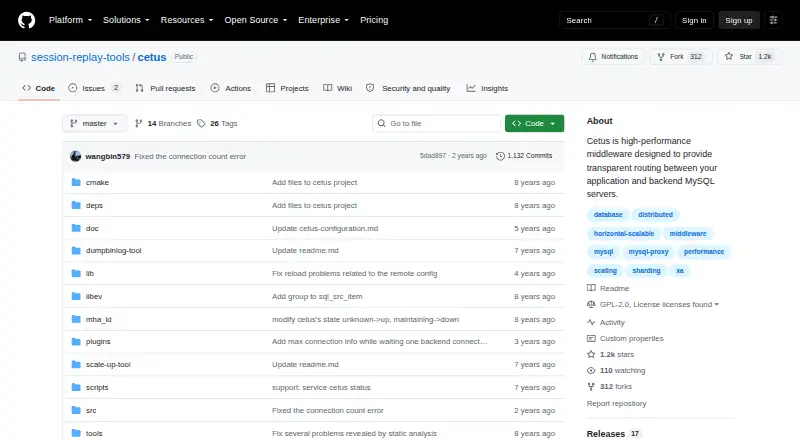
What Cetus is
Cetus is self-hosted C middleware that sits between applications and MySQL servers, routing database traffic through a Linux deployment. It comes in two editions: one for SQL read-write splitting and enhanced routing, and another for sharding, distributed transaction processing, and bulk inserts. Both editions offer transparent backend connection pooling and prepared statements. Cetus also provides status monitoring and an admin port for viewing or changing backend status and configuration. The quick-start guide recommends MySQL 5.7.16 or later and describes connecting with a MySQL client; management access through the admin port can use Python pymysql or MySQLdb. Startup instructions cover command-line and service-based methods. The project is free and open source under GPL-2.0. Its constraints matter for deployment planning: it does not support multi-tenant use or cross-shard joins, and the sharding edition does not support dynamic expansion or cross-database joins and is limited to 64 databases. Documentation conflicts on TLS support: the README lists client-side SSL/TLS, while the constraints guide says TLS is unsupported.
Who it suits
Cetus suits teams running MySQL on Linux that want self-hosted traffic routing, read-write splitting, or sharding. Its limits and conflicting TLS documentation merit review before deployment.
What it does well
- Free and open source under GPL-2.0
- Offers read-write splitting and sharding editions
- Supports backend connection pooling and prepared statements
- Admin port supports backend status and configuration changes
What to know first
- Runs only on Linux
- Does not support multi-tenant use
- Sharding edition is limited to 64 databases
- TLS documentation gives conflicting information
Verdict
Cetus provides MySQL routing, pooling, and distinct read-write and sharding editions for Linux deployments. Check its sharding constraints and resolve the conflicting TLS guidance against your requirements.
Facts from Cetus's own pages
- Connection handling
- Both versions support transparent backend connection pooling and prepared statements. · github.com, 10 Oct 2026
- Connections
- Cetus supports transparent backend connection pooling and prepared statements in its read-write splitting edition. · github.com, 11 Oct 2026
- Database compatibility
- The quick-start guide recommends MySQL 5.7.16 or later and describes using MySQL client connections to Cetus. · github.com, 10 Oct 2026
- Deployment
- Cetus runs only on Linux, and its installation guide describes compiling and installing it from source. · github.com, 11 Oct 2026
- Editions
- The project offers read-write splitting and database sharding editions. · github.com, 11 Oct 2026
- Integration
- The quick-start guide says the admin port can be accessed using Python pymysql and MySQLdb modules. · github.com, 11 Oct 2026
- License
- The repository identifies Cetus as GPL-2.0 licensed. · github.com, 10 Oct 2026
- Management
- Cetus exposes an admin port for viewing and changing backend status and configuration parameters. · github.com, 11 Oct 2026
- Management integrations
- The quick-start guide documents connecting to the management port with Python pymysql and MySQLdb modules. · github.com, 10 Oct 2026
- Monitoring
- Cetus supports status monitoring and provides an admin port for viewing and changing backend status and configuration parameters. · github.com, 10 Oct 2026
- Purpose
- Cetus is C middleware that acts as a MySQL database access proxy, allowing applications to connect through it for database-layer horizontal scaling and high availability. · github.com, 11 Oct 2026
- Read-write routing
- The read-write splitting edition supports SQL read-write splitting and enhanced SQL routing. · github.com, 11 Oct 2026
- Security
- The repository lists security management and client-side SSL/TLS support as features, while its usage constraints page says TLS is unsupported; the pages therefore give conflicting TLS information. · github.com, 11 Oct 2026
- Sharding
- The sharding edition supports data sharding, distributed transaction processing, and bulk inserts. · github.com, 11 Oct 2026
- Sharding limits
- The sharding edition does not support dynamic expansion or cross-database joins and supports at most 64 databases. · github.com, 11 Oct 2026
- Support
- The repository directs users to open an issue for bugs or feature requests and asks them to search existing issues first. · github.com, 11 Oct 2026
- TLS support
- The README lists client-side SSL/TLS support, while the constraints guide says TLS is unsupported. · github.com, 10 Oct 2026
- Usage limits
- The usage constraints page says Cetus does not support multi-tenant use, batch SQL execution, or client Ctrl+C query termination. · github.com, 11 Oct 2026
Where Cetus stands on Freedom251
- Database Proxy Software#27 of 31