Freedom251 › Container Registries
Quay
What Quay is
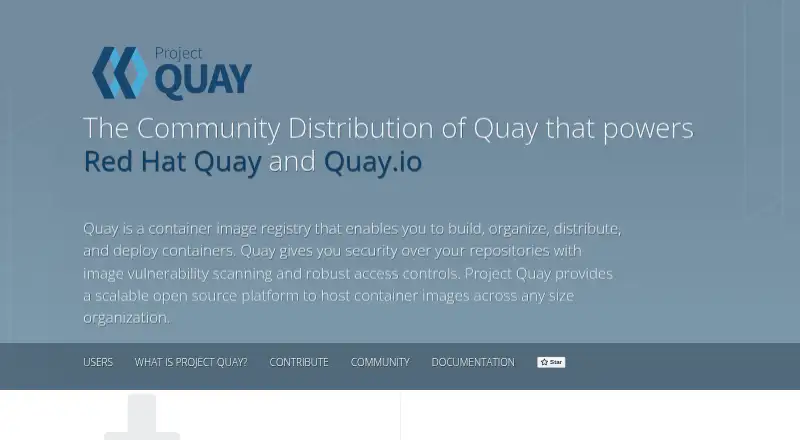
Project Quay is an open source registry for building, organizing, distributing, and deploying container images and OCI artifacts. Teams can use its web interface to manage private repositories and decide who can view or change content. It can run as a standalone component or as an Operator on OpenShift Container Platform, and it also supports Kubernetes deployments. Clair scans container images for known vulnerabilities and can suggest remediation. For distribution, Quay supports repository mirroring, multi-region replication with client failover, and disconnected environments. CI/CD and Git-compatible integrations, including GitHub, GitLab, and Bitbucket, can support automated builds and deployments. Its OAuth 2 REST API can be used to manage the registry and automate tasks. Security capabilities include TLS, isolated builds, role-based organization and team access, and encryption of sensitive fields at rest and at runtime. The community distribution is free under an Apache 2 license. Deployments require image storage, a database, and Redis; local image storage is intended only for proof-of-concept or test installations.
Who it suits
Quay suits teams that need to manage container images and OCI artifacts across development or production deployments. It supports both smaller deployments and enterprise use, including Kubernetes and disconnected environments.
What it does well
- Open source community distribution under an Apache 2 license
- Clair scans images and can suggest remediation
- Supports mirroring and multi-region replication
- Integrates with GitHub, GitLab, and Bitbucket
- Supports disconnected deployments
What to know first
- Requires image storage, a database, and Redis
- Local image storage is intended only for tests or proof-of-concept
- FIPS-compliant functions have deployment and version prerequisites
Limits
The free community distribution requires a database and reliable image storage. Local image storage is intended only for proof-of-concept or test installations because blob durability is not guaranteed.
Plans
| Plan | Billed and limits | Price |
|---|---|---|
| Project Quay (open source community distribution) | Apache 2 license · requires a database and reliable image storage | Free |
As projectquay.io lists them, read 30 Sept 2026. The maker's own page has the final word.
Getting started
- Visit the Project Quay website.
- Choose the open source community distribution, priced at $0.
- Prepare image storage, a database, and Redis for the deployment.
- Deploy Quay as a standalone component or as an Operator on OpenShift Container Platform; Kubernetes deployments are supported.
- Connect a supported storage option such as AWS S3, Google Cloud Storage, or Azure Blob Storage.
Verdict
Project Quay combines registry management, scanning, automation, and distribution options in an open source package. Plan for the required database, Redis, and durable image storage when choosing a deployment.
Questions
How much does Project Quay cost?
The open source community distribution is free under an Apache 2 license. The pricing model is freemium, and the pricing note includes a 30-day trial.
What platforms does Project Quay support?
Its listed platforms are API, Linux, self-hosted, and web. Deployments can run standalone or as an Operator on OpenShift Container Platform, and Kubernetes deployments are supported.
Is Project Quay open source?
Yes. The community distribution is open source under an Apache 2 license.
What infrastructure does a deployment need?
A deployment requires image storage, a database, and Redis. Supported storage options include AWS S3, Google Cloud Storage, and Azure Blob Storage.
Can Project Quay scan container images?
Yes. Clair scans container images for known vulnerabilities and can suggest remediation.
Who provides support for Project Quay?
Red Hat provides 24/7 support for Project Quay.
Facts from Quay's own pages
- API
- Project Quay provides an OAuth 2 REST API for managing the registry and automating tasks. · docs.projectquay.io, 30 Sept 2026
- Build automation
- It integrates with CI/CD tools and Git-compatible systems, including GitHub, GitLab, and Bitbucket, for automated builds and deployments. · docs.projectquay.io, 30 Sept 2026
- Compliance
- FIPS-compliant cryptographic functions can be enabled with prerequisites that vary by deployment environment and version. · docs.projectquay.io, 30 Sept 2026
- Deployments
- It can run as a standalone component or as an Operator on OpenShift Container Platform, and supports Kubernetes deployments. · docs.projectquay.io, 30 Sept 2026
- Distribution
- It supports repository mirroring, geographic replication with client failover, and deployment in disconnected environments. · docs.projectquay.io, 30 Sept 2026
- Intended users
- Project Quay supports small-scale and enterprise deployments, including development and production workloads. · docs.projectquay.io, 30 Sept 2026
- Notable limit
- Local image storage is intended only for proof-of-concept or test installations because blob durability is not guaranteed. · docs.projectquay.io, 30 Sept 2026
- Purpose
- Project Quay is an open source container image registry for building, organizing, distributing, and deploying containers and OCI artifacts. · projectquay.io, 30 Sept 2026
- Security controls
- Security capabilities include TLS, isolated builds, organization and team role-based access, and encryption of sensitive fields at rest and at runtime. · docs.projectquay.io, 30 Sept 2026
- Storage and infrastructure
- A deployment requires image storage, a database, and Redis; supported storage options include AWS S3, Google Cloud Storage, and Azure Blob Storage. · docs.projectquay.io, 30 Sept 2026
- Support
- The overview states that Red Hat provides 24/7 support for Project Quay. · docs.projectquay.io, 30 Sept 2026
- Vulnerability scanning
- Clair scans container images for known vulnerabilities and can suggest remediation. · docs.projectquay.io, 30 Sept 2026
- Web interface and access
- It provides a web interface, private repositories, and controls for managing who can view or change content. · docs.projectquay.io, 30 Sept 2026
Where Quay stands on Freedom251
- Container Registries#15 of 60