Freedom251 › Configuration Management Tools
Quattor
What Quattor is
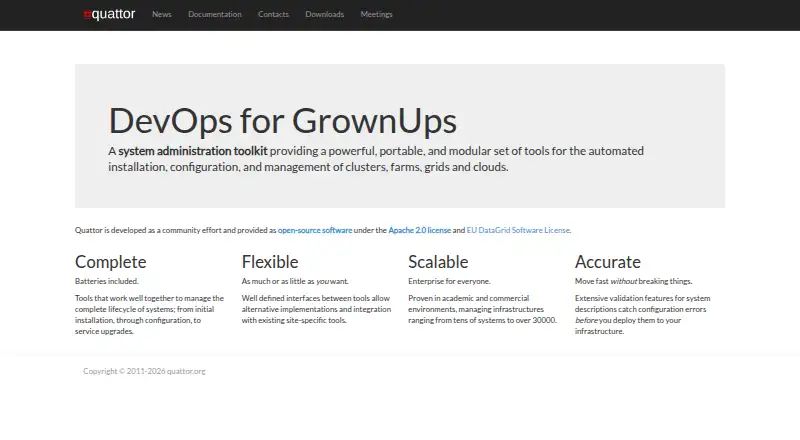
Quattor is a Linux system-administration toolkit for automating installation, configuration, and management across clusters, farms, grids, and clouds. It is self-hosted, open-source software under the Apache 2.0 and EU DataGrid Software licenses, with a free plan. Its tools cover the system lifecycle from initial installation through configuration and service upgrades. The architecture uses a CMDB server, an Automated Installation Infrastructure server, and managed clients; the two servers can share a system. AII plugins manage DHCP and PXE boot settings and create Kickstart files for Enterprise Linux-derived systems. On clients, the Configuration Cache Manager fetches and validates profiles, while the Node Configuration Dispatcher runs configuration components. Quattor validates system descriptions before deployment, and its Pan compiler translates declarative configuration into nested structures, including XML and JSON. Interfaces permit alternative implementations and site-specific tools. The site describes use in academic and commercial environments ranging from tens of systems to more than 30,000. Community members develop and support the toolkit; production use requires knowledge of Quattor and site configuration.
Who it suits
Quattor may suit administrators managing Linux infrastructure who can work with its toolkit and site-specific configuration. The getting-started guide describes it as a complex toolset and says production use requires that knowledge.
What it does well
- Automates installation, configuration, and upgrades
- Validates system descriptions before deployment
- Supports Rocky Linux and AlmaLinux
- Open-source under two listed licenses
What to know first
- Production use requires toolkit and site-configuration knowledge
- Nightly builds are not guaranteed to work in real environments
- Older SCDB is deprecated and has scaling problems above 2,500 systems
- Community support has no full-time paid developers
Limits
Nightly builds may pass unit tests but are not guaranteed to work in a real environment. The older SCDB configuration database is deprecated, has scaling problems above 2,500 systems, and will receive no further development.
Plans
| Plan | Billed and limits | Price |
|---|---|---|
| Quattor open-source software | Open-source software · Apache 2.0 and EU DataGrid Software licenses | Free |
As quattor.org lists them, read 8 Oct 2026. The maker's own page has the final word.
Getting started
- Visit the Quattor website and review the getting-started guide.
- Prepare an Enterprise Linux environment, including Rocky Linux or AlmaLinux.
- Set up the CMDB and Automated Installation Infrastructure servers; they can share a system.
- Use the downloads page for client and server RPMs through yum.quattor.org.
- Configure managed clients to fetch and validate profiles and run configuration components.
- Restrict access to profile and Kickstart configuration areas that may contain sensitive information.
- Use the discussion group or GitHub issues and pull requests for community support.
Verdict
Quattor provides lifecycle automation and validation for self-hosted Linux infrastructure, with interfaces for site-specific implementations. Its complexity and the deprecated SCDB limit are important considerations for administrators.
Questions
Is Quattor free and open source?
Yes. The listed plan is free, and Quattor is provided under the Apache 2.0 and EU DataGrid Software licenses.
Where does Quattor run?
It is Linux and self-hosted software. Supported platforms include Enterprise Linux, including Rocky Linux and AlmaLinux.
What infrastructure does Quattor manage?
It automates installation, configuration, and management for clusters, farms, grids, and clouds. The site describes use across environments from tens of systems to over 30,000.
What are Quattor's main components?
The documented architecture includes a CMDB server, an Automated Installation Infrastructure server, and managed clients. The CMDB and AII servers can share a system.
Who develops Quattor and where can users get support?
Quattor is developed and supported by its user community, with no full-time paid developers. The site directs users to its discussion group and GitHub issues or pull requests.
Does Quattor integrate with other configuration tools?
Its interfaces allow alternative implementations and site-specific tools. The overview also describes configuration components for core and grid services, including metaconfig and filecopy.
Facts from Quattor's own pages
- Architecture
- Quattor comprises a configuration management database server, an automated installation infrastructure server, and managed clients; the first two can run on one system. · quattor.org, 8 Oct 2026
- Client configuration
- Client tools fetch and validate profiles, cache them locally, and invoke configuration components to apply them. · quattor.org, 8 Oct 2026
- Configuration compiler
- The Pan compiler compiles the declarative Pan language into nested tree structures, including XML and JSON output formats. · quattor.org, 8 Oct 2026
- Customization
- Well-defined interfaces let users substitute alternative implementations and integrate site-specific tools. · quattor.org, 7 Oct 2026
- Downloads
- The downloads page provides client and server RPMs through yum.quattor.org and describes nightly builds for several platforms. · quattor.org, 7 Oct 2026
- Installation
- The AII server uses plugins to manage DHCP and PXE boot configuration and to create Kickstart files for EL-derived systems. · quattor.org, 7 Oct 2026
- Installation features
- Automated Installation Infrastructure plugins manage DHCP configuration, PXE boot and Kickstart installation files for Enterprise Linux derived systems. · quattor.org, 8 Oct 2026
- Integrations
- The overview describes configuration components for core and grid computing services, with examples including general-purpose metaconfig and filecopy components. · quattor.org, 8 Oct 2026
- Intended users
- The getting-started guide describes Quattor as a somewhat complex toolkit and says production use requires detailed knowledge of the tools and site configuration. · quattor.org, 8 Oct 2026
- License
- Quattor is open-source software provided under the Apache 2.0 license and the EU DataGrid Software License. · quattor.org, 7 Oct 2026
- Lifecycle management
- Its tools cover system management from initial installation through configuration to service upgrades. · quattor.org, 8 Oct 2026
- Modular design
- Well-defined interfaces allow alternative implementations and integration with site-specific tools. · quattor.org, 8 Oct 2026
- Notable limit
- The documentation says the older SCDB configuration database is deprecated, has scaling problems above 2,500 systems, and will receive no further development. · quattor.org, 8 Oct 2026
- Notable limitation
- The downloads page cautions that nightly builds may pass unit tests but are not guaranteed to work in a real environment. · quattor.org, 7 Oct 2026
- Purpose
- Quattor is a system administration toolkit for automated installation, configuration, and management of clusters, farms, grids, and clouds. · quattor.org, 8 Oct 2026
- Scale
- The site says Quattor has been used in academic and commercial environments managing infrastructures from tens of systems to over 30,000. · quattor.org, 8 Oct 2026
- Security
- The 26.2.0 release announcement says its RPM packages and repository metadata are signed with a GPG key. · quattor.org, 8 Oct 2026
- Security guidance
- The SCDB guide recommends restricting access to profile and Kickstart configuration areas because they may contain sensitive information, including passwords. · quattor.org, 7 Oct 2026
- Support
- Quattor is developed and supported by its user community, with discussion through a mailing group and issue or pull request reporting on GitHub. · quattor.org, 8 Oct 2026
- Validation
- Quattor includes validation features intended to catch configuration errors before deployment. · quattor.org, 8 Oct 2026
Where Quattor stands on Freedom251
- Configuration Management Tools#17 of 26
- Orchestration / Provisioning Software#18 of 27