Freedom251 › Data Deduplication Software
pyJedAI
What pyJedAI is
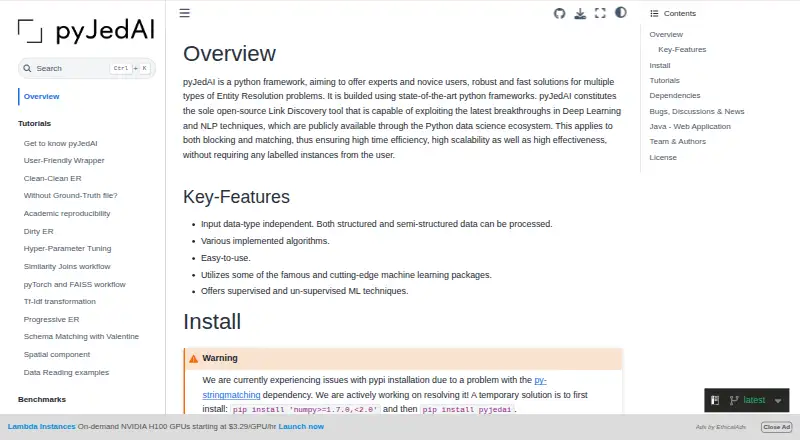
pyJedAI is a free, open-source Python framework for entity resolution and link discovery. Its documented workflow reads structured or semi-structured data, including pandas DataFrames, then proceeds through block building and cleaning, entity matching, clustering, and results with scores and visualizations. The project lists supervised and unsupervised machine-learning techniques, and says matching and blocking can use deep learning and natural language processing. A tutorial covers embedding-based blocking with PyTorch and Gensim vectorizers, followed by nearest-neighbor search with FAISS. The documentation also shows schema matching using Valentine methods such as Similarity Flooding, Cupid, COMA, EmbDI, and SemProp. A geospatial interlinking component includes spatial filtering, initialization, and verification steps. Installation is documented through PyPI, a local Git checkout, or Docker. The project says it has been tested on Windows and Linux and requires Python 3.8 or later; Windows additionally requires Microsoft Visual C++ 14.0. The project identifies itself as research by the AI-Team of the Department of Informatics and Telecommunications at the University of Athens. It recommends GitHub Discussions for general questions and discussions and links to an issue tracker for bugs.
Who it suits
pyJedAI suits developers, IT teams, and science or research users working on entity resolution or link discovery. The project describes it as intended for both novice and expert users.
What it does well
- Workflow includes matching, clustering, scores, and visualizations.
- Supports structured and semi-structured data.
- Includes schema matching and geospatial interlinking documentation.
- Installation options include PyPI, Git checkout, and Docker.
- Free and open source.
What to know first
- Requires Python 3.8 or later.
- Windows also requires Microsoft Visual C++ 14.0.
- Security updates are listed for version 0.0.x.
Plans
| Plan | Billed and limits | Price |
|---|---|---|
| pyJedAI | Open-source Python library · Apache-2.0 license | Free |
As pyjedai.readthedocs.io lists them, read 4 Oct 2026. The maker's own page has the final word.
Getting started
- Choose PyPI, a local Git checkout, or Docker as the installation route.
- Confirm that Python 3.8 or later is available.
- On Windows, install Microsoft Visual C++ 14.0 as required.
- Use the documented workflow to read data, build and clean blocks, match entities, cluster, and review scored results.
Overview
pyJedAI is an open-source Python framework for resolving records that refer to the same entity and discovering links across datasets. It suits developers and research teams working with structured or semi-structured data who want to build and inspect matching workflows in Python. Its breadth—from blocking and matching to schema and geospatial interlinking—is a strength, but it is a framework rather than a turnkey deduplication service.
Key features
The documented workflow runs from reading pandas DataFrames through block building and cleaning, entity matching and clustering, then presents results with scores and visualizations. That end-to-end structure is useful for teams that need to shape a resolution pipeline rather than hand matching off to a hosted product. The tradeoff is that users work within a Python workflow.
pyJedAI lists supervised and unsupervised machine-learning techniques, and says matching and blocking can use deep learning and NLP. An embedding tutorial combines PyTorch and Gensim vectorizers with FAISS nearest-neighbor search, offering a route for teams exploring vector-based blocking. Schema matching covers Valentine methods including Similarity Flooding, Cupid, COMA, EmbDI and SemProp. A separate geospatial interlinking component documents spatial filtering, initialization and verification.
Fuzzy matching and API access are supported. The combination makes pyJedAI a flexible option for technical users handling several kinds of linkage problems, though its documented workflows are best suited to users prepared to work with Python and the underlying methods.
Pricing
pyJedAI is free and open source under the Apache-2.0 license. The pyJedAI plan costs nothing. There is no free trial because there is no paid plan to trial. This makes it accessible for experimentation and ongoing use without a software fee, but does not make it a managed service: the framework is installed and run by the user.
Platforms
pyJedAI supports Linux and Windows and is self-hosted. Installation is documented through PyPI, a local Git checkout or Docker. The project says it has been tested on Windows and Linux and requires Python 3.8 or later; Windows also requires Microsoft Visual C++ 14.0. These prerequisites matter when choosing it for an existing environment, particularly on Windows.
Who it's for
The project identifies developers, IT and science or research audiences, and describes its intended users as both novice and expert. In practice, the Python-based workflows and range of algorithms will be most valuable to people able to configure and evaluate a matching pipeline. Teams seeking a ready-to-use interface or hosted service should consider alternatives instead.
The project is a research effort by the AI-Team in the Department of Informatics and Telecommunications at the University of Athens. General questions and discussion go to GitHub Discussions; bugs go to the issue tracker. The repository security policy lists version 0.0.x as supported for security updates.
Pros and cons
- Pros: The documented workflow spans blocking, cleaning, matching, clustering and scored results, giving technical users a coherent starting point for an end-to-end pipeline.
- Pros: Machine-learning, deep-learning, NLP and embedding-based approaches, alongside schema and geospatial matching, cover more than basic duplicate detection.
- Pros: Free, open-source licensing and PyPI, Git and Docker installation options suit teams that want to run the framework in their own environment.
- Cons: Python 3.8 or later is required, with an additional Microsoft Visual C++ 14.0 prerequisite on Windows; it is not a fit for teams that cannot manage that environment.
- Cons: A framework workflow puts pipeline setup and operation on the user, making it less direct than choosing a hosted or interface-led service.
Alternatives
For a wider set of data-deduplication options, browse Data Deduplication Software.
- Tilores is worth comparing if a local deployment and a cap of up to 100,000 records per deployment suit the job; its Studio Local Mode is free and needs no account or licence key.
- Choose DupeCatcher if a free option on Android, iOS or the web better suits your platform needs; its free plan includes all features.
- AWS Entity Resolution is an API and web alternative with paid plans; its data service provider matching is billed per 1,000 records and requires a provider license or subscription, with provider costs additional.
- Koalify may suit sandbox or demo use, or portals below 10K records, with its Free Forever plan. Its Pro Plan is $25 a month and billed annually.
- Plauti Deduplicate is an option for Salesforce users: its free version is available from AppExchange, while full-edition features require a trial or custom pricing.
- Splink is another free, self-hosted Python package for Linux, released under the MIT license; compare it if you want a separate open-source entity-resolution package.
- Zingg offers a free open-source Community edition for batch probabilistic matching at millions of records; consider it if that stated scale and approach fit your workload.
- Senzing Entity Resolution is a paid alternative with API, web and self-hosted platforms, among others; its 10M DSR subscription is $58,560 a year.
Verdict
Choose pyJedAI if you need a free, self-hosted Python framework for building and examining entity-resolution workflows across record matching, schema matching or geospatial interlinking.
Verdict
pyJedAI provides documented workflows for entity resolution, schema matching, and geospatial interlinking. Check the Python and Windows prerequisites before installation.
Questions
How much does pyJedAI cost?
The listed plan is free. The project is open source.
Which platforms does it support?
It is listed for Linux, Windows, and self-hosted use. The project says it has been tested on Linux and Windows.
What does pyJedAI require?
It requires Python 3.8 or later. Windows also requires Microsoft Visual C++ 14.0.
How can I install it?
Documented installation routes include PyPI, a local Git checkout, and Docker.
What does its workflow cover?
It covers data reading, block building and cleaning, entity matching, clustering, and results with scores and visualizations.
Who makes pyJedAI?
The project identifies itself as research by the AI-Team of the Department of Informatics and Telecommunications at the University of Athens.
Facts from pyJedAI's own pages
- Algorithms
- The project lists supervised and unsupervised machine-learning techniques and says its matching and blocking can use deep learning and NLP techniques. · github.com, 4 Oct 2026
- Embedding tools
- A tutorial documents embedding-based blocking with PyTorch and Gensim vectorizers and nearest-neighbor search using FAISS. · pyjedai.readthedocs.io, 4 Oct 2026
- Geospatial feature
- The documentation includes a geospatial interlinking component with spatial filtering, initialization, and verification steps. · pyjedai.readthedocs.io, 4 Oct 2026
- Input data
- It processes structured and semi-structured data, using pandas DataFrames as input in the documented workflow. · pyjedai.readthedocs.io, 4 Oct 2026
- Installation
- The project documents installation from PyPI, local Git checkout, and Docker. · github.com, 4 Oct 2026
- Intended users
- The project describes pyJedAI as intended for both expert and novice users and identifies developers, IT, and science/research audiences in its PyPI classifiers. · pypi.org, 4 Oct 2026
- Maker
- The project identifies itself as a research project by the AI-Team of the Department of Informatics and Telecommunications at the University of Athens. · github.com, 4 Oct 2026
- Operating systems
- The project says pyJedAI has been tested on Windows and Linux and requires Python 3.8 or later; Windows also requires Microsoft Visual C++ 14.0. · github.com, 4 Oct 2026
- Purpose
- pyJedAI is an open-source Python framework for entity resolution and link discovery. · github.com, 4 Oct 2026
- Schema matching
- The documentation shows pyJedAI schema matching with Valentine methods including Similarity Flooding, Cupid, COMA, EmbDI, and SemProp. · pyjedai.readthedocs.io, 4 Oct 2026
- Security
- The repository security policy lists version 0.0.x as supported for security updates and directs users to report bugs through an issue or discussion. · github.com, 4 Oct 2026
- Support
- The project recommends GitHub Discussions for general questions and discussions and links to its issue tracker for bugs. · github.com, 4 Oct 2026
- Workflow
- Its documented workflow covers data reading, block building and cleaning, entity matching, clustering, and results with scores and visualizations. · pyjedai.readthedocs.io, 4 Oct 2026
Where pyJedAI stands on Freedom251
- Data Deduplication Software#6 of 27