pycodestyle
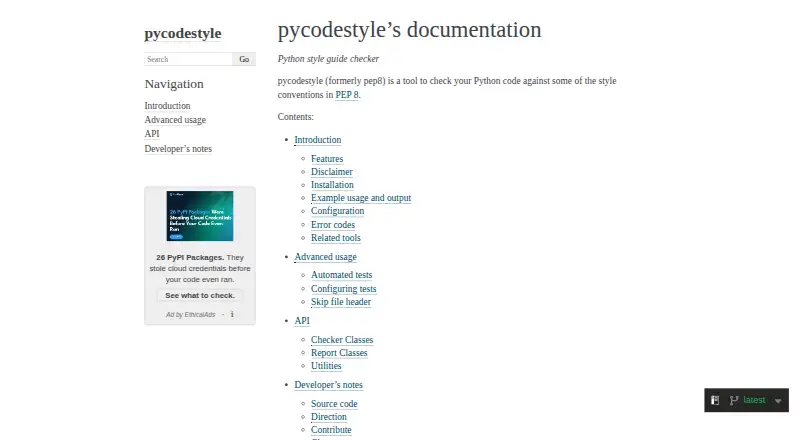
What pycodestyle is
pycodestyle is a free Python code checker that identifies some style issues covered by PEP 8. It runs on Linux, macOS, and Windows, and its command-line reports can be parsed by editors to jump to an error location. Reports can include source code and PEP 8 guidance, count errors, and use default, pylint, or custom formatting. Users can configure it for themselves or a project, including through setup.cfg or tox.ini files, and its plugin architecture allows additional checks. Flake8 is described as a wrapper around pycodestyle and similar tools that supports plugins.
The project describes pycodestyle as a single Python file that needs only the standard library and says it includes a comprehensive test suite. Its documentation provides pip commands to install, upgrade, and uninstall it. The listed plan is free; it is an MIT-licensed Python package requiring Python >=3.10. The checker does not cover every PEP 8 rule. Naming conventions, docstring conventions, and automatic fixing are outside its scope, with plugins or related tools pointed to for those needs.
Who it suits
pycodestyle suits Python developers who want command-line checks for selected PEP 8 conventions and editor-friendly error locations. It also fits projects that need configurable reports or want to extend checks through plugins, but not users seeking naming or docstring conventions or automatic fixing within the library itself.
What it does well
- Free under the listed free plan.
- Runs on Linux, macOS, and Windows.
- Editor-parseable output can jump to error locations.
- Supports user- and project-level configuration.
- Plugins can add checks.
- Requires only the Python standard library.
What to know first
- Does not enforce every PEP 8 rule.
- Naming and docstring conventions are outside its scope.
- Automatic fixing is outside its scope.
- Requires Python >=3.10.
Limits
The free plan is a checker with deliberately limited PEP 8 coverage: it does not enforce every rule. Naming conventions, docstring conventions, and automatic fixing are outside its scope.
Plans
| Plan | Billed and limits | Price |
|---|---|---|
| pycodestyle | MIT licensed Python package · requires Python >=3.10 | Free |
As pycodestyle.pycqa.org lists them, read 9 Oct 2026. The maker's own page has the final word.
Getting started
- Open the pycodestyle documentation website.
- Use the documented pip command to install pycodestyle.
- Configure settings for yourself or a project, including through setup.cfg or tox.ini if needed.
- Run its command-line checker and select the report format you need.
Verdict
Choose pycodestyle for free, configurable checks of selected PEP 8 conventions, especially when editor navigation or plugin extensions matter. Look elsewhere or use plugins or related tools if you need exhaustive rule coverage, naming or docstring checks, or automatic fixing.
Questions
How much does pycodestyle cost?
Its listed plan is free.
Which platforms does it support?
It runs on Linux, macOS, and Windows. PyPI classifies it as OS independent and lists CPython and PyPy implementations.
Can it automatically fix code?
No. Automatic fixing is outside the library’s scope.
Can I add custom checks?
Yes. Its plugin architecture allows additional checks.
How can I configure it?
Settings can be applied at user and project levels, including through setup.cfg or tox.ini.
What Python version does it require?
The listed package requires Python >=3.10.
Facts from pycodestyle's own pages
- Compatibility
- PyPI classifies the package as OS independent and lists CPython and PyPy implementations. · pypi.org, 9 Oct 2026
- Configuration
- Users can configure pycodestyle at user and project levels, including through setup.cfg or tox.ini. · pycodestyle.pycqa.org, 9 Oct 2026
- Editor output
- Its parseable output lets users jump to an error location in an editor. · pycodestyle.pycqa.org, 9 Oct 2026
- Installation
- The documentation gives pip install, upgrade, and uninstall commands for pycodestyle. · pycodestyle.pycqa.org, 9 Oct 2026
- Integration
- Flake8 is described as a wrapper around pycodestyle and similar tools that supports plugins. · pycodestyle.pycqa.org, 9 Oct 2026
- Lightweight
- The project says it is a single Python file that requires only the standard library. · pycodestyle.pycqa.org, 9 Oct 2026
- Limitations
- The checker does not enforce every PEP 8 rule and does not aim to be exhaustive. · pycodestyle.pycqa.org, 9 Oct 2026
- Out of scope
- Naming conventions, docstring conventions, and automatic fixing are outside the library’s scope; the documentation points to plugins or related tools for these needs. · pycodestyle.pycqa.org, 9 Oct 2026
- Plugins
- Its plugin architecture makes it easy to add new checks. · pycodestyle.pycqa.org, 9 Oct 2026
- Purpose
- pycodestyle checks Python code against some of the style conventions in PEP 8. · pycodestyle.pycqa.org, 9 Oct 2026
- Reporting
- The CLI can show source and PEP 8 guidance, count errors, and format output as default, pylint, or custom. · pycodestyle.pycqa.org, 9 Oct 2026
- Security and trust
- PyPI lists the 2.15.0 source distribution and wheel as not uploaded using Trusted Publishing. · pypi.org, 9 Oct 2026
- Test suite
- The project says it comes with a comprehensive test suite. · pycodestyle.pycqa.org, 9 Oct 2026
Where pycodestyle stands on Freedom251
- Linters#21 of 33