Freedom251 › Reverse Engineering Tools
pycdc
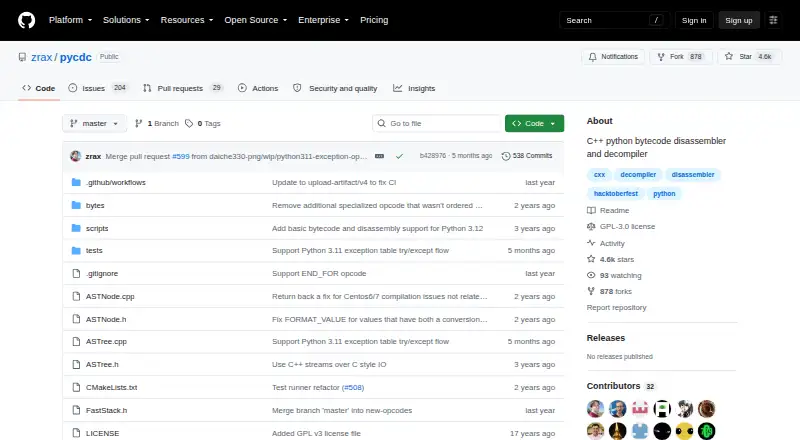
What pycdc is
pycdc is the command-line decompiler in Decompyle++, a C++ project that translates compiled Python bytecode into readable Python source. Give the pycdc command a PYC file and it prints the resulting source to standard output. The companion command, pycdas, disassembles a PYC file and prints its bytecode. Both tools can also process Python marshalled code objects, but those objects contain no version metadata, so you must supply the Python version. Decompyle++ aims to support bytecode from any Python version, and handles bytecode rather than native code.
The project runs on Linux, macOS, and Windows. To build it, use CMake to generate a project or makefile, then build the generated files. The README describes using tools such as MSVC for Windows project files and gives makefile build and test instructions for Unix-like systems or MSYS. Decompyle++ is licensed under the GNU General Public License, version 3, and credits Michael Hansen and Darryl Pogue as its authors. Its plan is free, with GPL-3.0-licensed source code; the repository has no packaged GitHub releases.
Who it suits
pycdc suits developers who need to turn compiled Python bytecode into source or inspect bytecode through disassembly. It is also relevant to people comfortable building C++ software with CMake on Linux, macOS, Windows, or MSYS.
What it does well
- Decompiles PYC files to Python source.
- Includes a companion bytecode disassembler.
- Supports Python marshalled code objects.
- Runs on Linux, macOS, and Windows.
- GPL-3.0 licensed source code is free.
What to know first
- Requires a CMake-based build process.
- Marshalled code objects require a specified Python version.
- The repository has no packaged GitHub releases.
Limits
The free plan provides GPL-3.0-licensed source code, with no packaged GitHub releases. Processing marshalled code objects requires specifying the Python version.
Plans
| Plan | Billed and limits | Price |
|---|---|---|
| Decompyle++ | GPL-3.0 licensed source code · no packaged GitHub releases | Free |
As github.com lists them, read 8 Oct 2026. The maker's own page has the final word.
Getting started
- Open the project website on GitHub.
- Use CMake to generate a project or makefile.
- Build the generated files with the tools for your platform.
- For marshalled code objects, specify the Python version when using either tool.
Verdict
Choose pycdc if you need a free command-line tool for decompiling Python bytecode and can build the project from source. Look elsewhere if you need native-code decompilation or packaged GitHub releases.
Questions
How much does pycdc cost?
The listed plan is free.
Which platforms does it support?
Linux, macOS, and Windows.
What does pycdc do?
It decompiles PYC files and prints Python source to standard output. Its companion, pycdas, disassembles PYC files and prints bytecode.
Does it support native-code decompilation?
No. The listed capability is bytecode decompilation.
What license does it use?
Decompyle++ is released under the GNU General Public License, version 3.
How do I build it?
Use CMake to generate a project or makefile, then build the generated files. The README describes MSVC for Windows project files and makefile instructions for Unix-like systems or MSYS.
Facts from pycdc's own pages
- Authors
- The README credits Michael Hansen and Darryl Pogue as the authors of Decompyle++. · github.com, 8 Oct 2026
- Build
- The project uses CMake to generate a project or makefile, which users then build. · github.com, 8 Oct 2026
- Decompiler
- The pycdc command decompiles a PYC file and prints Python source to standard output. · github.com, 8 Oct 2026
- Disassembler
- The pycdas command disassembles a PYC file and prints the bytecode to standard output. · github.com, 8 Oct 2026
- Distribution
- The GitHub releases page states that there are no releases for this repository. · github.com, 8 Oct 2026
- Implementation
- Decompyle++ is written in C++. · github.com, 8 Oct 2026
- Integrations
- The README names CMake as the build-system requirement and does not list product integrations. · github.com, 8 Oct 2026
- License
- The project is released under the GNU General Public License, version 3. · github.com, 8 Oct 2026
- Marshalled objects
- Both tools support Python marshalled code objects, and using them requires specifying the Python version because the objects contain no version metadata. · github.com, 8 Oct 2026
- Purpose
- Decompyle++ aims to translate compiled Python bytecode into valid, human-readable Python source code. · github.com, 8 Oct 2026
- Python versions
- The project says it seeks to support bytecode from any version of Python. · github.com, 8 Oct 2026
- Unix-like build
- The README gives makefile build and test instructions for *nix or MSYS. · github.com, 8 Oct 2026
- Windows build
- The README describes building generated project files with tools such as MSVC. · github.com, 8 Oct 2026
Where pycdc stands on Freedom251
- Reverse Engineering Tools#29 of 73
- Decompiler Software#14 of 24