ProtoCall
What ProtoCall is
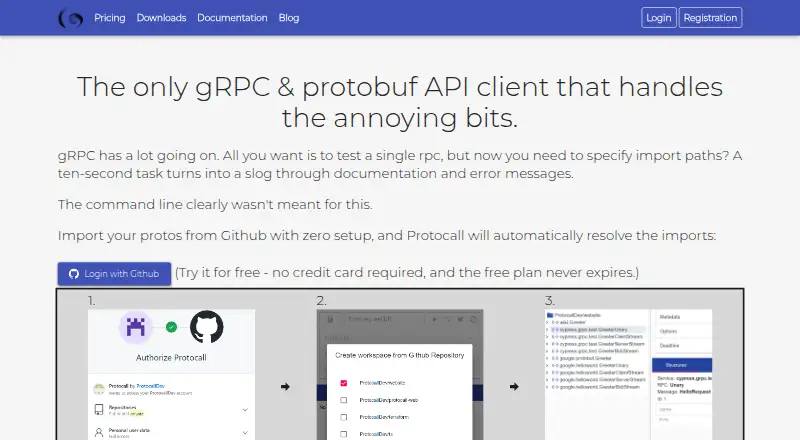
ProtoCall is a cloud-based web app intended to simplify steps in building an API with gRPC. It runs in a browser without installation and organizes proto files into workspaces, where files are resolved within one namespace through their packages and imports. Users can create a workspace manually by importing proto files or import a GitHub repository they own, collaborate on, or can access through an organization. Imports can track later repository changes automatically. The browser app relies on ProtoCall Agent, a local webserver that makes outbound requests browsers cannot make directly because of CORS restrictions. The agent has its own CORS restrictions and additional authentication to prevent unauthorized non-browser processes from connecting. It is supported on Windows and macOS through a Docker container and on Linux as a binary executable. ProtoCall currently supports workspaces for a single repository, not multiple repositories. Its free plan includes GitHub imports and manually created workspaces.
Who it suits
ProtoCall may suit engineering teams working with proto files and gRPC service interfaces. It is also relevant to users who want browser-based access with GitHub or manual workspace creation.
What it does well
- Browser app requires no installation
- Imports accessible GitHub repositories
- Imports can track repository changes automatically
- Free plan includes GitHub and manual imports
What to know first
- Workspaces support only a single repository
- Local agent is required for outbound requests
Limits
ProtoCall supports single-repository workspaces rather than workspaces spanning multiple repositories.
Plans
| Plan | Billed and limits | Price |
|---|---|---|
| Free | Free app supports GitHub imports and manually created workspaces | Free |
As protocall.dev lists them, read 4 Oct 2026. The maker's own page has the final word.
Getting started
- Open the ProtoCall web app.
- Create a workspace by importing proto files manually or importing an accessible GitHub repository.
- Install or run ProtoCall Agent on Windows, macOS, or Linux for outbound requests that browsers cannot make directly.
- Choose GitHub import tracking if you want future repository changes to be followed automatically.
Overview
ProtoCall is a browser-based tool for organizing the proto files behind gRPC APIs. It is best suited to engineering teams that want to bring repository-backed definitions into a shared workspace. The trade-off is a local agent requirement and a workspace model that stops at one repository.
Key features
A workspace groups proto files in one namespace, resolving them through their packages and imports. That gives teams a coherent place to work with related definitions rather than handle each file in isolation. The single-repository limit is consequential: teams whose service interfaces depend on files from multiple repositories cannot bring that full set into one workspace.
GitHub imports cover repositories a user owns, collaborates on, or can access through organization membership, and can track later changes automatically. That is a practical fit for teams keeping definitions in GitHub; email-registered accounts must grant repository and user OAuth scopes to import, a permission cost worth weighing. Manual workspace creation offers a route for importing proto files without connecting a repository.
The web app needs no installation, but outbound requests that browsers cannot make directly because of CORS restrictions require ProtoCall Agent, a local webserver. The agent has its own CORS restrictions and additional authentication to prevent unauthorized non-browser processes from communicating with it. It runs on Windows and macOS through a Docker container, or on Linux as a binary executable. The cloud app plus local component is a less frictionless arrangement than a standalone browser tool, especially where installing or running a local service is undesirable.
Pricing
ProtoCall uses a freemium model. The Free plan costs nothing and supports both GitHub imports and manually created workspaces, so it includes the two stated ways to assemble a workspace without a paid commitment. No other plan terms are established; the free plan’s stated scope is enough to make it a sensible starting point for teams evaluating a single-repository workflow.
Platforms
ProtoCall is a cloud-deployed web app that requires no browser-side installation. Its local agent is supported on Windows and macOS via Docker and on Linux as a binary executable. The distinction matters: using the web app does not eliminate the need to run the agent for outbound requests.
Who it's for
ProtoCall makes the most sense for engineering organizations that manage gRPC service interfaces in GitHub and want a workspace that resolves a repository’s proto files together. It is also a reasonable fit for users who prefer to import files manually. Teams with definitions split across repositories, or those unable to accommodate a local agent, should look elsewhere.
Pros and cons
- Pro: GitHub imports can follow repository changes automatically, reducing the need to refresh definitions by hand.
- Pro: Manual imports provide a workspace path that does not depend on connecting GitHub.
- Pro: The Free plan includes both import paths at no cost.
- Con: A local agent is required for browser-restricted outbound requests, adding a component to install or run.
- Con: Workspaces support one repository only, excluding multi-repository proto sets from a single workspace.
- Con: Email-registered accounts must grant GitHub repository and user OAuth scopes to import.
Alternatives
For a broader comparison, see gRPC Tools. Choose gRPC CLI instead if a free, build-from-source tool for unary RPC calls better matches the task. grpcui is another free option, with web and self-hosted platforms as well as desktop support. Pick Kreya if its free individual plan and request-history limit to the latest request suit your use; its free trial may also help with evaluation.
protoc-gen-doc is a free, MIT-licensed option for readers seeking software they can use, modify, and distribute under that license. sabledocs is a free static generator, but requires Python 3.11+ and a Protobuf descriptor file. Bandura offers a free plan for personal and commercial use with no account, paid seats, or feature tiers. Evans is a free open-source gRPC client. FintX is worth considering for its free/open-source plan, which includes unlimited gRPC clients, request auto-save, import/export, method tabs, a JSON editor, and projects.
Verdict
Choose ProtoCall if your team wants GitHub-linked or manually assembled proto workspaces and its single-repository scope matches your service layout. Automatic tracking and a free plan make it a straightforward fit for that workflow. Look elsewhere if your definitions span repositories or you cannot run a local agent.
Verdict
ProtoCall organizes gRPC-related proto files in browser-based workspaces and offers both GitHub and manual import paths. Teams needing a workspace spanning multiple repositories should note its current single-repository limit.
Questions
Is ProtoCall free?
Yes. Its Free plan costs nothing and supports GitHub imports and manually created workspaces.
Which platforms does ProtoCall support?
The listed platforms are Linux, macOS, web, and Windows.
Does ProtoCall require installation?
The web app runs in a browser without installation. ProtoCall Agent is a separate local webserver; it is supported via Docker on Windows and macOS and as a binary executable on Linux.
Can ProtoCall import GitHub repositories?
Yes. You can import repositories you own, collaborate on, or can access through organization membership. Imports can track future changes automatically.
Can a workspace combine multiple repositories?
No. ProtoCall currently supports single-repository workspaces.
Facts from ProtoCall's own pages
- Agent platforms
- ProtoCall Agent is supported on Windows and macOS via a Docker container and on Linux as a binary executable. · docs.protocall.dev, 4 Oct 2026
- Agent security
- The agent applies its own CORS restrictions and uses additional authentication to prevent unauthorized non-browser processes from communicating with it. · docs.protocall.dev, 4 Oct 2026
- Audience
- The maker's blog discusses ProtoCall in the context of engineering organizations managing proto files and gRPC service interfaces. · docs.protocall.dev, 4 Oct 2026
- GitHub integration
- Users can import GitHub repositories they own, collaborate on, or can access through organization membership; imports can track future changes automatically. · docs.protocall.dev, 4 Oct 2026
- GitHub permissions
- For accounts registered by email, GitHub import requests the repo and user OAuth scopes. · docs.protocall.dev, 4 Oct 2026
- Local agent
- ProtoCall Agent is a local webserver the web app needs to make outbound requests that browsers cannot make directly because of CORS restrictions. · docs.protocall.dev, 4 Oct 2026
- Manual import
- Users can create a workspace manually and import proto files into it. · docs.protocall.dev, 4 Oct 2026
- Purpose
- ProtoCall describes its goal as simplifying each step of building an API with gRPC. · docs.protocall.dev, 4 Oct 2026
- Web app
- ProtoCall is a web app that requires no installation. · docs.protocall.dev, 4 Oct 2026
- Workspace limit
- ProtoCall currently supports single-repository workspaces, not multi-repository workspaces. · docs.protocall.dev, 4 Oct 2026
- Workspaces
- A workspace is a collection of proto files resolved within one namespace using their packages and imports. · docs.protocall.dev, 4 Oct 2026
Where ProtoCall stands on Freedom251
- gRPC Tools#15 of 24