Freedom251 › Event Streaming Platforms
Pravega
What Pravega is
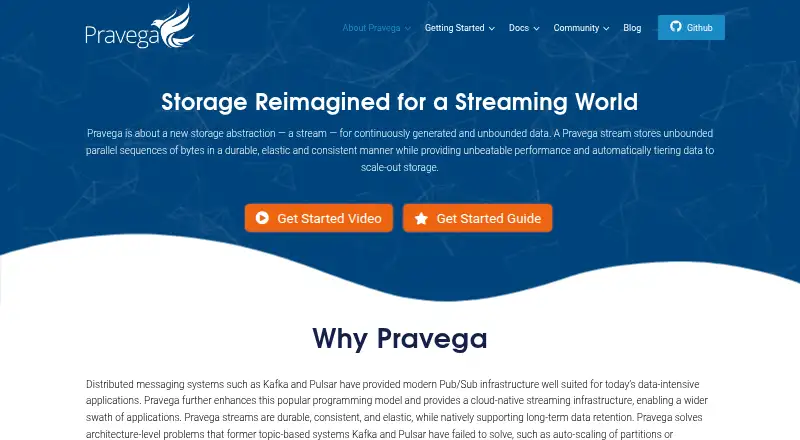
Pravega is an open-source storage system built around durable, append-only streams for continuous, unbounded data. Streams can scale as ingestion rates change, use automatic tiering to scale-out storage, and retain data indefinitely for access to current and historical events. Pravega describes exactly-once event delivery and processing with ordering guarantees despite client, server, or network failures. Transactions let developers write a set of events atomically.
The system is designed for streaming applications, IoT data, and batch or interactive analytics on large data volumes. Connectors include Apache Flink, Spark, Hadoop, Presto, Boomi, and Apache NiFi; supported client languages include Java, Rust, and Python. Pravega can run as a single-process standalone server or in distributed mode using Docker Compose. In standalone mode, clients connect through localhost only, and its security settings are off by default. TLS encryption and role-based access control are configurable. Distributed production deployments list Java 11, a supported long-term storage option, ZooKeeper 3.6.3, and BookKeeper 4.14.1 as prerequisites. Pravega is free and self-hosted.
Who it suits
Pravega suits developers building streaming or real-time applications, IoT data systems, or analytics workloads that need access to current and historical data. Teams should be prepared to manage a self-hosted deployment and its listed production prerequisites.
What it does well
- Streams retain data indefinitely.
- Describes exactly-once delivery and processing guarantees.
- Transactions write event sets atomically.
- Connectors include Flink, Spark, Hadoop, and NiFi.
- Supports Java, Rust, and Python clients.
What to know first
- Standalone clients can connect through localhost only.
- Standalone security settings are off by default.
- Distributed production deployment has listed prerequisites.
Limits
In standalone mode, clients can access the server through localhost only, and standalone security settings are off by default. Distributed production deployments list Java 11, a supported long-term storage option, ZooKeeper 3.6.3, and BookKeeper 4.14.1 as prerequisites.
Getting started
- Visit the Pravega website and choose a deployment mode.
- For a standalone server, run it as a single process; clients connect through localhost.
- For distributed mode, use Docker Compose or another listed deployment approach.
- For distributed production use, provide Java 11, a supported long-term storage option, ZooKeeper 3.6.3, and BookKeeper 4.14.1.
- Configure TLS encryption and role-based access control if needed; standalone security settings are off by default.
- Use the listed connectors or Java, Rust, and Python clients to work with streams.
Verdict
Pravega provides free, self-hosted stream storage with retention, scaling, and transaction capabilities. Its standalone localhost restriction and production deployment prerequisites are important considerations.
Questions
Is Pravega free and open source?
Pravega describes itself as 100% open source and community-driven. Its components are available under the Apache 2 License on GitHub.
What does Pravega store?
It stores continuous, unbounded data in durable, append-only streams. Streams can retain data indefinitely and provide access to real-time and historical events.
What are Pravega's delivery guarantees?
Pravega describes exactly-once event delivery and processing with ordering guarantees despite client, server, or network failures.
How can Pravega be deployed?
It can run as a single-process standalone server or in distributed mode using Docker Compose. Standalone clients access the server through localhost only.
What is required for distributed production deployment?
The listed prerequisites include Java 11, a supported long-term storage option, ZooKeeper 3.6.3, and BookKeeper 4.14.1.
Which integrations and client languages are listed?
Connectors are listed for Apache Flink, Spark, Hadoop, Presto, Boomi, and Apache NiFi. Supported client languages include Java, Rust, and Python.
Facts from Pravega's own pages
- Auto-scaling
- Pravega can automatically adjust individual streams’ parallelism to accommodate changes in data ingestion rate. · pravega.io, 5 Oct 2026
- Autoscaling
- Pravega can automatically scale individual data streams as data ingestion rates change. · pravega.io, 5 Oct 2026
- Deployment
- Pravega offers standalone mode for development and testing and distributed mode for production, including Kubernetes operators and Docker Swarm deployment options. · pravega.io, 5 Oct 2026
- Exactly-once
- Pravega describes exactly-once delivery and processing with ordering guarantees despite client, server, or network failures. · pravega.io, 5 Oct 2026
- Exactly-once processing
- Pravega describes exactly-once event delivery and processing with ordering guarantees despite client, server, or network failures. · pravega.io, 5 Oct 2026
- Headquarters
- Seattle, WA, USA · pravega.io, 28 Sept 2026
- Integrations
- The documented connectors include Apache Flink, Apache Spark, Apache Hadoop, Presto, Boomi, and Apache NiFi. · pravega.io, 5 Oct 2026
- License
- Pravega describes itself as 100% open source and community-driven, with components available under the Apache 2 License on GitHub. · pravega.io, 5 Oct 2026
- Product
- Pravega is a storage system built around durable, elastic, append-only streams for continuous, unbounded data. · pravega.io, 5 Oct 2026
- Production prerequisites
- The deployment guide lists Java 11, and for distributed production deployments it lists AWS S3, Azure Blob Storage, Google Cloud Storage, HDFS or a mounted distributed filesystem, ZooKeeper 3.6.3, and BookKeeper 4.14.1. · pravega.io, 5 Oct 2026
- Retention
- Pravega supports retaining stream data according to application needs, with capacity limited by the configured storage cluster or cloud provider. · pravega.io, 5 Oct 2026
- Security
- Pravega supports configurable TLS encryption and role-based access control; its standalone security settings are off by default. · pravega.io, 5 Oct 2026
- Standalone limitation
- In standalone mode, clients access the server through the localhost interface only. · pravega.io, 5 Oct 2026
- Stream storage
- A Pravega stream stores unbounded parallel sequences of bytes durably, elastically, and consistently, with automatic tiering to scale-out storage. · pravega.io, 5 Oct 2026
- Support
- The site directs users to the Pravega community on Slack for help and to GitHub Issues to report bugs. · pravega.io, 5 Oct 2026
- Transactions
- Pravega transactions let a developer write a set of events to a stream atomically. · pravega.io, 5 Oct 2026
- Use case
- Pravega is designed for streaming applications that ingest continuous data and need low-latency access to both current and historical data. · pravega.io, 5 Oct 2026
- What it does
- Pravega is an open-source storage system that uses streams to store continuous, unbounded data. · pravega.io, 5 Oct 2026
- Who it is for
- The FAQ describes Pravega as suited to streaming and real-time application data, IoT data, and batch or interactive analytics on large amounts of data. · pravega.io, 5 Oct 2026
Where Pravega stands on Freedom251
- Event Streaming Platforms#11 of 27