Freedom251 › Port Scanner Software
portwave
What portwave is
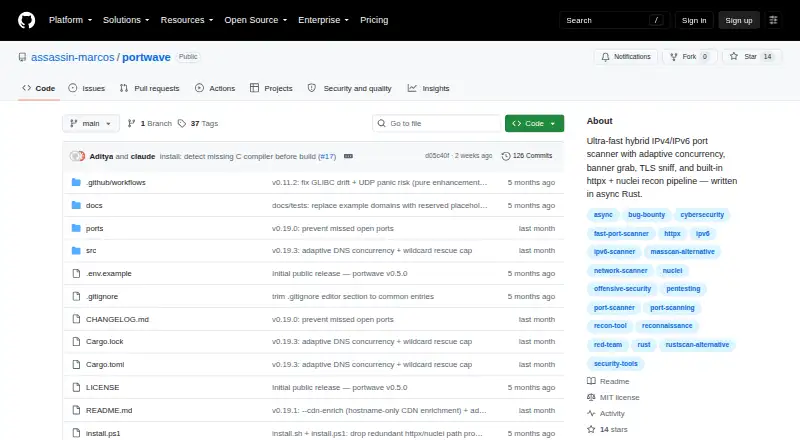
Portwave is a free command-line tool for scanning IPv4 and IPv6 targets across Linux, macOS, and Windows. It accepts individual IPs, CIDR blocks, ranges, domains, and ASNs, including mixed inputs. A standard scan uses a curated port list; the `--all-ports` option requests scans of all 65,535 TCP ports. Portwave uses adaptive TCP connect scans, then can enrich confirmed HTTP targets with banners, TLS details, certificate names and issuers, and nuclei findings. Its DNS handling resolves domains in parallel, filters wildcard responses, and skips known CDN edge IPs by default. Options allow hostname enrichment or scanning those CDN addresses. Results include open-port evidence, HTTP and SSL findings, nuclei results, summaries, and differences between runs. They can be exported as JSONL, JSON, or TXT. Packet rate and maximum scan time can be constrained, and small scopes pace simultaneous probes per host. Large IPv6 scopes are refused above 2²⁰ hosts unless overridden; smart IPv6 mode can sample likely addresses in large ranges. Portwave uses TCP connect scans without raw sockets or root. It classifies protocols but does not provide deeper service-version fingerprinting, SYN scans, IDS evasion, or ICMP discovery. The project is MIT licensed, with support through GitHub issues and pull requests.
Who it suits
Portwave suits security researchers who need a command-line scanner for mixed IPv4 and IPv6 targets, with HTTP, TLS, certificate, and nuclei enrichment. The maker describes it for systems the user owns or has written permission to scan.
What it does well
- Accepts IPs, CIDRs, ranges, domains, and ASNs together.
- Scans IPv4 and IPv6 targets on three desktop platforms.
- Adds HTTP, TLS, certificate, and nuclei findings.
- Exports results as JSONL, JSON, or TXT.
- Can record summaries and port differences between runs.
What to know first
- A bare scan uses a curated port list.
- Service identification stops at protocol classification.
- No SYN scans, IDS evasion, or ICMP discovery preflight.
- Large IPv6 scopes need an override or smart sampling.
Limits
The free plan's bare scan uses a curated port list; scanning all 65,535 TCP ports requires the explicit `--all-ports` option. IPv6 scopes larger than 2²⁰ hosts are refused unless overridden, while smart IPv6 mode can sample likely addresses.
Getting started
- Open the Portwave GitHub project page.
- Follow the maker's installation instructions for Linux, macOS, or Windows.
- Run Portwave with IPs, CIDRs, ranges, domains, ASNs, or a mixture of them.
- Use `--all-ports` when a scan should cover all 65,535 TCP ports.
- Set packet-rate or maximum-time constraints as needed.
Verdict
Choose Portwave if you want a free CLI scanner with HTTP and SSL enrichment, file exports, and support for mixed target types. Look elsewhere if you need SYN scanning, detailed service-version fingerprinting, IDS evasion, or ICMP host discovery.
Questions
How much does Portwave cost?
Portwave is free, with a free plan and no free trial.
Which platforms does Portwave support?
It runs on Linux, macOS, and Windows.
What targets and ports can it scan?
It accepts IPs, CIDRs, ranges, domains, and ASNs, including mixed inputs. A bare scan uses a curated port list; `--all-ports` requests all 65,535 TCP ports.
What output formats are available?
Portwave exports JSONL, JSON, and TXT. Results can include port evidence, HTTP enrichment, SSL and nuclei findings, summaries, and scan differences.
Is Portwave open source?
The repository identifies Portwave as MIT licensed.
Where can I get support?
The maker directs users to GitHub issues and pull requests.
Facts from portwave's own pages
- DNS and CDN handling
- It resolves domains in parallel, filters wildcard DNS, and skips known CDN edge IPs by default, with options to enrich hostnames or scan CDN edges. · github.com, 8 Oct 2026
- Enrichment
- The pipeline includes banner grabbing, TLS inspection, native HTTP(S) probing, certificate SAN and issuer extraction, and nuclei scans of confirmed HTTP targets. · github.com, 8 Oct 2026
- Inputs
- It accepts IPs, CIDRs, ranges, domains, and ASNs, including mixed target types. · github.com, 8 Oct 2026
- Installation
- The maker provides install instructions for Linux and macOS and for Windows, plus commands to update, check for updates, and uninstall. · github.com, 8 Oct 2026
- Integrations
- The README documents piping subfinder output into portwave and using ProjectDiscovery nuclei for vulnerability scanning when installed. · github.com, 8 Oct 2026
- Intended use
- The maker describes portwave as a security-research tool and says to scan only systems owned by the user or covered by written permission. · github.com, 8 Oct 2026
- IPv6 limits
- Scopes larger than 2²⁰ hosts are refused unless an override is used; --smart-ipv6 can sample likely addresses in large ranges. · github.com, 8 Oct 2026
- IPv6 scope
- Scopes larger than 2²⁰ hosts are refused unless an override is used; smart IPv6 mode samples likely addresses for large ranges. · github.com, 8 Oct 2026
- License
- The repository identifies the software as MIT licensed. · github.com, 8 Oct 2026
- License and support
- The repository identifies the project as MIT licensed and directs users to GitHub issues and pull requests. · github.com, 8 Oct 2026
- Limitations
- Portwave uses TCP connect scans without raw sockets or root, does not fingerprint service versions beyond protocol classification, and has no IDS evasion or ICMP discovery preflight. · github.com, 8 Oct 2026
- Outputs
- It writes scan results, HTTP enrichment, SSL findings, summaries, and run-to-run port differences to files. · github.com, 8 Oct 2026
- Purpose
- Portwave is an IPv4/IPv6 port scanner with HTTP(S) enrichment, SSL reconnaissance, and a nuclei pipeline. · github.com, 8 Oct 2026
- Rate controls
- Scans can be constrained by packet rate and maximum scan time, and small scopes pace simultaneous probes per host. · github.com, 8 Oct 2026
- Results
- Scan outputs include open-port evidence, HTTP enrichment, SSL findings, nuclei findings, summaries, and scan diffs. · github.com, 8 Oct 2026
- Scanning
- It uses adaptive TCP connect scanning and can scan all 65,535 TCP ports when explicitly requested. · github.com, 8 Oct 2026
- Scope limits
- A bare scan uses a curated port list; scanning all 65535 TCP ports requires the explicit --all-ports option. · github.com, 8 Oct 2026
- Security behavior
- The README says bundled OpenSSL accepts self-signed, expired, hostname-mismatched, and malformed certificates so the scanner can inspect responses. · github.com, 8 Oct 2026
- Support
- The maker directs users to GitHub Issues and pull requests for contact and support. · github.com, 8 Oct 2026
- Targets
- It accepts IPs, CIDRs, ranges, domains, and ASNs, including mixed target inputs. · github.com, 8 Oct 2026
- Technical limits
- Portwave uses TCP connect scanning and does not provide SYN scans, service-version fingerprinting beyond a 9-label protocol classification, IDS evasion, or ICMP host discovery. · github.com, 8 Oct 2026
Where portwave stands on Freedom251
- Port Scanner Software#19 of 26