Freedom251 › Legal Knowledge Management Software
Picard.law
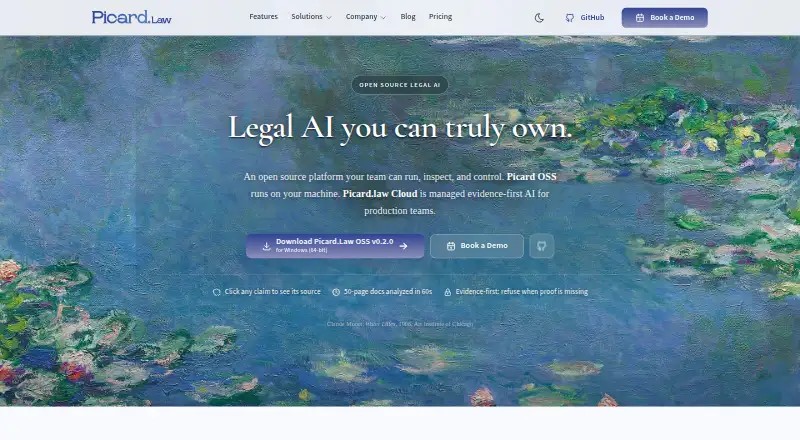
What Picard.law is
Picard.law provides legal document analysis through locally run open-source software and a managed cloud product for production teams. It answers questions about legal documents with citations grounded in the documents, and refuses when evidence is missing. Matter workspaces let teams upload agreements and diligence packs while keeping context across documents. Tabular review extracts information across documents and cites each cell to a page and quote; the open-source version also includes Excel export. Picard OSS runs on a single machine with documents stored locally, using BM25 full-text search and CARP retrieval on SQLite FTS5. Picard.law Cloud is managed on Azure and uses Neo4j GraphRAG. The homepage describes OSS as suited to legal engineers and air-gap use, and Cloud as suited to production legal AI teams. OSS is single-user and has no built-in authentication. Its license cost is free under AGPL for local development and proof of concept, with model API costs paid using your own keys. The cloud offering is managed SaaS or enterprise; contact sales to book a demo. The service is available as self-hosted software and on the web.
Who it suits
Picard OSS suits legal engineers and air-gap use, while Picard.law Cloud is aimed at production legal AI teams. Teams reviewing agreements or diligence packs can use matter workspaces, document-grounded answers, and tabular review.
What it does well
- Answers legal questions with document citations
- Refuses to answer when the evidence is missing
- Matter workspaces keep context across uploaded documents
- Tabular review cites extracted cells to pages and quotes
- OSS includes Excel export and stores documents locally
- Cloud data is encrypted at rest and in transit
What to know first
- Picard OSS is single-user
- Picard OSS has no built-in authentication
- OSS users pay model API costs with their own keys
- Cloud pricing is contact sales to book a demo
Limits
Picard OSS is single-user and has no built-in authentication. Its zero-cost license covers local development and proof of concept, while model API costs are paid with your own keys.
Plans
| Plan | Billed and limits | Price |
|---|---|---|
| Picard OSS | Zero license cost · AGPL for local development and proof of concept · model API costs paid with your own keys | Free |
| Picard.law Cloud | Managed SaaS / enterprise · contact sales to book a demo | On request |
As picard.law lists them, read 8 Oct 2026. The maker's own page has the final word.
Getting started
- Open the Picard.law website
- Choose locally run Picard OSS or managed Picard.law Cloud
- For OSS, use your own model API keys and pay the model API costs
- For Cloud, contact sales to book a demo
- Upload agreements or diligence packs into a matter workspace
Picard.law combines locally run, open-source legal document analysis with a managed cloud product for production teams. Picard OSS is best suited to legal engineers and air-gap use; Cloud is aimed at teams that need managed deployment. Its citation-grounded analysis and matter workspaces make it a focused option, while the local edition’s single-user design limits collaboration.
Overview
Picard.law analyzes legal documents and answers questions with citations, refusing to answer when the documents do not provide evidence. Matter workspaces keep agreements and diligence packs together so teams can carry context across documents. That combination is useful when review depends on traceable answers across a set of files, rather than general-purpose chat.
The product comes in two forms: Picard OSS runs on one machine with documents stored locally, while Picard.law Cloud is managed on Azure. The local option favors control and air-gap use; the cloud option is the better fit for a production team that wants a managed service.
Key features
Tabular review extracts information across documents and ties each cell to a page and quote. That makes it easier to check a comparison against its source, and the OSS edition can export the table to Excel.
Search differs by edition. OSS combines BM25 full-text search with CARP retrieval on SQLite FTS5; Cloud uses Neo4j GraphRAG. The distinction gives technical users a concrete reason to choose between a local stack and the managed product, though the search methods alone do not establish which will suit a particular corpus better.
Users can integrate their DMS, but Picard.law does not identify a specific DMS integration. Teams should confirm that their system fits before relying on that connection in a workflow.
Pricing
| Plan | Price | What it includes | Best fit |
|---|---|---|---|
| Picard OSS | free | Zero license cost; AGPL for local development and proof of concept. Model API costs are paid with your own keys. | Legal engineers evaluating or developing a local setup, including air-gap use. |
| Picard.law Cloud | Custom pricing | Managed SaaS / enterprise; contact sales to book a demo. | Production legal AI teams seeking managed deployment. |
OSS removes the license fee, but it is single-user, has no built-in authentication, and passes model API costs to the user. Those trade-offs make it a poor substitute for a shared production service. Cloud is designed for that role, but teams need to contact sales for pricing.
Platforms
Picard.law is available as self-hosted software and on the web. OSS stores documents locally and runs on a single machine; Cloud is hosted on Azure. The privacy policy says cloud data is encrypted at rest with AES-256 and in transit with TLS 1.3, documents are not used to train AI models, and users can export or delete their data. It also says AI providers do not retain document content after processing.
Who it's for
Picard OSS is the natural choice for legal engineers who want an open-source starting point, local document storage, or an air-gap deployment. Its single-user limit and lack of built-in authentication make it unsuitable for teams that need shared access. Picard.law Cloud is aimed at production legal AI teams that prefer managed infrastructure. The company lists [email protected] as its Help Center contact.
Pros and cons
Pros
- Answers cite supporting material and refuse when evidence is missing, helping reviewers trace claims back to documents.
- Matter workspaces preserve context across agreements and diligence packs.
- Tabular review cites each cell to a page and quote, and OSS adds Excel export.
- OSS has no license cost and stores documents locally.
- The cloud privacy policy describes encryption, data export and deletion, and limits on model training and provider retention.
Cons
- OSS is single-user and has no built-in authentication, limiting its usefulness for team workflows.
- OSS users pay model API costs with their own keys, so zero license cost does not mean zero operating cost.
- Cloud has custom pricing, which makes budget comparisons harder before a sales conversation.
- The DMS integration is not tied to a named system, so compatibility needs to be confirmed.
Alternatives
Lawformer is another freemium option with a free community package and versions for macOS, web, and Windows; consider it if desktop platform choice matters.
Kahana offers a web-based free plan with three hubs, ten counted uploads per hub, unlimited members, and files up to 5 MB; it may suit readers who want a defined free collaboration allowance.
Legal Assistant is a paid web product with pricing available by demo or contact.
Lexsoft T3 is a paid option available through SaaS, web, API, and self-hosted deployment.
Aloi is a paid self-hosted and web option with custom pricing by demo request.
Argos is a web-based paid product that requires an enterprise agreement.
Arivu is another paid option.
AtlasFuse is a paid web and API subscription with a 12-month minimum term and implementation and support services.
Readers comparing broader legal knowledge management or research tools can also browse Legal Knowledge Management Software and AI Legal Research Software.
Verdict
Choose Picard OSS if you are a legal engineer who needs locally stored document analysis, source citations, and an open-source path for development or air-gap use. Choose Picard.law Cloud if your production legal AI team wants managed deployment and accepts custom pricing. Look elsewhere if your team needs multi-user access from the local edition or a clearly priced cloud plan before engaging sales.
Verdict
Choose Picard OSS for locally stored legal document analysis and an open-source option suited to legal engineers or air-gap use. Choose Picard.law Cloud if you need a managed product for a production legal AI team; its price is available through sales.
Questions
Is Picard.law free?
Picard OSS costs nothing for its license, for local development and proof of concept. Users pay model API costs with their own keys.
Is Picard.law open source?
Picard OSS is open source under AGPL for local development and proof of concept.
What platforms are available?
Picard.law is listed as self-hosted and web. Picard OSS runs on one machine; Picard.law Cloud is managed on Azure.
What is the difference between OSS and Cloud?
OSS stores documents locally and uses BM25 full-text search and CARP retrieval on SQLite FTS5. Cloud is managed on Azure and uses Neo4j GraphRAG.
Does it cite its answers?
Yes. Legal document answers are grounded in citations, and tabular review cites each cell to a page and quote. The product refuses when evidence is missing.
Who makes Picard.law?
The About page identifies Saurabh as founder and CEO and says Picard.Law was built in 2024.
Facts from Picard.law's own pages
- Data control
- The privacy policy says users can export or delete their data, and that AI providers do not retain document content after processing. · picard.law, 8 Oct 2026
- Deployment
- Picard OSS runs on a single machine with documents stored locally, while Picard.law Cloud is managed on Azure. · picard.law, 8 Oct 2026
- Document analysis
- The product analyzes legal documents and provides chat answers grounded in citations, with a refusal when evidence is missing. · picard.law, 8 Oct 2026
- Founder
- The About page identifies Saurabh as founder and CEO and says Picard.Law was built in 2024. · picard.law, 8 Oct 2026
- Headquarters
- The homepage says the company is based in Dubai and India and serves global LegalOps teams. · picard.law, 8 Oct 2026
- Integration
- The maker says users can integrate their DMS, but does not name a specific DMS integration on the page. · picard.law, 8 Oct 2026
- Intended users
- The homepage describes OSS as suited to legal engineers and air-gap use, and Cloud as suited to production legal AI teams. · picard.law, 8 Oct 2026
- Local use limit
- Picard OSS is single-user and has no built-in authentication, according to the product comparison on the homepage. · picard.law, 8 Oct 2026
- Matter workspaces
- Matter-scoped workspaces let teams upload agreements and diligence packs and keep context across documents. · picard.law, 8 Oct 2026
- Product
- Picard.law offers locally run open-source legal AI and a managed cloud product for production teams. · picard.law, 8 Oct 2026
- Search
- Picard OSS uses BM25 full-text search and CARP retrieval on SQLite FTS5, while the cloud version uses Neo4j GraphRAG. · picard.law, 8 Oct 2026
- Security
- The privacy policy states that cloud data is encrypted at rest with AES-256 and in transit with TLS 1.3, and documents are not used to train AI models. · picard.law, 8 Oct 2026
- Support
- The homepage lists [email protected] as the Help Center contact. · picard.law, 8 Oct 2026
- Tabular review
- Tabular review extracts information across documents and cites each cell to a page and quote; the OSS version includes Excel export. · picard.law, 8 Oct 2026
Where Picard.law stands on Freedom251
- Legal Knowledge Management Software#3 of 23
- AI Legal Research Software#13 of 32