Freedom251 › Call blocker apps
PhoneBlock
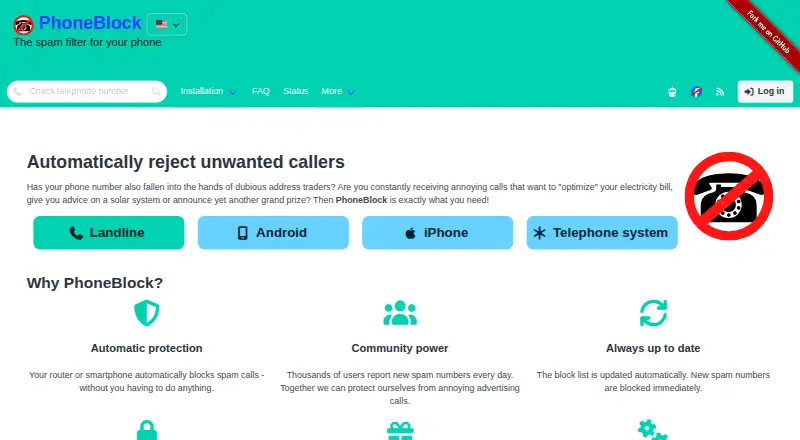
What PhoneBlock is
PhoneBlock blocks unwanted advertising and spam calls using a community-maintained database. Users can report numbers through the app, website or personal blacklist, and those reports feed into the shared blacklist. Its Android app blocks known spam calls, keeps a call history and supports reporting and personal lists; it requires Android 10 or later. PhoneBlock says the Android app sends only the incoming caller number's SHA-1 hash and does not access contacts.
Landline users can choose a router dongle, a cloud answering machine through Fritz!Box, or a blocklist phonebook synchronized by CardDAV. The documented iPhone setup syncs spam numbers into contacts through CardDAV. A native iPhone app is in development, with beta registration available. Phone systems can download the blocklist in various formats or query it through an API; the integration page links to a community 3CX project. PhoneBlock is licensed under GPL-3.0 and is operated as a private project by Bernhard Haumacher. The operator offers email help, including for numbers mistakenly added to the blocklist. The service is free to use, with donations optional.
Who it suits
PhoneBlock suits people looking to block known spam callers on Android or configure call blocking for a landline. It may also suit phone-system users who want to access a shared blocklist through downloads or an API.
What it does well
- Free to use, with donations optional
- Community reports add numbers to a shared blacklist
- Android app keeps call history and supports personal lists
- Landline options include Fritz!Box and CardDAV
- Licensed under GPL-3.0
What to know first
- Android app requires Android 10 or later
- Documented iPhone setup syncs numbers into contacts
- Native iPhone app is still in development
- Terms advise against business use
Limits
The Android app requires Android 10 or later. The documented iPhone setup uses CardDAV; a native iPhone app is in development.
Plans
| Plan | Billed and limits | Price |
|---|---|---|
| PhoneBlock | Free to use · donations optional | Free |
As phoneblock.net lists them, read 7 Oct 2026. The maker's own page has the final word.
Getting started
- Visit the PhoneBlock website.
- Choose the option for Android, a landline setup, iPhone CardDAV syncing, or a phone system/API.
- For Android, install the app on a device running Android 10 or later.
- For iPhone, use the documented CardDAV setup to sync spam numbers into contacts.
- For landlines, choose a router dongle, Fritz!Box cloud answering machine, or CardDAV phonebook.
- Report spam numbers through the app, website, or personal blacklist.
PhoneBlock is a free, community-driven call-blocking service for Android, landlines and phone systems. It is strongest for people who want to draw on a shared spam database without a subscription; iPhone users get a contact-sync workaround rather than a native app, and business use is discouraged.
Its combination of community reporting and several connection methods is compelling, particularly for Android and landline users. The main trade-offs are the less direct iPhone setup and the operator’s warning against commercial use.
Overview
PhoneBlock uses a shared database of reported spam numbers to identify unwanted calls. Users can contribute reports through the app, website or personal blacklist, so a number reported by one person can help inform protection for others. This community approach is useful beyond maintaining a private blocklist, though its reach depends on contributions from users.
The software is licensed under GPL-3.0 and run as a private project by Bernhard Haumacher. The site says it has no ads or third-party trackers. Its privacy policy says unregistered visitors’ IP addresses are logged temporarily for error analysis and deleted after 14 days.
Key features
Android blocking and privacy
The Android app blocks known spam calls, keeps a call history and supports spam reports and personal lists. It requires Android 10 or later, ruling it out for older devices. For incoming calls, it sends only the phone number’s SHA-1 hash and does not access contacts, a meaningful privacy advantage for people who do not want a call-blocking app reading their address book.
Landline and phone-system connections
Landline users can choose a router dongle, a cloud answering machine through Fritz!Box or a blocklist phonebook synced by CardDAV. Phone systems can download the blocklist in various formats or query it through an API, and the integration page links to a community 3CX project. This breadth makes PhoneBlock more adaptable than an app-only blocker, but it does mean the best route depends on the equipment and setup a household or system already uses.
iPhone through CardDAV
The documented iPhone method syncs spam numbers into contacts through CardDAV. A native iPhone app is in development, with beta registration offered. For now, iPhone users must accept a contact-based setup rather than the direct app experience Android users get.
Answering machine and support
When the answering machine is used, PhoneBlock stores the Fritz!Box IP address for registration and compares incoming caller numbers against its spam database. The operator offers email help, including for users whose number has been mistakenly added to the blocklist.
Pricing
PhoneBlock is free to use, with donations optional. Its PhoneBlock plan costs nothing. There is no free trial because the service is already free; there are no paid tiers or subscription terms to weigh against its core offering.
The free model suits people who want shared spam blocking without a recurring charge. The important limit is not a usage quota but the terms: PhoneBlock advises against business use and places responsibility for resulting damage on the user. Organizations seeking a service explicitly intended for commercial deployment should choose another option.
Platforms
PhoneBlock supports Android, iOS, web, API and self-hosted use. Android requires version 10 or later. On iPhone, the documented CardDAV contact sync is the available method, while a native app remains in development. Landline access includes the router dongle, Fritz!Box cloud answering machine and CardDAV phonebook approaches; phone systems can use downloads or the API.
Who it's for
PhoneBlock is a good fit for Android users on version 10 or later who want caller screening and community reporting without paying, and for landline users willing to connect it through one of the supported methods. It also suits technically capable phone-system users who want to download or query a shared blocklist. iPhone users can use it, but should be comfortable syncing numbers through CardDAV. Businesses should heed the operator’s explicit advice against business use.
Pros and cons
- Pro: Community reports feed a shared blacklist, extending protection beyond each user’s personal list.
- Pro: Free use with optional donations avoids a recurring subscription.
- Pro: Android’s incoming-call handling sends only a SHA-1 hash and does not access contacts.
- Pro: Router, Fritz!Box, CardDAV and API options cover more than smartphone-only use.
- Con: The Android app requires Android 10 or later, excluding older devices.
- Con: The documented iPhone route syncs numbers into contacts; a native app is still in development.
- Con: The terms advise against business use and assign users responsibility for resulting damage.
Alternatives
For a broader comparison, see Spam Call Blocking Apps.
- Getcontact is worth considering if you want a freemium Android, iOS or web option with a paid Premium plan at $2.99 a month; its free basic version costs nothing.
- YouMail may suit readers who want cloud voicemail features alongside blocking: its free plan includes 50 cloud messages, 100 voicemail-to-text transcriptions per month and unlimited known-spammer blocking.
- Hiya Spam Blocker offers a free basic plan with caller ID, basic call blocking and spam reporting on Android and iOS, plus a free trial.
- NumBuster is another freemium choice for Android, iOS and web users who want a free mobile app and the option of paid features.
- RoboKiller offers a free plan with a global blacklist, spam-call notifications, weekly insights, spam reporting and Spam Patrol, as well as a free trial.
- Should I Answer? may fit Android users seeking free community-based call protection; it also supports iOS, web and an extension.
- Who Called is a free, open-source alternative for Android, iOS and web users who want a service with no paid tiers stated.
- Whoscall provides a free Android and iOS plan with caller ID, call blocking, number, URL and screenshot checks, and scam reports and rewards.
Verdict
Choose PhoneBlock if you want free, community-based spam blocking and need more than a standalone mobile app—especially on Android, a landline or a phone system. Its shared blacklist, open-source licence and multiple connection methods are the strongest reasons to pick it. Look elsewhere if you need a native iPhone app now or a service intended for business use.
Verdict
PhoneBlock offers community-based spam blocking for Android, landlines and phone systems, with an iPhone method based on CardDAV. It is free to use, though the operator advises against business use.
Questions
How much does PhoneBlock cost?
The PhoneBlock plan is free. Donations are optional.
Is PhoneBlock open source?
Yes. PhoneBlock is licensed under GPL-3.0.
Which platforms does PhoneBlock support?
The listed platforms are Android, iOS, API, self-hosted, and web. The Android app requires Android 10 or later; the documented iPhone setup uses CardDAV.
Does PhoneBlock have a native iPhone app?
Its page says a native iPhone app is in development and offers beta registration. The documented setup syncs spam numbers into contacts through CardDAV.
Can PhoneBlock work with landlines or phone systems?
Landline options include a router dongle, a Fritz!Box cloud answering machine, and a CardDAV-synced blocklist phonebook. Phone systems can download the blocklist in various formats or query it through an API.
Who operates PhoneBlock?
The imprint identifies it as a private project operated by Bernhard Haumacher.
Facts from PhoneBlock's own pages
- Android app
- The Android app blocks known spam calls, keeps a call history, supports spam reports and personal lists, and requires Android 10 or later. · phoneblock.net, 7 Oct 2026
- Android privacy
- For incoming calls, the Android app sends only the phone number’s SHA-1 hash and does not access contacts. · phoneblock.net, 7 Oct 2026
- Answering machine data
- When using the answering machine, PhoneBlock stores the Fritz!Box IP address for registration and compares incoming caller numbers with the spam database. · phoneblock.net, 7 Oct 2026
- Commercial use
- The terms advise against business use and place responsibility for resulting damage on the user. · phoneblock.net, 7 Oct 2026
- Community reports
- Users can report spam numbers through the app, website, or personal blacklist, and reports are added to the shared blacklist. · phoneblock.net, 7 Oct 2026
- iPhone support
- The documented iPhone setup syncs spam numbers into contacts through CardDAV; the page says a native iPhone app is in development and offers beta registration. · phoneblock.net, 7 Oct 2026
- Landline options
- Landline users can choose a router dongle, a cloud answering machine through Fritz!Box, or a blocklist phonebook synced by CardDAV. · phoneblock.net, 7 Oct 2026
- Open source
- The software is licensed under GPL-3.0. · phoneblock.net, 7 Oct 2026
- Operator
- The imprint identifies PhoneBlock as a private project operated by Bernhard Haumacher. · phoneblock.net, 7 Oct 2026
- PBX/API
- PhoneBlock says phone systems can download the blocklist in various formats or query it through an API; its integration page links a community 3CX project. · phoneblock.net, 7 Oct 2026
- Purpose
- PhoneBlock automatically blocks unwanted advertising and spam calls using a community maintained database. · phoneblock.net, 7 Oct 2026
- Support
- The operator says users can contact him by email for help, including if their number was mistakenly added to the blocklist. · phoneblock.net, 7 Oct 2026
- Website privacy
- The privacy policy says unregistered visitors’ IP addresses are logged temporarily for error analysis and deleted after 14 days; it says the site has no ads or third-party trackers. · phoneblock.net, 7 Oct 2026
Where PhoneBlock stands on Freedom251
- Call blocker apps#3 of 41
- Spam Call Blocking Apps#5 of 41