Freedom251 › Database Vulnerability Scanners
PGDSAT
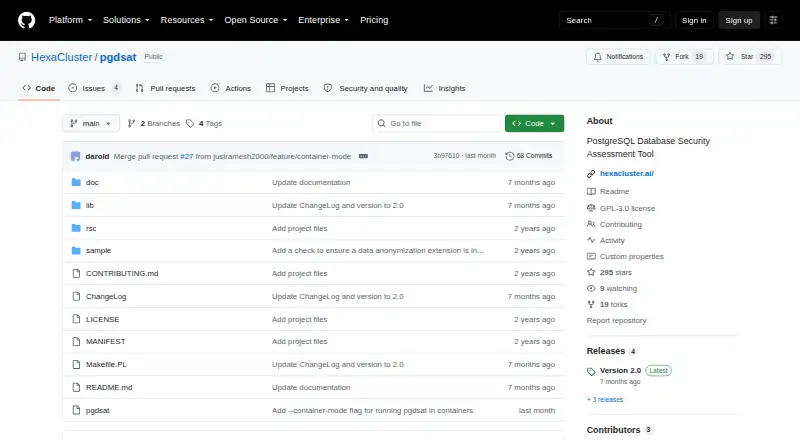
What PGDSAT is
PGDSAT is a Linux tool for assessing security across PostgreSQL clusters. It checks around 90 controls, including every recommendation in the CIS Benchmark for PostgreSQL 17 as well as additional checks. Its coverage includes installation and patches, file permissions, logging and auditing, access control, connections, PostgreSQL settings, replication, and other configuration considerations. Some checks run automatically, while others call for manual review. The tool can automate assessments to help verify company security policies and identify security issues a cluster may face.
Each assessment provides a status summary and detailed findings in text or HTML. Command-line options let users select or exclude databases, remove checks, set a report title, and choose the output format and language. Reports can be produced in English, French, or Chinese. PGDSAT queries PostgreSQL using psql and includes checks for pgAudit and pgBackRest configuration. It is free software under the GPLv3 license and is intended for on-premises use. It requires PostgreSQL 10 or later, PostgreSQL binaries on PATH, connection details supplied through environment variables or command-line options, and Perl bignum. The README recommends running it as the postgres system user so it can inspect the system and PostgreSQL installation.
Who it suits
PGDSAT suits PostgreSQL administrators and teams that want to review cluster security controls or automate checks against company policies. It is particularly relevant to teams using PostgreSQL 10 or later who can run the tool on Linux with the required binaries and privileges.
What it does well
- Checks around 90 PostgreSQL security controls.
- Implements all CIS Benchmark recommendations for PostgreSQL 17, plus additional checks.
- Produces summaries and detailed findings in text or HTML.
- Command-line options customize database selection, checks, report title, format, and language.
- Free software distributed under the GPLv3 license.
What to know first
- Linux is the listed platform.
- Requires PostgreSQL 10 or later and PostgreSQL binaries on PATH.
- The README recommends running as the postgres system user.
- Uses internet access for its PostgreSQL version check unless that check is disabled.
Limits
PGDSAT has no paid plan listed; it is free software under GPLv3. Its documented requirements include Linux, PostgreSQL 10 or later, PostgreSQL binaries on PATH, Perl bignum, connection details, and privileges to inspect the system; the online version check can be disabled.
Getting started
- Open the PGDSAT project on GitHub.
- Use a Linux environment with PostgreSQL 10 or later and PostgreSQL binaries on PATH.
- Provide PostgreSQL connection details through environment variables or command-line options.
- Run PGDSAT as the postgres system user, as the README recommends.
- Choose databases, checks, report title, output format, and language with command-line options.
- Allow internet access for the PostgreSQL version check, or disable that check.
Verdict
Choose PGDSAT if you need a free, on-premises assessment tool for PostgreSQL clusters, with CIS Benchmark coverage and configurable reports. It requires Linux, PostgreSQL 10 or later, supporting dependencies, and sufficient privileges to inspect the system.
Questions
How much does PGDSAT cost?
It is free software under the GPLv3 license.
Which PostgreSQL versions does it require?
PGDSAT requires PostgreSQL 10 or later. Its CIS coverage includes all recommendations for PostgreSQL 17, along with additional checks.
What reports can PGDSAT create?
It produces a status summary and detailed findings in text or HTML. Report languages include English, French, and Chinese.
Does PGDSAT need internet access?
It uses curl and internet access to check PostgreSQL versions online. That check can be disabled.
Who maintains PGDSAT?
The README lists Gilles Darold as the author. The repository identifies HexaCluster Corp as the copyright holder for 2024–2026.
What does PGDSAT need to run?
It requires Linux, PostgreSQL 10 or later, PostgreSQL binaries on PATH, Perl bignum, and connection details supplied through environment variables or command-line options. The README recommends running it as the postgres system user.
Facts from PGDSAT's own pages
- Assessment areas
- Its checks cover installation and patches, permissions, logging and auditing, access, connections, PostgreSQL settings, replication, and configuration considerations. · github.com, 7 Oct 2026
- Assessment output
- It produces a summary of test statuses and detailed findings, with text and HTML output formats. · github.com, 7 Oct 2026
- Automated assessment
- The README says the tool can automate assessments to verify company security policies and help identify security issues a cluster may face. · github.com, 7 Oct 2026
- Automation
- The tool supports automated assessments to verify company security policies and identify security issues a cluster may face. · github.com, 7 Oct 2026
- Check coverage
- Checks cover installation and patches, file permissions, logging and auditing, access control, connections, settings, replication, and special configuration considerations. · github.com, 7 Oct 2026
- CIS checks
- The tool implements all recommendations from the CIS Benchmark for PostgreSQL 17, along with additional checks. · github.com, 7 Oct 2026
- CIS coverage
- The project says it implements all CIS Benchmark recommendations for PostgreSQL 17, along with additional checks. · github.com, 7 Oct 2026
- Dependencies and limits
- The documented requirements include PostgreSQL binaries on PATH, connection details supplied through environment variables or command-line options, and Perl bignum; an internet connection is used for the PostgreSQL version check unless that check is disabled. · github.com, 7 Oct 2026
- Execution
- The README says to run PGDSAT as the postgres system user because it needs privileges to inspect the system and PostgreSQL installation. · github.com, 7 Oct 2026
- Integrations
- The tool uses psql to query the PostgreSQL cluster and includes checks for pgAudit and pgBackRest configuration. · github.com, 7 Oct 2026
- Internet requirement
- The tool uses curl and internet access to check PostgreSQL versions online, with an option to disable that check. · github.com, 7 Oct 2026
- Languages
- Report output supports en_US, fr_FR, and zh_CN. · github.com, 7 Oct 2026
- License
- PGDSAT is distributed as free software under the GPLv3 license. · github.com, 7 Oct 2026
- Maintainer
- The README lists Gilles Darold as the author. · github.com, 7 Oct 2026
- Maker location
- HexaCluster lists addresses in Toronto, Canada and Dubai, UAE. · hexacluster.ai, 7 Oct 2026
- Maker locations
- HexaCluster lists addresses in Toronto, Canada, and Dubai, UAE. · hexacluster.ai, 7 Oct 2026
- Manual checks
- The listed checks include manual checks as well as checks performed automatically by the tool. · github.com, 7 Oct 2026
- PostgreSQL requirement
- PGDSAT requires PostgreSQL 10 or later. · github.com, 7 Oct 2026
- Provider
- The repository identifies HexaCluster Corp as the copyright holder for 2024–2026 and links to HexaCluster's website. · github.com, 7 Oct 2026
- Purpose
- PGDSAT is a PostgreSQL security assessment tool that checks around 90 security controls on PostgreSQL clusters. · github.com, 7 Oct 2026
- Report customization
- Command-line options can select databases, exclude databases, remove checks, set a report title, and choose output format and language. · github.com, 7 Oct 2026
- Reports
- It generates a summary of test statuses and detailed findings, with text and HTML output formats. · github.com, 7 Oct 2026
- Requirements
- PGDSAT requires PostgreSQL 10 or later and PostgreSQL binaries available through PATH. · github.com, 7 Oct 2026
Where PGDSAT stands on Freedom251
- Database Vulnerability Scanners#10 of 27