Freedom251 › Payment Hub Software
PayYantra
What PayYantra is
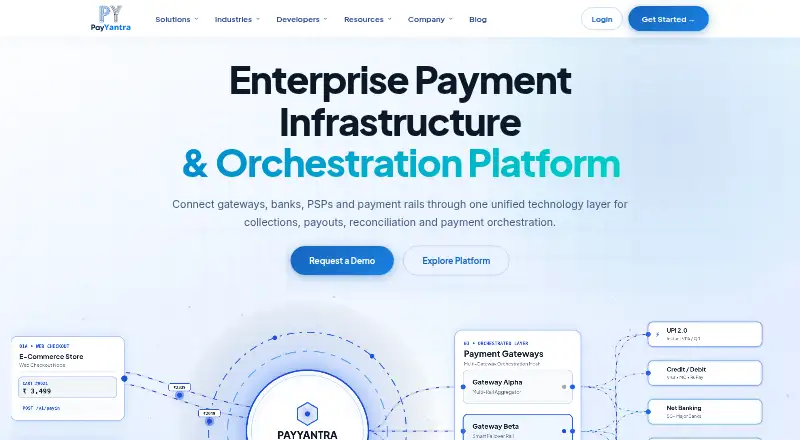
PayYantra is a payment infrastructure and orchestration platform for managing collections, payouts, payment routing, settlement, and reconciliation. Its unified API accepts UPI, cards, net banking, wallets, and buy now, pay later payments. The platform evaluates connected payment service providers using live performance information and routes transactions accordingly. Payouts can be sent through IMPS, NEFT, RTGS, and UPI. OmniVAN provides virtual accounts for collections, incoming-payment tracking, UTR capture, and automated reconciliation; eNACH supports mandates and scheduled collections. The platform also offers automated settlement reconciliation and ledger or MIS reporting across payment channels. Developer materials cover REST APIs, webhooks, API keys, an isolated sandbox, and native iOS and Android SDKs, as well as React Native and Flutter. PayYantra says it serves enterprises, banks, NBFCs, fintechs, and regulated institutions. It is not a bank; funds are held in nodal accounts with RBI-licensed scheduled commercial banks. Pricing is available on request.
Who it suits
PayYantra is aimed at enterprises, banks, NBFCs, fintechs, and regulated institutions that need collections, payouts, routing, or reconciliation. Its integration options include ERP systems such as SAP, Oracle, Tally, and Zoho.
What it does well
- One API supports multiple collection methods.
- Payouts support IMPS, NEFT, RTGS, and UPI.
- OmniVAN and eNACH support collection workflows.
- Developer materials include a sandbox and SDKs.
- Security controls include TLS 1.3 and HMAC-SHA256 signatures.
What to know first
- Pricing is available only on request.
- PayYantra is not a bank.
- Funds are held in bank nodal accounts.
Limits
Pricing is on request, and the deployment option listed is cloud. The company states that it is not a bank and that funds are held in nodal accounts with RBI-licensed scheduled commercial banks.
Getting started
- Visit the PayYantra website.
- Contact PayYantra for pricing, an integration discussion, or a demo.
- Use the developer materials to access REST APIs, webhooks, API keys, and the sandbox.
- Choose the native iOS or Android SDK, or the React Native or Flutter SDK, if applicable.
- Connect ERP or other systems such as SAP, Oracle, Tally, Zoho, or a custom system.
PayYantra is a cloud payment orchestration platform for organizations that need to collect, route, disburse, and reconcile payments across multiple channels. It is best suited to enterprises and regulated financial businesses with developer resources for integration. Its breadth of payment flows is compelling, but custom pricing and the use of bank-held nodal accounts call for careful operational planning.
Overview
PayYantra brings collections, payouts, recurring payments, virtual accounts, routing, settlement, and reconciliation into one platform. Its gateway accepts UPI, cards, net banking, wallets, and buy now, pay later through a single API; payouts can move over IMPS, NEFT, RTGS, and UPI. This range can reduce the number of separate payment connections a business needs to manage, especially when it handles both incoming and outgoing transactions.
Routing evaluates connected payment service providers using live performance information and selects where to send transactions. That approach is relevant to organizations working with multiple providers and seeking to optimize payment success rates. PayYantra is not a bank: funds are held in nodal accounts with RBI-licensed scheduled commercial banks. Buyers should factor that arrangement into their payment operations.
Key features
Collections, routing, and payouts
The unified collection API covers five payment methods, while the payout service consolidates four transfer rails behind one API. That breadth suits businesses operating across channels or geographies where these methods are relevant. Routing can help manage connections to multiple providers, though its usefulness depends on the providers a customer connects and the performance information available to the platform.
Virtual accounts and recurring payments
OmniVAN provides virtual account collections, incoming payment tracking, UTR capture, and automated reconciliation. Those functions fit organizations that need to identify transfers and match them to records without relying entirely on manual reconciliation. The eNACH product supports mandate creation, scheduled collections, payment tracking, and reconciliation, making it relevant to businesses collecting repeat payments through mandates.
Integration and developer controls
Developer materials describe REST APIs, webhooks, API keys, and an isolated sandbox for simulating payment scenarios. The guide specifies Bearer token authentication over TLS 1.3, HMAC-SHA256 webhook signatures, and idempotency keys for state-changing endpoints. Native iOS and Android SDKs, plus React Native and Flutter support, give teams several integration paths. These tools are most useful to organizations with engineering capacity; the platform's API-led approach is less suited to buyers looking for a purely self-service setup.
OmniVAN lists SAP, Oracle, Tally, Zoho, and custom systems as ERP and system integrations. PayYantra also describes automated settlement reconciliation and ledger or MIS reporting across payment channels. Together, these capabilities address back-office matching as well as payment processing, which matters to organizations managing activity across several channels.
Security and support
PayYantra names ISO/IEC 27001:2022, PCI-DSS v4.0.1, and SOC 2 among its security standards, and says its information systems receive regular audits by CERT-In empanelled auditors. These stated controls may be relevant to regulated buyers assessing vendors, alongside their own security and compliance reviews. Integration support and demo requests are available through the company's contact channel.
Pricing
PayYantra is a paid product with custom pricing. No public plans or self-serve price points are provided, so prospective customers need to contact the company for a quote. This model can accommodate organizations with differing payment volumes or integration needs, but it makes early budget comparison harder and gives smaller teams no published low-cost entry point.
Platforms
PayYantra supports web, Android, iOS, and API access, with cloud deployment. Its native mobile SDKs and support for React Native and Flutter suit teams integrating payment flows into mobile apps, while REST APIs and webhooks support broader system integrations.
Who it's for
The company describes PayYantra as serving enterprises, banks, NBFCs, fintechs, and regulated institutions, with examples across education, healthcare, e-commerce, and government. It is a stronger fit for organizations coordinating multiple payment methods, payout rails, and reconciliation workflows than for small businesses seeking a straightforward payment tool. Buyers should also be comfortable with an API-centered implementation and the stated nodal-account arrangement.
Pros and cons
Pros
- Broad payment coverage: One collection API accepts UPI, cards, net banking, wallets, and BNPL, while payouts cover IMPS, NEFT, RTGS, and UPI.
- Routing and reconciliation in the same platform: Live provider performance informs routing, and automated settlement reconciliation with ledger or MIS reporting supports payment operations after transactions are made.
- Useful integration options: REST APIs, webhooks, a sandbox, mobile SDKs, and named ERP integrations give technical teams several ways to connect systems.
- Published security controls: The developer guide specifies TLS 1.3, Bearer token authentication, HMAC-SHA256 webhook signatures, and idempotency keys.
Cons
- Custom pricing: Buyers cannot compare a published plan price or assess a self-serve tier before contacting PayYantra.
- Funds are held by partner banks: PayYantra is not a bank, and its nodal-account arrangement with RBI-licensed scheduled commercial banks may not suit every organization's operating requirements.
- Integration requires technical capacity: The API and SDK options are valuable for development teams but make the platform less suited to buyers who need a simple, standalone setup.
Alternatives
Browse payment hub software to compare products in this category. BR-DGE and CellPoint Digital are other paid options with web, API, Android, and iOS platforms. Consider Gr4vy if a paid platform with custom pricing and no free trial is a better fit. Primer offers tailored pricing plans. Temenos Wealth Front Office is a paid option for web, API, and self-hosted platforms. AccessPay uses a flat annual subscription priced according to estimated annual transaction volumes, users, and required data configurations and submission workflows. ACI Automated Dispute Manager is a paid web product with no free plan. Bottomline Internal Threat Management is a paid enterprise fraud and insider risk management solution.
Verdict
PayYantra is worth considering for enterprises and regulated financial organizations that need broad collection and payout coverage, provider routing, and reconciliation behind an API-led platform. Its main advantage is bringing these payment operations together with mobile and ERP integration options. Look elsewhere if a published price, a self-serve setup, or an arrangement that does not rely on bank-held nodal accounts is essential.
Verdict
PayYantra brings collection, payout, routing, and reconciliation services together with APIs and integration options. Organizations considering it should account for its on-request pricing and the stated arrangement for holding funds.
Questions
How much does PayYantra cost?
Pricing is available on request. PayYantra offers contact for demo requests.
Which payment methods can it accept?
Its unified gateway supports UPI, cards, net banking, wallets, and BNPL. Its payout service supports IMPS, NEFT, RTGS, and UPI.
Which developer tools are available?
Developer materials describe REST APIs, webhooks, API keys, and an isolated sandbox. Native SDKs are listed for iOS and Android, as well as React Native and Flutter.
Which systems does PayYantra integrate with?
OmniVAN lists SAP, Oracle, Tally, Zoho, and custom systems as ERP and system integrations.
Is PayYantra a bank?
No. PayYantra states it is not a bank and that funds are held in nodal accounts with RBI-licensed scheduled commercial banks.
What security standards and controls does it describe?
Its privacy policy names ISO/IEC 27001:2022, PCI-DSS v4.0.1, and SOC 2. The developer guide specifies Bearer token authentication over TLS 1.3 and HMAC-SHA256 webhook signatures.
Facts from PayYantra's own pages
- API security
- Its developer guide specifies Bearer token authentication over TLS 1.3 and support for idempotency keys on state-changing endpoints. · payyantra.com, 9 Oct 2026
- Audience
- The company describes its platform as serving enterprises, banks, NBFCs, and regulated fintechs. · payyantra.com, 9 Oct 2026
- Company
- The site identifies the company as PayYantra Innovations Pvt. Ltd. and says it was founded in Gurgaon. · payyantra.com, 9 Oct 2026
- Developer tools
- The developer materials describe REST APIs, webhooks, API keys, and an isolated sandbox for simulating payment scenarios. · payyantra.com, 9 Oct 2026
- Headquarters
- Gurgaon, Haryana, India · payyantra.com, 28 Sept 2026
- Important limitation
- PayYantra states that it is not a bank and that funds are held in nodal accounts with RBI-licensed scheduled commercial banks. · payyantra.com, 9 Oct 2026
- Integrations
- OmniVAN lists SAP, Oracle, Tally, Zoho, and custom systems as ERP and system integrations. · payyantra.com, 9 Oct 2026
- Mobile SDKs
- The unified gateway page states that native SDKs are available for iOS and Android, as well as React Native and Flutter. · payyantra.com, 9 Oct 2026
- Payment collection
- Its payment collection service accepts UPI, cards, net banking, wallets, and buy now, pay later through one payment API. · payyantra.com, 9 Oct 2026
- Payment methods
- Its unified gateway supports UPI, cards, net banking, wallets, and BNPL through one API. · payyantra.com, 9 Oct 2026
- Payout rails
- Its developer documentation says payouts can be sent through IMPS, NEFT, RTGS, and UPI. · payyantra.com, 9 Oct 2026
- Payouts
- Its payout service supports IMPS, NEFT, RTGS, and UPI disbursements through one API. · payyantra.com, 9 Oct 2026
- Product
- PayYantra describes itself as a payment infrastructure and orchestration platform for collections, payouts, payment routing, and reconciliation. · payyantra.com, 9 Oct 2026
- Reconciliation
- PayYantra offers automated settlement reconciliation and ledger or MIS reporting across payment channels. · payyantra.com, 9 Oct 2026
- Recurring payments
- Its eNACH product supports mandate creation, scheduled collections, payment tracking, and reconciliation. · payyantra.com, 9 Oct 2026
- Routing
- The platform evaluates connected payment service providers and routes transactions using live performance information. · payyantra.com, 9 Oct 2026
- Security
- PayYantra's privacy policy names ISO/IEC 27001:2022, PCI-DSS v4.0.1, and SOC 2 among its security standards and says its information systems receive regular audits by CERT-In empanelled auditors. · payyantra.com, 9 Oct 2026
- Security controls
- The developer guide says API requests use Bearer token authentication over TLS 1.3 and webhook signatures use HMAC-SHA256. · payyantra.com, 9 Oct 2026
- Smart routing
- The platform evaluates connected PSP performance and routes transactions to optimize success rates. · payyantra.com, 9 Oct 2026
- Support
- The contact page lists [email protected] and offers contact for integration support and demo requests. · payyantra.com, 9 Oct 2026
- Virtual accounts
- OmniVAN provides virtual account collections, incoming payment tracking, UTR capture, and automated reconciliation. · payyantra.com, 9 Oct 2026
- What it does
- PayYantra describes itself as a payment infrastructure and orchestration platform for collections, payouts, payment routing, settlement, and reconciliation. · payyantra.com, 9 Oct 2026
- Who it serves
- PayYantra says it serves enterprises, banks, NBFCs, fintechs, and regulated institutions, with examples spanning education, healthcare, e-commerce, and government. · payyantra.com, 9 Oct 2026
Where PayYantra stands on Freedom251
- Payment Hub Software#15 of 23