Freedom251 › Text-to-Speech Software

Parler-TTS
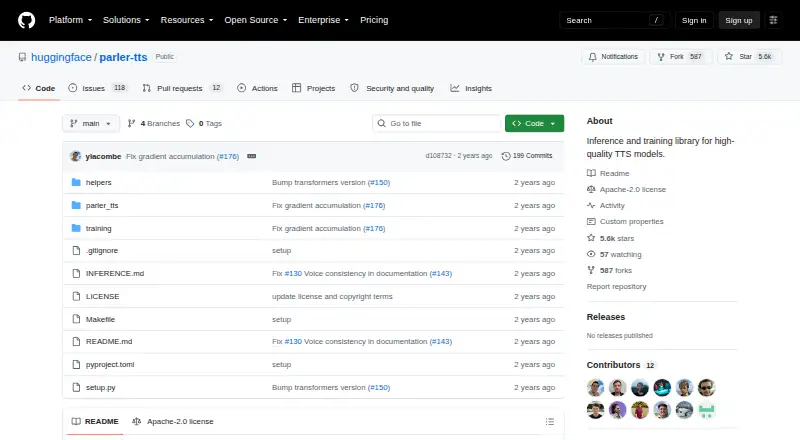
What Parler-TTS is
Parler-TTS is an open-source text-to-speech model and Python library that generates speech guided by text prompts. Prompts can steer characteristics such as gender, speaking rate, pitch, background noise and reverberation. The project offers Mini, with 880 million parameters, and Large, with 2.3 billion parameters. Mini v1 was trained on 45,000 hours of audio, and the Mini v1 and Large v1 checkpoints were trained on 34 named speakers for consistency across generations.
The library can be installed from the GitHub repository with pip and run locally. Its inference guide documents SDPA, Flash Attention 2, model compilation, batch generation and audio streaming; training and fine-tuning guides are also included. Transformers instructions and links to Google Colab and Kaggle notebooks are available. The guide lists CUDA and Apple MPS device options, with an additional PyTorch command for Apple Silicon. Parler-TTS supports one language and WAV export. The project identifies Apache-2.0 as its license and permits commercial use. Its Mini v1 and Large v1 model pages state that neither is deployed by an Inference Provider.
Who it suits
Parler-TTS suits developers who want to generate prompted speech locally or train and fine-tune a model. It fits projects that can work with one language and WAV output under Apache-2.0 licensing.
What it does well
- Prompts can steer several speech characteristics.
- Offers Mini and Large model sizes.
- Includes training and fine-tuning guides.
- Supports batch generation and audio streaming.
- Commercial use is permitted under Apache-2.0.
What to know first
- Supports one language.
- Neither Mini v1 nor Large v1 is deployed by an Inference Provider.
Limits
The project supports one language and exports WAV. Deployment is self-hosted, and the Mini v1 and Large v1 model pages state that neither model is deployed by an Inference Provider.
Getting started
- Open the Parler-TTS GitHub repository
- Install the library with pip
- Run it locally using Python
- Follow the Transformers instructions or use a Google Colab or Kaggle notebook
- Select a CUDA device or Apple MPS option when applicable
Verdict
Parler-TTS provides a self-hosted text-to-speech toolkit with prompt controls, multiple model sizes and documented inference and training workflows. Users should account for its single-language scope and the absence of provider deployment for the listed model versions.
Questions
Is Parler-TTS free?
Yes. It is listed as free and open source, with Apache-2.0 identified for the repository and model cards.
Can it be used commercially?
Yes, commercial use is permitted.
What platforms does it support?
It is available for self-hosted and web use. The inference guide documents CUDA devices and Apple MPS, with an additional PyTorch command for Apple Silicon.
What audio format does it export?
WAV.
How many languages and speakers are supported?
The project lists one language. Mini v1 and Large v1 checkpoints were trained on 34 named speakers for consistent voice generation.
Can models be trained or fine-tuned?
Yes. The repository includes guides and code for training or fine-tuning a Parler-TTS model.
Facts from Parler-TTS's own pages
- Commercial use
- Yes · github.com, 20 Sept 2026
- Export formats
- WAV · github.com, 20 Sept 2026
- Inference features
- The inference guide documents SDPA and Flash Attention 2, model compilation, batch generation, and audio streaming. · github.com, 8 Oct 2026
- Inference optimization
- The project describes support for SDPA, torch.compile, batching and streaming to improve inference speed. · github.com, 9 Oct 2026
- Installation
- The library can be installed from the GitHub repository with pip and run locally using Python. · github.com, 8 Oct 2026
- Integrations
- The model cards provide Transformers usage examples and links to Google Colab and Kaggle notebooks. · huggingface.co, 9 Oct 2026
- Languages
- 1 · github.com, 20 Sept 2026
- License
- The repository identifies its license as Apache-2.0, and the model card also lists Apache-2.0. · github.com, 8 Oct 2026
- Local installation
- The library can be installed from the GitHub repository using pip. · github.com, 9 Oct 2026
- Model license
- The Mini v1 and Large v1 model cards identify the license as Apache 2.0. · huggingface.co, 9 Oct 2026
- Model sizes
- The Mini v1 model has about 0.9 billion parameters and the Large v1 model has about 2 billion parameters. · huggingface.co, 9 Oct 2026
- Open source
- The project says its datasets, preprocessing, training code and model weights are publicly released under permissive licenses. · huggingface.co, 9 Oct 2026
- Platform requirement
- The repository says Apple Silicon users need a nightly PyTorch build for bfloat16 support. · github.com, 9 Oct 2026
- Platforms
- self_hosted · github.com, 20 Sept 2026
- Prompt controls
- Text prompts can control speech characteristics including gender, speaking rate, pitch, background noise and reverberation. · huggingface.co, 9 Oct 2026
- Provider availability
- The Mini v1 and Large v1 model pages state that neither model is deployed by an Inference Provider. · huggingface.co, 9 Oct 2026
- Purpose
- Parler-TTS is a lightweight text-to-speech model that generates natural-sounding speech in a requested speaker style. · github.com, 9 Oct 2026
- Related project
- The project is designed to accompany Data-Speech, a repository for speech dataset annotation. · github.com, 8 Oct 2026
- Speaker choices
- The Mini v1 checkpoint was trained on 34 named speakers to support speaker consistency across generations. · huggingface.co, 8 Oct 2026
- Speaker consistency
- The Mini v1 and Large v1 checkpoints were trained on 34 named speakers for consistent voice generation. · huggingface.co, 9 Oct 2026
- Training
- The repository includes guides and code for training or fine-tuning a Parler-TTS model. · github.com, 9 Oct 2026
- Training data
- The Mini v1 and Large v1 models were trained on 45,000 hours of audio data. · huggingface.co, 9 Oct 2026
- Voice controls
- Prompts can control characteristics such as gender, speaking rate, pitch, background noise, and reverberation. · huggingface.co, 8 Oct 2026
Where Parler-TTS stands on Freedom251
- Text-to-Speech Software#138 of 223
- Game Voice Generators#31 of 45
- Text-to-speech tools#168 of 232