Freedom251 › Distributed File System Software
PanFS
What PanFS is
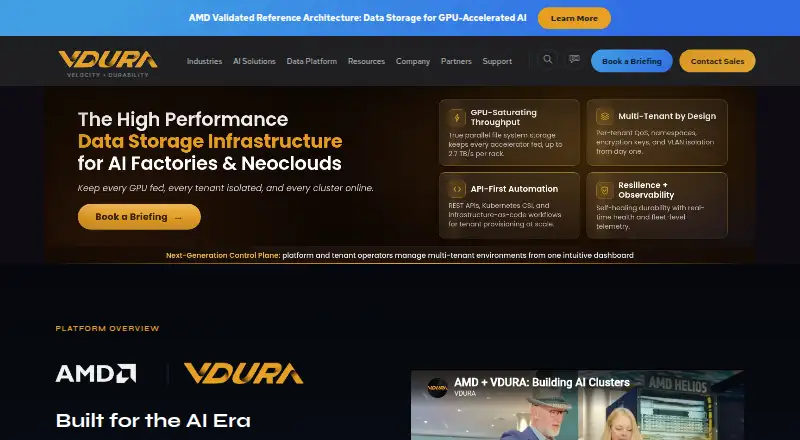
PanFS is the parallel file system foundation carried forward in the VDURA Data Platform, software-defined storage for AI and high-performance computing workloads. The platform brings parallel file system performance together with object storage resilience and cost efficiency. VDURA describes it for high-throughput AI training, low-latency inference, and persistent key-value cache and session context.
The system is described as scaling linearly to thousands of nodes and supporting tens of thousands of clients, with performance of up to 2.7 TB/s per rack. Context-Aware Tiering moves data across NVMe, SSD, and object storage tiers according to access patterns. Interfaces include REST, Kubernetes CSI, CLI, and S3-compatible object storage; file access protocols include DirectFlow, NFSv3, SMB/CIFS v3.1, and S3.
Resilience features include MLEC and client erasure coding, with VDURA claiming up to 12 nines of durability. VDURA says AES-256 protects data at rest and in flight across tenant data paths. Multi-tenant controls include per-tenant quality of service, namespaces, and access policies. The platform uses a hybrid deployment model and open hardware, letting customers choose hardware vendors. VDURA is headquartered in Pittsburgh, Pennsylvania, and was founded in 2001.
Who it suits
The VDURA Data Platform suits Neoclouds, AI factories, enterprises, and HPC environments that need storage for AI or high-performance computing workloads. Its tiering, interfaces, and tenant controls may be relevant to teams managing varied data access and multiple tenants.
What it does well
- Designed for AI training, inference, and persistent KV cache
- Scales to thousands of nodes and tens of thousands of clients
- Up to 2.7 TB/s performance per rack
- Context-Aware Tiering spans NVMe, SSD, and object tiers
- AES-256 encryption for data at rest and in flight
- Supports REST, Kubernetes CSI, CLI, and S3-compatible object storage
What to know first
- Pricing is available by request rather than stated on the maker pages
- The maker directs visitors to contact sales
Plans
| Plan | Billed and limits | Price |
|---|---|---|
| VDURA Data Platform | AI and HPC storage platform · pricing not stated on the opened pages | On request |
As vdura.com lists them, read 7 Oct 2026. The maker's own page has the final word.
Getting started
- Visit the VDURA website.
- Contact sales for pricing.
- Choose a preferred hardware vendor; the platform is described as open hardware.
- Use the platform through its REST, Kubernetes CSI, CLI, or S3-compatible interface.
Verdict
Consider VDURA Data Platform for AI and HPC storage where its scale, tiering, multi-tenancy, and interfaces match the workload. Buyers who need a stated price before contacting a provider may prefer to look elsewhere.
Questions
What is PanFS?
PanFS is the parallel file system foundation carried forward in the VDURA Data Platform, a software-defined storage platform for AI and HPC workloads.
How is the platform priced?
Pricing is available on request; the maker pages direct visitors to contact sales.
Which workloads does it target?
VDURA describes it for AI training, inference, persistent KV cache and session context, and high-performance computing.
What interfaces and file access protocols does it support?
Interfaces include REST, Kubernetes CSI, CLI, and S3-compatible object storage. File access protocols include DirectFlow, NFSv3, SMB/CIFS v3.1, and S3.
Does it support encryption and multi-tenancy?
VDURA states that AES-256 protects data at rest and in flight. The platform supports per-tenant quality of service, namespaces, and access policies.
Who makes the platform?
VDURA makes the Data Platform. The company was founded in 2001 and is headquartered in Pittsburgh, Pennsylvania, United States.
Facts from PanFS's own pages
- Architecture
- The platform combines parallel file system performance with object storage resilience and cost efficiency in a unified system. · vdura.com, 7 Oct 2026
- Encryption
- VDURA states that AES-256 encryption protects data at rest and in flight across every tenant data path. · vdura.com, 7 Oct 2026
- Founded
- 2001 · vdura.com, 28 Sept 2026
- Hardware
- VDURA describes its platform as open hardware, letting customers choose preferred hardware vendors. · vdura.com, 7 Oct 2026
- Headquarters
- VDURA lists its headquarters at 1501 Reedsdale St., Suite 1001, Pittsburgh, Pennsylvania 15233. · vdura.com, 7 Oct 2026
- Interfaces
- The platform provides REST, Kubernetes CSI, and CLI interfaces, plus an S3-compatible object storage interface. · vdura.com, 7 Oct 2026
- Multi-tenancy
- The platform supports per-tenant quality of service, namespaces, and access policies. · vdura.com, 7 Oct 2026
- Performance
- VDURA states performance of up to 2.7 TB/s per rack. · vdura.com, 7 Oct 2026
- Pricing availability
- The opened maker pages direct visitors to contact sales and do not state a product price. · vdura.com, 7 Oct 2026
- Product identity
- VDURA Data Platform carries forward the PanFS parallel file system foundation as software-defined storage for AI and HPC workloads. · vdura.com, 7 Oct 2026
- Resilience
- The platform uses MLEC and client erasure coding, and VDURA claims up to 12 nines of durability. · vdura.com, 7 Oct 2026
- Scalability
- The platform is described as scaling linearly to thousands of nodes and supporting tens of thousands of clients. · vdura.com, 7 Oct 2026
- Support
- VDURA advertises global technical support available 24/7/365. · vdura.com, 7 Oct 2026
- Target users
- The maker identifies Neoclouds, AI factories, enterprises, and HPC environments as intended users. · vdura.com, 7 Oct 2026
- Tiering
- Context-Aware Tiering automatically moves data across NVMe, SSD, and object tiers according to access patterns. · vdura.com, 7 Oct 2026
- Use cases
- The maker describes high-throughput storage for AI training, low-latency access for inference, and persistent KV cache and session context. · vdura.com, 7 Oct 2026
Where PanFS stands on Freedom251
- Distributed File System Software#23 of 32