Freedom251 › Cloud Storage Gateway Software
ObjectiveFS
What ObjectiveFS is
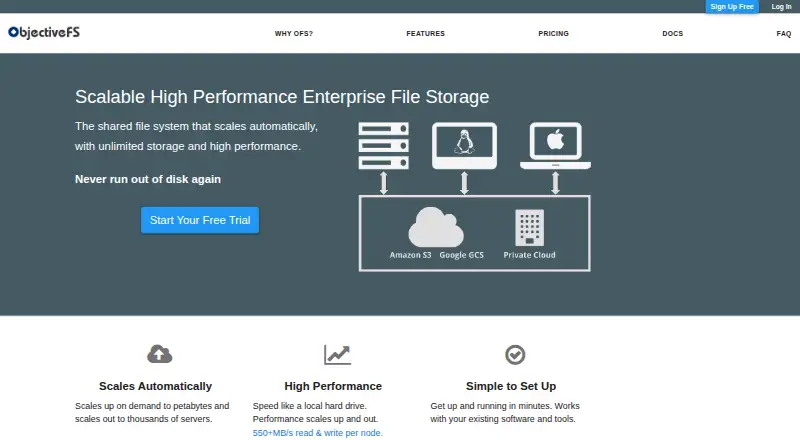
ObjectiveFS is a shared distributed POSIX file system for persistent storage across cloud instances, laptops, containers, and office servers. It runs on Linux and macOS, including self-hosted deployments, and connects machines directly to object storage through the S3 API. It does not require storage clusters or metadata servers. Multiple machines can read and write the same filesystem, with changes visible across those machines. Supported storage targets include Amazon S3, Google Cloud Storage, Azure Blob Storage, IBM Cloud Object Storage, Oracle Cloud, DigitalOcean Spaces, Scaleway, Wasabi, Ceph, MinIO, NetApp StorageGRID, Hitachi Content Platform, and other S3-compatible stores. ObjectiveFS uses workload-adaptive performance techniques, caching, and bundled writes; its homepage states read and write speeds above 550 MB/s per node. Data is encrypted locally with a customer-known key and remains encrypted in transit and at rest. Checksums verify integrity, and snapshots can be created automatically or at checkpoints and mounted read-only. Plans begin at $99 /mo, with a 14-day trial. Object-store provider charges are separate.
Who it suits
ObjectiveFS suits teams that need shared persistent files across Linux or macOS machines and want to use an object-store target. It is also relevant where local encryption, snapshots, concurrent access, or self-hosting matter.
What it does well
- Machines can read and write a shared filesystem concurrently.
- Connects to a broad range of object storage targets.
- Encrypts data locally, in transit, and at rest.
- Snapshots can be mounted as read-only filesystems.
- Supports FUSE, NFS, SMB, and edge synchronization.
What to know first
- No free plan; paid plans start at $99 /mo.
- Does not run natively on Windows.
- Object-store charges are billed separately.
Limits
The Personal plan is $99 / month and includes 3 instances, a 50-instance maximum, and 5TB storage. The Team plan is $499 / month and includes 10 instances, a 500-instance maximum, and 100TB storage; Corporate is $999 / month and includes 15 instances, a 5000-instance maximum, and 1PB storage. Enterprise has unlimited instances and storage, with price available by contacting the company; object-store charges are separate.
Plans
| Plan | Billed and limits | Price |
|---|---|---|
| Team | $499 / month · 10 included instances · 500 maximum instances · 100TB storage · Unlimited filesystems | $499 a month |
| Personal | $99 / month · 3 included instances · 50 maximum instances · 5TB storage · Unlimited filesystems | $99 a month |
| Corporate | $999 / month · 15 included instances · 5000 maximum instances · 1PB storage · Unlimited filesystems | $999 a month |
| Enterprise | Contact Us ([email protected]) · Unlimited instances · Unlimited storage · Unlimited filesystems · SLA options available | On request |
As objectivefs.com lists them, read 1 Oct 2026. The maker's own page has the final word.
Getting started
- Visit https://objectivefs.com/.
- Choose Linux or macOS for the machine running ObjectiveFS.
- Select an object-store target supported through the S3 API.
- Choose a plan, starting at $99 /mo, or use the 14-day trial.
- For Windows access, export from a Linux machine through NFS or Samba.
Verdict
Choose ObjectiveFS when machines need concurrent access to persistent files backed by object storage, with local encryption and snapshot support. Look elsewhere if native Windows operation or a free plan is essential; Windows access requires export from a Linux machine through NFS or Samba.
Questions
Does ObjectiveFS have a free plan or trial?
There is no free plan. A 14-day trial is available.
How much does ObjectiveFS cost?
Personal is $99 a month, Team is $499 a month, and Corporate is $999 a month. Enterprise pricing is available by contacting ObjectiveFS.
Which platforms does ObjectiveFS support?
It runs on Linux and macOS and can be self-hosted. It does not run natively on Windows, but a Linux machine can export it to Windows through NFS or Samba.
Which storage targets can it use?
Targets include Amazon S3, Google Cloud Storage, Azure Blob Storage, IBM Cloud Object Storage, Oracle Cloud, DigitalOcean Spaces, Scaleway, Wasabi, Ceph, MinIO, NetApp StorageGRID, Hitachi Content Platform, and S3-compatible stores.
Are object-store fees included in the plan?
No. Object-store charges are billed separately by the storage provider.
Who makes ObjectiveFS?
It is a product of Objective Security Corp, a security-focused technology company with over 20 years of history.
Facts from ObjectiveFS's own pages
- Architecture
- The software runs on your machines and connects directly to an object store through the S3 API without requiring storage clusters or metadata servers. · objectivefs.com, 1 Oct 2026
- Concurrent access
- Multiple machines can read and write the same filesystem concurrently, with updates visible across machines. · objectivefs.com, 1 Oct 2026
- Cryptography
- ObjectiveFS uses the NaCl crypto library with Salsa20 and Poly1305 algorithms and protection against cache timing attacks. · objectivefs.com, 1 Oct 2026
- Encryption
- Data is encrypted locally with a key known only to the customer and remains encrypted in transit and at rest. · objectivefs.com, 1 Oct 2026
- Enterprise security
- Enterprise supports AWS server-side encryption with Amazon S3-managed keys and AWS KMS-managed keys. · objectivefs.com, 1 Oct 2026
- Headquarters
- Raleigh, North Carolina, United States · objectivefs.com, 28 Sept 2026
- Integrity
- Cryptographically strong checksums verify data integrity and operations are retried when checksums do not match. · objectivefs.com, 1 Oct 2026
- Maker
- ObjectiveFS is a product by Objective Security Corp, a security-focused technology company with over 20 years of history. · objectivefs.com, 1 Oct 2026
- Object-store billing
- Object-store charges are billed separately by the object-store provider and are not included in ObjectiveFS pricing. · objectivefs.com, 1 Oct 2026
- Object stores
- Supported object stores include Amazon S3, Google Cloud Storage, Azure Blob Storage, IBM Cloud Object Storage, Oracle Cloud, DigitalOcean Spaces, Scaleway, Wasabi, Ceph and MinIO. · objectivefs.com, 1 Oct 2026
- Performance
- The product uses workload-adaptive heuristics, advanced caching and bundled writes, with the homepage stating speeds above 550 MB/s read and write per node. · objectivefs.com, 1 Oct 2026
- Product
- ObjectiveFS is a shared distributed POSIX file system providing persistent storage among cloud instances, laptops, containers and office servers. · objectivefs.com, 1 Oct 2026
- Snapshots
- The product supports automatic and checkpoint snapshots, and snapshots can be mounted as read-only filesystems. · objectivefs.com, 1 Oct 2026
- Support
- Pricing lists standard email support for Personal, priority email support for Team, high-priority email and phone support for Corporate, and highest-priority email and phone support plus onboarding, optimization and SLA options for Enterprise. · objectivefs.com, 1 Oct 2026
- Windows limitation
- ObjectiveFS currently does not run natively on Windows, but a Linux machine can export it to Windows through NFS or Samba. · objectivefs.com, 1 Oct 2026
Where ObjectiveFS stands on Freedom251
- Cloud Storage Gateway Software#10 of 26
- Distributed File System Software#21 of 32